


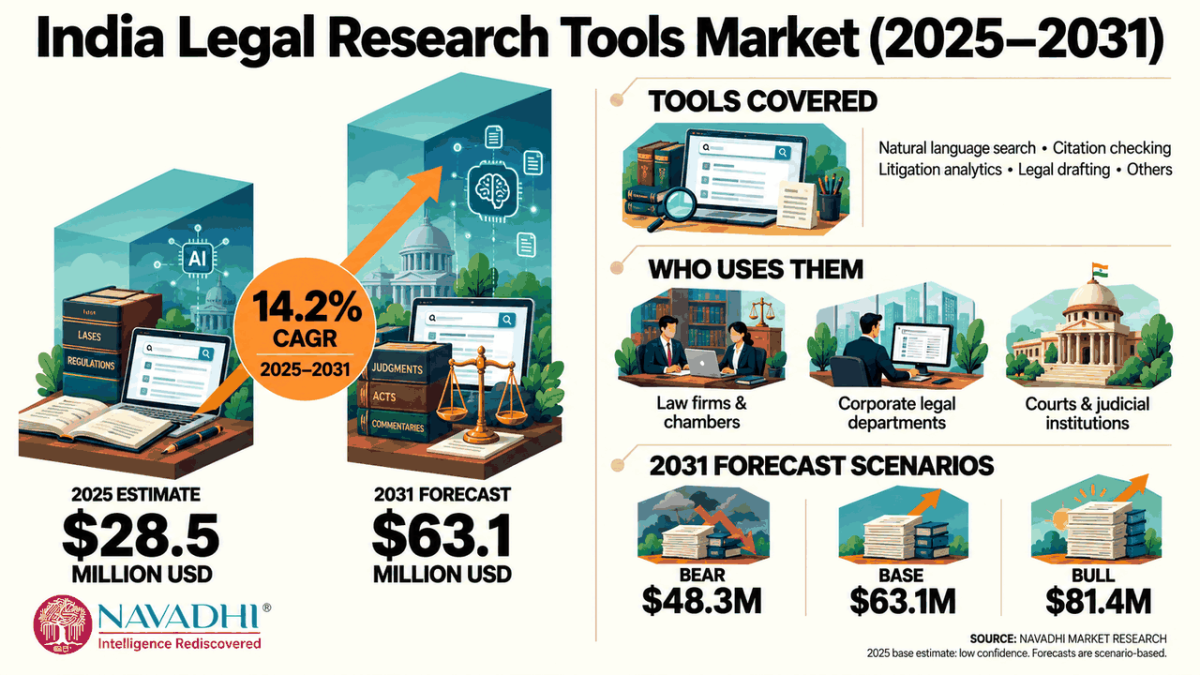
The India legal research tools market is estimated at US$28.5 million (about Rs 249 crore) in 2025 and is forecast to reach US$63.1 million by 2031, a compound annual growth rate (CAGR) of 14.2% over 2025-2031. The report treats the base year as a low-confidence estimate: no Indian provider discloses research revenue or paying subscribers, so the 2025 value averages a demand-side build (US$41.3 million, from enrolled advocates, paying share and spend) and a vendor-side build (US$15.8 million, from claimed user bases and the one disclosed revenue bracket).
The market is defined as subscription and credit-based research platforms and AI research assistants used by advocates, law firms, corporate legal departments, courts and judicial institutions, government bodies and law schools in India to find, check and apply Indian law. Case management, compliance and contract software, print law reports, free public sources such as the Indian Kanoon free tier and the eCourts portals, and court recording and transcription tools are excluded. The report is value only, in US dollars, converted at Rs 87.2 per US dollar (ECB 2025 average).
Scope of the India Legal Research Tools Market Strategic Research Report
This report covers market value (US$ million) for 2022-2031, with 2025 as the base year and 2026-2031 as the forecast period. It analyses five product types, four buyer categories, five India zones and 15 states and state groupings with rest-of-zone residuals, together with base, bear and bull scenarios (2031: US$48.3 million bear, US$81.4 million bull), growth drivers and restraints, an evidence grade for every channel, and profiles of 18 providers. No market share or concentration statistic is stated, because no provider discloses India-specific revenue.
Segment by Type
Segment by Application
Key Companies Profiled
SCC Online (Eastern Book Company), Manupatra Information Solutions, CaseMine (Gauge Data Solutions), Lexlegis.ai, Indian Kanoon, eCourtsIndia, Jhana, Lucio, Nyayanidhi, Bharat.Law, LegitQuest, Vaquill, Jurisphere, Nyai, Thomson Reuters, LexisNexis (RELX), Harvey, Adalat AI.
Who Can Use This Report?
1. Executive Summary
1.1 Executive Summary
1.1.1 Market Definition and Size
1.1.2 Growth Drivers
1.1.3 Segment Highlights
1.1.4 Regional and State-Level Highlights
1.1.5 Competitive Structure
1.1.6 Principal Risks
1.1.7 Outlook
2. Industry Overview & Forecast
2.1 Market Definition and Scope
2.2 Market Size and Historical Performance
2.3 Annual Market Value Table
2.4 Forecast and Growth Logic
2.5 Volume Analysis
2.6 Value Chain and Pricing Architecture
3. Market Segmentation by Type
3.1 Overview of the Type Segmentation Framework
3.1.1 Natural Language Search
3.1.2 Citation Checking
3.1.3 Litigation Analytics
3.1.4 Legal Drafting
3.1.5 Others
3.2 Comparative Analysis and Mix Shift Implications
4. Market Segmentation by Application
4.1 Overview of the Application Framework
4.1.1 Law Firms and Chambers
4.1.2 Corporate Legal Departments
4.1.3 Courts and Judicial Institutions
4.1.4 Others
4.1.5 Comparative Analysis Across Application Segments
5. Regional Market Forecast
5.1 North India
5.1.1 Regional Overview
5.1.2 Key Growth Drivers
5.1.3 Regulatory & Infrastructure Landscape
5.1.4 State-Level Analysis
5.1.5 Market Forecast 2025–2031
5.2 West India
5.2.1 Regional Overview
5.2.2 Key Growth Drivers
5.2.3 Regulatory & Infrastructure Landscape
5.2.4 State-Level Analysis
5.2.5 Market Forecast 2025–2031
5.3 South India
5.3.1 Regional Overview
5.3.2 Key Growth Drivers
5.3.3 Regulatory & Infrastructure Landscape
5.3.4 State-Level Analysis
5.3.5 Market Forecast 2025–2031
5.4 East and North-East India
5.4.1 Regional Overview
5.4.2 Key Growth Drivers
5.4.3 Regulatory & Infrastructure Landscape
5.4.4 State-Level Analysis
5.4.5 Market Forecast 2025–2031
5.5 Central India
5.5.1 Regional Overview
5.5.2 Key Growth Drivers
5.5.3 Regulatory & Infrastructure Landscape
5.5.4 State-Level Analysis
5.5.5 Market Forecast 2025–2031
6. State-Level Market Forecast
6.1 North India
6.1.1 Delhi
6.1.2 Punjab and Haryana
6.1.3 Rajasthan
6.1.4 Rest of North India
6.2 West India
6.2.1 Maharashtra and Goa
6.2.2 Gujarat
6.2.3 Rest of West India
6.3 South India
6.3.1 Karnataka
6.3.2 Tamil Nadu
6.3.3 Telangana
6.3.4 Kerala
6.3.5 Andhra Pradesh
6.3.6 Rest of South India
6.4 East and North-East India
6.4.1 West Bengal
6.4.2 Bihar
6.4.3 Orissa
6.4.4 Rest of East and North-East India
6.5 Central India
6.5.1 Uttar Pradesh
6.5.2 Madhya Pradesh
6.5.3 Rest of Central India
7. Growth Drivers & Inhibitors
7.1 Market Growth Drivers
7.2 Market Restraints and Inhibitors
7.3 Impact Assessment Summary
7.4 Integrated Assessment
8. Key Company Profiles
8.1 SCC Online (Eastern Book Company)
8.1.1 Company Overview
8.1.2 Key Products & Segments
8.1.3 Financial Performance (2023–2025)
8.1.4 Business Strategy
8.1.5 SWOT Analysis
8.1.6 Strategic Implications (2025–2031)
8.2 Manupatra Information Solutions
8.2.1 Company Overview
8.2.2 Key Products & Segments
8.2.3 Financial Performance (2023–2025)
8.2.4 Business Strategy
8.2.5 SWOT Analysis
8.2.6 Strategic Implications (2025–2031)
8.3 CaseMine (Gauge Data Solutions)
8.3.1 Company Overview
8.3.2 Key Products & Segments
8.3.3 Financial Performance (2023–2025)
8.3.4 Business Strategy
8.3.5 SWOT Analysis
8.3.6 Strategic Implications (2025–2031)
8.4 Lexlegis.ai
8.4.1 Company Overview
8.4.2 Key Products & Segments
8.4.3 Financial Performance (2023–2025)
8.4.4 Business Strategy
8.4.5 SWOT Analysis
8.4.6 Strategic Implications (2025–2031)
8.5 Indian Kanoon
8.5.1 Company Overview
8.5.2 Key Products & Segments
8.5.3 Financial Performance (2023–2025)
8.5.4 Business Strategy
8.5.5 SWOT Analysis
8.5.6 Strategic Implications (2025–2031)
8.6 eCourtsIndia
8.6.1 Company Overview
8.6.2 Key Products & Segments
8.6.3 Financial Performance (2023–2025)
8.6.4 Business Strategy
8.6.5 SWOT Analysis
8.6.6 Strategic Implications (2025–2031)
8.7 Jhana
8.7.1 Company Overview
8.7.2 Key Products & Segments
8.7.3 Financial Performance (2023–2025)
8.7.4 Business Strategy
8.7.5 SWOT Analysis
8.7.6 Strategic Implications (2025–2031)
8.8 Lucio
8.8.1 Company Overview
8.8.2 Key Products & Segments
8.8.3 Financial Performance (2023–2025)
8.8.4 Business Strategy
8.8.5 SWOT Analysis
8.8.6 Strategic Implications (2025–2031)
8.9 Nyayanidhi
8.9.1 Company Overview
8.9.2 Key Products & Segments
8.9.3 Financial Performance (2023–2025)
8.9.4 Business Strategy
8.9.5 SWOT Analysis
8.9.6 Strategic Implications (2025–2031)
8.10 Bharat.Law
8.10.1 Company Overview
8.10.2 Key Products & Segments
8.10.3 Financial Performance (2023–2025)
8.10.4 Business Strategy
8.10.5 SWOT Analysis
8.10.6 Strategic Implications (2025–2031)
8.11 LegitQuest
8.11.1 Company Overview
8.11.2 Key Products & Segments
8.11.3 Financial Performance (2023–2025)
8.11.4 Business Strategy
8.11.5 SWOT Analysis
8.11.6 Strategic Implications (2025–2031)
8.12 Vaquill
8.12.1 Company Overview
8.12.2 Key Products & Segments
8.12.3 Financial Performance (2023–2025)
8.12.4 Business Strategy
8.12.5 SWOT Analysis
8.12.6 Strategic Implications (2025–2031)
8.13 Jurisphere
8.13.1 Company Overview
8.13.2 Key Products & Segments
8.13.3 Financial Performance (2023–2025)
8.13.4 Business Strategy
8.13.5 SWOT Analysis
8.13.6 Strategic Implications (2025–2031)
8.14 Nyai
8.14.1 Company Overview
8.14.2 Key Products & Segments
8.14.3 Financial Performance (2023–2025)
8.14.4 Business Strategy
8.14.5 SWOT Analysis
8.14.6 Strategic Implications (2025–2031)
8.15 Thomson Reuters
8.15.1 Company Overview
8.15.2 Key Products & Segments
8.15.3 Financial Performance (2023–2025)
8.15.4 Business Strategy
8.15.5 SWOT Analysis
8.15.6 Strategic Implications (2025–2031)
8.16 LexisNexis (RELX)
8.16.1 Company Overview
8.16.2 Key Products & Segments
8.16.3 Financial Performance (2023–2025)
8.16.4 Business Strategy
8.16.5 SWOT Analysis
8.16.6 Strategic Implications (2025–2031)
8.17 Harvey
8.17.1 Company Overview
8.17.2 Key Products & Segments
8.17.3 Financial Performance (2023–2025)
8.17.4 Business Strategy
8.17.5 SWOT Analysis
8.17.6 Strategic Implications (2025–2031)
8.18 Adalat AI
8.18.1 Company Overview
8.18.2 Key Products & Segments
8.18.3 Financial Performance (2023–2025)
8.18.4 Business Strategy
8.18.5 SWOT Analysis
8.18.6 Strategic Implications (2025–2031)
9. Competitive Landscape
9.1 Competitive Landscape Overview
9.1.1 Market Structure
9.1.2 Verified Company Facts
9.1.3 Why Market Concentration Cannot Be Measured
9.1.4 Competitive Intensity
9.2 Competitive Intensity Assessment
9.2.1 Structural Grouping of Competitors
9.2.2 Capacity Versus Demand Dynamics
9.2.3 Pricing Environment
9.2.4 Barriers to Entry and Exit
9.3 Key Player Strategies & Positioning
9.3.1 Strategic Group Mapping
9.3.2 Differentiation Strategies Across Major Players
9.3.3 Geographic Strongholds
9.3.4 M&A and Partnership Activity (2022–Present)
9.3.5 R&D and Technology Investment Trends
9.4 Competitive Dynamics & Strategic Outlook
9.4.1 Emerging Competitive Threats and New Entrant Activity
9.4.2 Consolidation Versus Fragmentation Outlook
9.4.3 Competitive Response Matrix
9.4.4 Strategic Recommendations for 2026–2031
10. Porter's Five Forces Analysis
10.1 Threat of New Entrants
10.2 Bargaining Power of Buyers
10.3 Bargaining Power of Suppliers
10.4 Threat of Substitutes
10.5 Competitive Rivalry
11. PESTLE Analysis
11.1 India Legal Research Tools Market: Macro-Environmental Assessment
11.1.1 Political
11.1.2 Economic
11.1.3 Social
11.1.4 Technological
11.1.5 Legal
11.1.6 Environmental
11.2 PESTLE Summary Assessment
12. SWOT Analysis
12.1 Industry SWOT Analysis
12.1.1 Detailed Analysis
12.1.1.1 Strengths
12.1.1.2 Weaknesses
12.1.1.3 Opportunities
12.1.1.4 Threats
12.1.2 Strategic Implications
13. Future Trends & Outlook
13.1 India Legal Research Tools Market
13.2 Overview of the Directional Landscape
13.3 Trend Analysis: Seven Defining Forces Shaping 2026–2031
13.3.1 Artificial Intelligence Embedding Transitions from Pilot to Product Standard
13.3.2 Structural Underpenetration Creates a Multi-Year Paid Adoption Runway
13.3.3 Tiered and Freemium Pricing Architectures Become Competitive Default
13.3.4 Court Infrastructure Digitisation Expands the Research Tool Addressable Perimeter
13.3.5 Venture Capital Re-engagement Accelerates Competitive Landscape Fragmentation
13.3.6 Geographic Concentration Poses a Redistribution Opportunity for Regional Market Penetration
13.3.7 Global Platform Entry Elevates Competitive Benchmark Without Dominating Domestic Pricing
13.4 Summary of Trends
13.5 Forward Outlook: 2026–2031
List of Exhibits
Exhibit 2.1: Forecast of India Market YoY Growth Rate & CAGR Summary (in %)
Exhibit 2.2: Forecast of India Legal Research Tools (in USD Mn)
Exhibit 2.3: Forecast of North India (in USD Mn)
Exhibit 2.4: Forecast of West India (in USD Mn)
Exhibit 2.5: Forecast of South India (in USD Mn)
Exhibit 2.6: Forecast of East and North-East India (in USD Mn)
Exhibit 2.7: Forecast of Central India (in USD Mn)
Exhibit 3.8: Forecast of Natural Language Search (in USD Mn)
Exhibit 3.9: Forecast of Citation Checking (in USD Mn)
Exhibit 3.10: Forecast of Litigation Analytics (in USD Mn)
Exhibit 3.11: Forecast of Legal Drafting (in USD Mn)
Exhibit 3.12: Forecast of Others (in USD Mn)
Exhibit 4.13: Forecast of Law Firms and Chambers (in USD Mn)
Exhibit 4.14: Forecast of Corporate Legal Departments (in USD Mn)
Exhibit 4.15: Forecast of Courts and Judicial Institutions (in USD Mn)
Exhibit 4.16: Forecast of Others (in USD Mn)
Exhibit 6.17: Forecast of North India (in USD Mn)
Exhibit 6.18: Forecast of Rest of North India (in USD Mn)
Exhibit 6.19: Forecast of Rest of East and North-East India (in USD Mn)
Exhibit 6.20: Forecast of Delhi (in USD Mn)
Exhibit 6.21: Forecast of Punjab and Haryana (in USD Mn)
Exhibit 6.22: Forecast of Rajasthan (in USD Mn)
Exhibit 6.23: Forecast of West India (in USD Mn)
Exhibit 6.24: Forecast of Rest of West India (in USD Mn)
Exhibit 6.25: Forecast of Maharashtra and Goa (in USD Mn)
Exhibit 6.26: Forecast of Gujarat (in USD Mn)
Exhibit 6.27: Forecast of South India (in USD Mn)
Exhibit 6.28: Forecast of Rest of South India (in USD Mn)
Exhibit 6.29: Forecast of Karnataka (in USD Mn)
Exhibit 6.30: Forecast of Tamil Nadu (in USD Mn)
Exhibit 6.31: Forecast of Telangana (in USD Mn)
Exhibit 6.32: Forecast of Kerala (in USD Mn)
Exhibit 6.33: Forecast of Andhra Pradesh (in USD Mn)
Exhibit 6.34: Forecast of East and North-East Ind (in USD Mn)
Exhibit 6.35: Forecast of West Bengal (in USD Mn)
Exhibit 6.36: Forecast of Bihar (in USD Mn)
Exhibit 6.37: Forecast of Orissa (in USD Mn)
Exhibit 6.38: Forecast of Central India (in USD Mn)
Exhibit 6.39: Forecast of Rest of Central India (in USD Mn)
Exhibit 6.40: Forecast of Uttar Pradesh (in USD Mn)
Exhibit 6.41: Forecast of Madhya Pradesh (in USD Mn)
*If Applicable.

NAVADHI is a market research company that helps global firms differentiate themselves, break market entry barriers, track their investments, develop business strategies and plan for future by providing actionable market research intelligence that helps them succeed.