
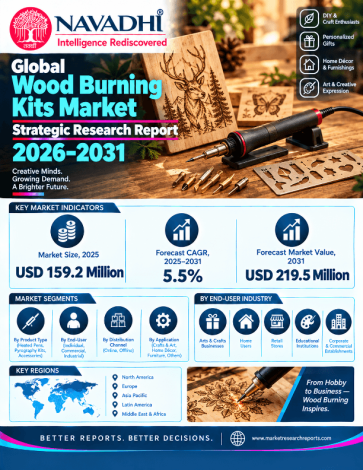

The global wood burning kits market is valued at approximately USD 159.2 million in 2025 and is projected to reach about USD 219.5 million by 2031, a compound annual growth rate of 5.5%. North America holds the largest share of 2025 value at about 37%, followed by Europe at 27% and Asia Pacific at 25%, with Asia Pacific growing fastest in the model.
The market is fragmented. A handful of craft and tool brands, including Walnut Hollow, Weller, Plaid and Wall Lenk, sell beginner kits through craft chains, hardware and woodworking retailers; professional makers such as Razertip, Colwood and Burnmaster sell pens and machines to artists; and a large, fast-changing tail of marketplace kits, many made in China, fills the middle and low price tiers. Best-selling kits on a US marketplace range from about USD 15 to USD 70.
The report profiles 12 companies including Walnut Hollow Farm, Inc. (Handprint), Weller (Apex Tool Group, LLC), Razertip Industries Inc., Wall Lenk Corporation, Plaid Enterprises, Inc., Colwood Electronics, and is intended for corporate strategy, investment, M&A and procurement teams. It also provides Porter's Five Forces, PESTLE and SWOT analyses and a 2031 outlook.
1. Executive Summary
2. Industry Overview & Forecast
2.1.1 Market Definition & Scope
2.1.2 Headline Figures
2.1.3 Market Value Forecast, 2026-2031
2.1.4 Historical Market Review, 2022-2025
2.1.5 Scenario Analysis (Base, Bull, Bear Cases)
2.1.6 Market Size Reliability and Cross-Checks
2.1.7 Regional Value Structure
2.1.8 Segment Outlook by Burner Type
2.1.9 Segment Outlook by User
2.1.10 Technology Overview: Wire Nib, Solid Point and Station Burners
2.1.11 Pricing, Distribution Channels and Consumer Behavior
2.1.12 Forecast Considerations and Data Limitations
3. Market Segmentation by Type
3.1 Market Segmentation by Burner Type
3.1.1 Market by Type Overview
3.1.2 Wire Nib Wood Burning Kits
3.1.3 Solid Point Wood Burning Kits
3.1.4 Multi-Functional Pyrography Station Kits
3.1.5 Type Segment Outlook and Strategic Reading
4. Market Segmentation by Application
4.1 Market Segmentation by Application
4.1.1 Market by Application Overview
4.1.2 Hobbyists and DIY Enthusiasts
4.1.3 Professional Artists and Craftspeople
4.1.4 Educational Institutions
4.1.5 Application Outlook
5. Regional Market Forecast
North America
Europe
Asia Pacific
Latin America
Middle East & Africa
6. Country-Level Market Forecast
6.1 North America
6.1.1 United States
6.1.2 Canada
6.1.3 Mexico
6.2 Europe
6.2.1 Germany
6.2.2 United Kingdom
6.2.3 France
6.2.4 Italy
6.2.5 Spain
6.2.6 Poland
6.2.7 Netherlands
6.2.8 Rest of Europe
6.3 Asia Pacific
6.3.1 China
6.3.2 Japan
6.3.3 India
6.3.4 Australia
6.3.5 South Korea
6.3.6 Southeast Asia
6.3.7 Rest of Asia Pacific
6.4 Latin America
6.4.1 Brazil
6.4.2 Argentina
6.4.3 Colombia
6.4.4 Chile
6.4.5 Rest of Latin America
6.5 Middle East & Africa
6.5.1 South Africa
6.5.2 Turkiye
6.5.3 United Arab Emirates
6.5.4 Saudi Arabia
6.5.5 Israel
6.5.6 Egypt
6.5.7 Rest of Middle East & Africa
7. Growth Drivers & Inhibitors
7.1 Growth Drivers & Inhibitors
7.1.1 Market Drivers
7.1.1.1 Hobby and Craft Participation
7.1.1.2 Social-Media-Led Demand for Stencils and Personalised Wood Gifts
7.1.1.3 Low Entry Prices and Kit Bundling
7.1.1.4 Professional Demand for Fine-Line, Digitally Controlled Tools
7.1.2 Market Restraints
7.1.2.1 Product Quality Perception
7.1.2.2 Safety Enforcement Against Low-Cost Imports
7.1.2.3 Retail Consolidation
7.1.2.4 Seasonality and Discretionary Spending
7.1.3 Regulation and Product Safety
7.1.4 Impact Assessment
7.1.5 Opportunities and White-Space Analysis
7.1.5.1 Premium and Professional Stations
7.1.5.2 Education
7.1.5.3 Asia Pacific
7.1.5.4 Safety-Certified Kits Through Craft Chains
7.1.6 Analyst Perspective
8. Key Company Profiles
8.1 Walnut Hollow Farm, Inc.
8.1.1 Company Overview
8.1.2 Key Products & Segments
8.1.3 Financial Performance (2023–2025)
8.1.4 Business Strategy
8.1.5 SWOT Analysis
8.1.6 Strategic Implications (2025–2031)
8.2 Weller
8.2.1 Company Overview
8.2.2 Key Products & Segments
8.2.3 Financial Performance (2023–2025)
8.2.4 Business Strategy
8.2.5 SWOT Analysis
8.2.6 Strategic Implications (2025–2031)
8.3 Razertip Industries Inc.
8.3.1 Company Overview
8.3.2 Key Products & Segments
8.3.3 Financial Performance (2023–2025)
8.3.4 Business Strategy
8.3.5 SWOT Analysis
8.3.6 Strategic Implications (2025–2031)
8.4 Wall Lenk Corporation
8.4.1 Company Overview
8.4.2 Key Products & Segments
8.4.3 Financial Performance (2023–2025)
8.4.4 Business Strategy
8.4.5 SWOT Analysis
8.4.6 Strategic Implications (2025–2031)
8.5 Plaid Enterprises, Inc.
8.5.1 Company Overview
8.5.2 Key Products & Segments
8.5.3 Financial Performance (2023–2025)
8.5.4 Business Strategy
8.5.5 SWOT Analysis
8.5.6 Strategic Implications (2025–2031)
8.6 Colwood Electronics
8.6.1 Company Overview
8.6.2 Key Products & Segments
8.6.3 Financial Performance (2023–2025)
8.6.4 Business Strategy
8.6.5 SWOT Analysis
8.6.6 Strategic Implications (2025-2031)
8.7 Burnmaster (Master Carver)
8.7.1 Company Overview
8.7.2 Key Products & Segments
8.7.3 Financial Performance (2023–2025)
8.7.4 Business Strategy
8.7.5 SWOT Analysis
8.7.6 Strategic Implications (2025–2031)
8.8 TRUArt LLC
8.8.1 Company Overview
8.8.2 Key Products & Segments
8.8.3 Financial Performance (2023–2025)
8.8.4 Business Strategy
8.8.5 SWOT Analysis
8.8.6 Strategic Implications (2025–2031)
8.9 YIHUA
8.9.1 Company Overview
8.9.2 Key Products & Segments
8.9.3 Financial Performance (2023–2025)
8.9.4 Business Strategy
8.9.5 SWOT Analysis
8.9.6 Strategic Implications (2025–2031)
8.10 FIRElood
8.10.1 Company Overview
8.10.2 Key Products & Segments
8.10.3 Financial Performance (2023–2025)
8.10.4 Business Strategy
8.10.5 SWOT Analysis
8.10.6 Strategic Implications (2025–2031)
9. Competitive Landscape
9.1 Competitive Landscape Overview
9.2 Competitive Intensity Assessment
9.3 Key Player Strategies & Positioning
9.4 Competitive Dynamics & Strategic Outlook
9.4.1 Emerging Competitive Threats
9.4.2 Consolidation vs Fragmentation Outlook
9.4.3 Competitive Response Matrix
9.4.4 Strategic Recommendations, 2025 to 2031
10. Porter's Five Forces Analysis
10.1 Threat of New Entrants
10.2 Bargaining Power of Buyers
10.3 Bargaining Power of Suppliers
10.4 Threat of Substitutes
10.5 Competitive Rivalry
11. PESTLE Analysis
11.1 PESTLE Analysis
11.1.1 Political
11.1.2 Economic
11.1.3 Social
11.1.4 Technological
11.1.5 Legal & Regulatory
11.1.6 Environmental
11.1.7 Net Assessment
12. SWOT Analysis
12.1 SWOT Analysis
12.1.1 Market-Level Strengths
12.1.1.1 Strength: Broad and Resilient Hobbyist Demand Base
12.1.1.2 Strength: Low Entry Price and High Perceived Value Through Bundling
12.1.1.3 Strength: Strong Social-Media Visibility and Seasonal Gifting Appeal
12.1.1.4 Strength: Clear Upgrade Path from Hobby to Professional Use
12.1.1.5 Strength: Established Specialist Heritage Brands
12.1.1.6 Strength: Diversified Application Footprint
12.1.2 Market-Level Weaknesses
12.1.2.1 Weakness: Persistent Product Quality and Performance Complaints
12.1.2.2 Weakness: Highly Fragmented and Largely Unbranded Marketplace Supply
12.1.2.3 Weakness: Concentrated Manufacturing and Sourcing Exposure
12.1.2.4 Weakness: Limited Market Data Transparency
12.1.2.5 Weakness: Small Absolute Market Size Constrains Investment Scale
12.1.2.6 Weakness: Seasonality and Discretionary Exposure
12.1.3 Strategic Opportunities
12.1.3.1 Opportunity: Premium and Professional Digital-Control Stations
12.1.3.2 Opportunity: Safety-Certified Kits Through Craft Chains
12.1.3.3 Opportunity: Education and Classroom Programmes
12.1.3.4 Opportunity: Asia Pacific Growth
12.1.3.5 Opportunity: Brand Building Against Unbranded Marketplace Supply
12.1.3.6 Opportunity: Accessory, Consumable and Content Ecosystems
12.1.3.7 Opportunity: Adjacent Craft Crossover
12.1.4 External Threats
12.1.4.1 Threat: Tightening Product Safety Regulation and Enforcement
12.1.4.2 Threat: Retail Consolidation and Loss of Specialist Floor Space
12.1.4.3 Threat: Low-Cost Import Competition and Price Erosion
12.1.4.4 Threat: Discretionary Spending and Macroeconomic Sensitivity
12.1.4.5 Threat: Classification and Trade Ambiguity
12.1.4.6 Threat: Definitional Spread and Market Credibility Risk
12.1.4.7 Threat: Substitute and Competing Hobby Activities
12.1.5 Analyst Assessment and Strategic Implications
13. Future Trends & Outlook
13.1 Future Trends & Outlook
13.1.1 Digital-Control Stations and Dual-Pen Systems
13.1.2 Marketplace Brands versus Craft-Chain Brands
13.1.3 Safety Certification and Regulatory Direction
13.1.4 Long-Term Market Outlook (2032-2035)
13.1.5 Investment & Partnership Outlook
List of Exhibits
Exhibit 2.1: Forecast of Global (in USD Mn)
Exhibit 2.2: Forecast of Global Market YoY Growth Rate & CAGR Summary (in %)
Exhibit 2.3: Forecast of North America (in USD Mn)
Exhibit 2.4: Forecast of Europe (in USD Mn)
Exhibit 2.5: Forecast of Asia Pacific (in USD Mn)
Exhibit 2.6: Forecast of Latin America (in USD Mn)
Exhibit 2.7: Forecast of Middle East & Africa (in USD Mn)
Exhibit 3.8: Forecast of Wire Nib Wood Burning Kits (in USD Mn)
Exhibit 3.9: Forecast of Solid Point Wood Burning Kits (in USD Mn)
Exhibit 3.10: Forecast of Multi-Functional Pyrography Station Kits (in USD Mn)
Exhibit 4.11: Forecast of Hobbyists and DIY Enthusiasts (in USD Mn)
Exhibit 4.12: Forecast of Professional Artists and Craftspeople (in USD Mn)
Exhibit 4.13: Forecast of Educational Institutions (in USD Mn)
Exhibit 6.14: Forecast of North America (in USD Mn)
Exhibit 6.15: Forecast of United States (in USD Mn)
Exhibit 6.16: Forecast of Canada (in USD Mn)
Exhibit 6.17: Forecast of Mexico (in USD Mn)
Exhibit 6.18: Forecast of Europe (in USD Mn)
Exhibit 6.19: Forecast of Germany (in USD Mn)
Exhibit 6.20: Forecast of United Kingdom (in USD Mn)
Exhibit 6.21: Forecast of France (in USD Mn)
Exhibit 6.22: Forecast of Italy (in USD Mn)
Exhibit 6.23: Forecast of Spain (in USD Mn)
Exhibit 6.24: Forecast of Poland (in USD Mn)
Exhibit 6.25: Forecast of Netherlands (in USD Mn)
Exhibit 6.26: Forecast of Rest of Europe (in USD Mn)
Exhibit 6.27: Forecast of Asia Pacific (in USD Mn)
Exhibit 6.28: Forecast of China (in USD Mn)
Exhibit 6.29: Forecast of Japan (in USD Mn)
Exhibit 6.30: Forecast of India (in USD Mn)
Exhibit 6.31: Forecast of Australia (in USD Mn)
Exhibit 6.32: Forecast of South Korea (in USD Mn)
Exhibit 6.33: Forecast of Southeast Asia (in USD Mn)
Exhibit 6.34: Forecast of Rest of Asia Pacific (in USD Mn)
Exhibit 6.35: Forecast of Latin America (in USD Mn)
Exhibit 6.36: Forecast of Brazil (in USD Mn)
Exhibit 6.37: Forecast of Argentina (in USD Mn)
Exhibit 6.38: Forecast of Colombia (in USD Mn)
Exhibit 6.39: Forecast of Chile (in USD Mn)
Exhibit 6.40: Forecast of Rest of Latin America (in USD Mn)
Exhibit 6.41: Forecast of Middle East & Africa (in USD Mn)
Exhibit 6.42: Forecast of South Africa (in USD Mn)
Exhibit 6.43: Forecast of Turkiye (in USD Mn)
Exhibit 6.44: Forecast of United Arab Emirates (in USD Mn)
Exhibit 6.45: Forecast of Saudi Arabia (in USD Mn)
Exhibit 6.46: Forecast of Israel (in USD Mn)
Exhibit 6.47: Forecast of Egypt (in USD Mn)
Exhibit 6.48: Forecast of Rest of Middle East & Africa (in USD Mn)
Total exhibits: 48
*If Applicable.

NAVADHI is a market research company that helps global firms differentiate themselves, break market entry barriers, track their investments, develop business strategies and plan for future by providing actionable market research intelligence that helps them succeed.