
NAVADHI Market Research
Published on NAVADHI Market Research (https://www.navadhi.com)

Home > Global Wearable Ultrasound Devices Market Strategic Research Report 2026-2031

Global Wearable Ultrasound Devices Market Strategic Research Report 2026-2031

Global Wearable Ultrasound Devices Market Strategic Research Report 2026-2031
Publication ID: 
NAV1026034
Publication Date: 
October 23, 2026
Pages: 
264
Countries: 
Global [1]
Please choose the suitable license type from above. More details are at given under tab "Report License Types" below.

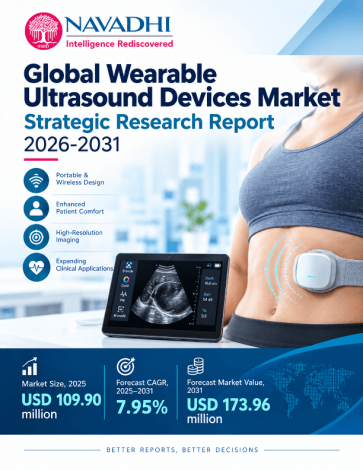
The global wearable ultrasound devices market is estimated at US$109.9 million in 2025 and is forecast to reach US$174.0 million by 2031, a compound annual growth rate (CAGR) of 8.0% over 2025-2031. Volume is estimated at about 67.7 thousand units in 2025, rising to about 183.0 thousand units in 2031. The 2025 base is a bottom-up channel build anchored on Bioventus's disclosed Restorative Therapies net sales; published top-down estimates (median US$252.1 million) were given zero weight because their definitions could not be reconciled. No audited industry sales series exists, so confidence in the absolute base is low to medium. Bear and bull cases for 2031 are US$157.7 million (6.2% CAGR) and US$193.3 million (9.9% CAGR).

Wearable ultrasound devices are ultrasound systems whose transducer stays attached to the body during use through an adhesive pad, patch, strap or band: low-intensity pulsed ultrasound (LIPUS) bone-healing systems, wearable therapeutic ultrasound for pain and soft-tissue care, and emerging monitoring and diagnostic patches. Value is manufacturer-level revenue in US dollars; volume is devices and treatment courses in thousand units. Handheld probes, cart-mounted systems and high-intensity focused ultrasound are excluded. EXOGEN-class bone-healing systems account for most of the 2025 base, and the report states this scope decision explicitly.

Scope of the Global Wearable Ultrasound Devices Market Strategic Research Report

This report covers market value (US$ million) and unit volume (thousand units) for 2022-2031, with 2025 as the base year and 2026-2031 as the forecast period. It analyses three device types, three care settings, five regions and 24 named countries (plus rest-of-region groupings), and profiles 12 companies. Company market shares and concentration ratios are not published because company revenues are not disclosed at the wearable-ultrasound level.

Segment by Type

  • Bone Healing Ultrasound
  • Pain and Soft-Tissue Therapy
  • Monitoring and Diagnostic Patches

Segment by Application

  • Home Healthcare
  • Hospital and Critical Care
  • Clinics, Rehabilitation and Sports Medicine

Segment by Region

  • North America (United States, Canada, Mexico, Rest of North America)
  • Europe (Germany, United Kingdom, France, Italy, Spain, Netherlands, Rest of Europe)
  • Asia Pacific (Japan, China, South Korea, Australia, India, Singapore, Rest of Asia Pacific)
  • Latin America (Brazil, Argentina, Chile, Colombia, Rest of Latin America)
  • Middle East and Africa (Saudi Arabia, United Arab Emirates, Turkey, Israel, South Africa, Rest of Middle East and Africa)

Who Can Use This Report?

  • Therapeutic ultrasound and bone-stimulation device makers benchmarking the market and its pricing
  • Developers of wearable monitoring and diagnostic ultrasound patches planning entry and regulatory strategy
  • Orthopaedic, rehabilitation and home-care providers and distributors assessing demand
  • Investors and research institutions needing a transparent, source-based view of a small, defined market
  1. 1. Executive Summary
    1. 1.1.1 Market Definition and Headline Sizing
    2. 1.1.2 Key Growth Drivers
    3. 1.1.3 Segmentation Highlights
    4. 1.1.4 Regional and Country Highlights
    5. 1.1.5 Competitive Structure
    6. 1.1.6 Principal Risks and Restraints
    7. 1.1.7 Outlook
  2. 2. Industry Overview & Forecast
    1. 2.1 Market Definition and Scope
    2. 2.2 Market Size and Historical Performance
    3. 2.3 Forecast and Growth Logic
    4. 2.4 Volume Analysis
    5. 2.5 Value-Chain and Pricing Architecture
  3. 3. Market Segmentation by Type
    1. 3.1 Overview of the Type Segmentation Framework
    2. 3.1.1 Bone Healing Ultrasound
    3. 3.1.2 Pain and Soft-Tissue Therapy
    4. 3.1.3 Monitoring and Diagnostic Patches
    5. 3.2 Volume Analysis
    6. 3.2.1 Global Unit Volume by Year, 2022–2031
    7. 3.3 Comparative Commentary on Revenue Mix Shift
  4. 4. Market Segmentation by Application
    1. 4.1 Overview of the Application Segmentation Framework
    2. 4.1.1 Home Healthcare
    3. 4.1.2 Hospital and Critical Care
    4. 4.1.3 Clinics, Rehabilitation and Sports Medicine
    5. 4.1.4 Comparative Assessment of Application Segments
  5. 5. Regional Market Forecast
    1. North America
    2. Europe
    3. Asia Pacific
    4. Latin America
    5. Middle East and Africa
  6. 6. Country-Level Market Forecast
    1. 6.1 North America
    2. 6.1.1 United States
    3. 6.1.2 Canada
    4. 6.1.3 Mexico
    5. 6.1.4 Rest of North America
    6. 6.2 Europe
    7. 6.2.1 Germany
    8. 6.2.2 United Kingdom
    9. 6.2.3 France
    10. 6.2.4 Italy
    11. 6.2.5 Spain
    12. 6.2.6 Netherlands
    13. 6.2.7 Rest of Europe
    14. 6.3 Asia Pacific
    15. 6.3.1 Japan
    16. 6.3.2 China
    17. 6.3.3 South Korea
    18. 6.3.4 Australia
    19. 6.3.5 India
    20. 6.3.6 Singapore
    21. 6.3.7 Rest of Asia Pacific
    22. 6.4 Latin America
    23. 6.4.1 Brazil
    24. 6.4.2 Argentina
    25. 6.4.3 Chile
    26. 6.4.4 Colombia
    27. 6.4.5 Rest of Latin America
    28. 6.5 Middle East and Africa
    29. 6.5.1 Saudi Arabia
    30. 6.5.2 United Arab Emirates
    31. 6.5.3 Turkey
    32. 6.5.4 Israel
    33. 6.5.5 South Africa
    34. 6.5.6 Rest of Middle East and Africa
  7. 7. Growth Drivers & Inhibitors
    1. 7.1 Section Overview
    2. 7.2 Market Growth Drivers
    3. 7.2.1 Proven Clinical Efficacy of Low-Intensity Pulsed Ultrasound in Fracture Healing Sustains
    4. 7.2.2 Accelerating Technology Maturation in Flexible Transducer Engineering Enables New
    5. 7.2.3 Expanding Home Healthcare Infrastructure and Shift Toward Ambulatory Treatment
    6. 7.2.4 Clinical Validation Momentum in Haemodynamic Monitoring Patches Signals Imminent
    7. 7.2.5 Government and Defence Funding Reduces Early-Stage Capital Risk and Validates
    8. 7.2.6 Regulatory Pathway Expansion and Jurisdictional Diversification Broaden Market Access
    9. 7.3 Market Restraints
    10. 7.3.1 Extremely Limited Number of Revenue-Generating Commercial Products Constrains
    11. 7.3.2 Reimbursement Coverage Remains Narrow, Restricting Uptake Beyond Established
    12. 7.3.3 Proposed FDA Down-Classification of Bone Growth Stimulators Creates Pricing and Competitive Pressure on Established Leaders
    13. 7.3.4 Extended Clinical Validation Timelines and Flexible Transducer Reliability Constraints
    14. 7.3.5 Data Integrity Gaps and Unverified Commercial Claims Impede Investor Confidence and Market Transparency
    15. 7.4 Driver and Restraint Impact Assessment
    16. 7.5 Integrated Assessment
  8. 8. Key Company Profiles
    1. 8.1 Bioventus Inc.
    2. 8.1.1 Company Overview
    3. 8.1.2 Key Products & Segments
    4. 8.1.3 Financial Performance (2023–2025)
    5. 8.1.4 Business Strategy
    6. 8.1.5 SWOT Analysis
    7. 8.1.6 Strategic Implications (2025–2031)
    8. 8.2 Orthofix Medical Inc.
    9. 8.2.1 Company Overview
    10. 8.2.2 Key Products & Segments
    11. 8.2.3 Financial Performance (2023–2025)
    12. 8.2.4 Business Strategy
    13. 8.2.5 SWOT Analysis
    14. 8.2.6 Strategic Implications (2025–2031)
    15. 8.3 ZetrOZ Systems
    16. 8.3.1 Company Overview
    17. 8.3.2 Key Products & Segments
    18. 8.3.3 Financial Performance (2023–2025)
    19. 8.3.4 Business Strategy
    20. 8.3.5 SWOT Analysis
    21. 8.3.6 Strategic Implications (2025–2031)
    22. 8.4 Flosonics Medical
    23. 8.4.1 Company Overview
    24. 8.4.2 Key Products & Segments
    25. 8.4.3 Financial Performance (2023–2025)
    26. 8.4.4 Business Strategy
    27. 8.4.5 SWOT Analysis
    28. 8.4.6 Strategic Implications (2025–2031)
    29. 8.5 IGEA S.p.A.
    30. 8.5.1 Company Overview
    31. 8.5.2 Key Products & Segments
    32. 8.5.3 Financial Performance (2023–2025)
    33. 8.5.4 Business Strategy
    34. 8.5.5 SWOT Analysis
    35. 8.5.6 Strategic Implications (2025–2031)
    36. 8.6 UNIO Medical Devices Inc.
    37. 8.6.1 Company Overview
    38. 8.6.2 Key Products & Segments
    39. 8.6.3 Financial Performance (2023–2025)
    40. 8.6.4 Business Strategy
    41. 8.6.5 SWOT Analysis
    42. 8.6.6 Strategic Implications (2025–2031)
    43. 8.7 iSono Health
    44. 8.7.1 Company Overview
    45. 8.7.2 Key Products & Segments
    46. 8.7.3 Financial Performance (2023–2025)
    47. 8.7.4 Business Strategy
    48. 8.7.5 SWOT Analysis
    49. 8.7.6 Strategic Implications (2025–2031)
    50. 8.8 Sonus Microsystems
    51. 8.8.1 Company Overview
    52. 8.8.2 Key Products & Segments
    53. 8.8.3 Financial Performance (2023–2025)
    54. 8.8.4 Business Strategy
    55. 8.8.5 SWOT Analysis
    56. 8.8.6 Strategic Implications (2025–2031)
    57. 8.9 Novosound
    58. 8.9.1 Company Overview
    59. 8.9.2 Key Products & Segments
    60. 8.9.3 Financial Performance (2023–2025)
    61. 8.9.4 Business Strategy
    62. 8.9.5 SWOT Analysis
    63. 8.9.6 Strategic Implications (2025–2031)
    64. 8.10 Softsonics
    65. 8.10.1 Company Overview
    66. 8.10.2 Key Products & Segments
    67. 8.10.3 Financial Performance (2023–2025)
    68. 8.10.4 Business Strategy
    69. 8.10.5 SWOT Analysis
    70. 8.10.6 Strategic Implications (2025–2031)
    71. 8.11 ClearSens, Inc.
    72. 8.11.1 Company Overview
    73. 8.11.2 Key Products & Segments
    74. 8.11.3 Financial Performance (2023–2025)
    75. 8.11.4 Business Strategy
    76. 8.11.5 SWOT Analysis
    77. 8.11.6 Strategic Implications (2025–2031)
    78. 8.12 Pulsenmore Ltd.
    79. 8.12.1 Company Overview
    80. 8.12.2 Key Products & Segments
    81. 8.12.3 Financial Performance (2023–2025)
    82. 8.12.4 Business Strategy
    83. 8.12.5 SWOT Analysis
    84. 8.12.6 Strategic Implications (2025–2031)
  9. 9. Competitive Landscape
    1. 9.1 Competitive Landscape Overview
    2. 9.1.1 Market Structure and Industry Configuration
    3. 9.1.2 Company Reference Table
    4. 9.1.3 Why Market Concentration Cannot Be Measured
    5. 9.1.4 Competitive Dynamics by Segment
    6. 9.1.5 Competitive Intensity Assessment
    7. 9.2 Competitive Intensity Assessment
    8. 9.2.1 Structural Grouping of the Competitive Field
    9. 9.2.2 Capacity Versus Demand Dynamics
    10. 9.2.3 Pricing Environment
    11. 9.2.4 Barriers to Entry and Exit
    12. 9.3 Key Player Strategies & Positioning
    13. 9.3.1 Strategic Group Landscape
    14. 9.3.2 Bioventus Inc. — Defending the Revenue Base Through Organic Growth and Channel Depth
    15. 9.3.3 Orthofix Medical Inc. — Gaining Ground Through PMA Approval and Segment Scale
    16. 9.3.4 ZetrOZ Systems — Penetrating the Military, Veterans, and Sports Medicine Niches
    17. 9.3.5 Flosonics Medical — Pivoting from Clinical Utility to Government-Backed Scale
    18. 9.3.6 IGEA S.p.A. and UNIO Medical Devices — European and Canadian Regulatory Strongholds
    19. 9.3.7 Emerging Innovators — Technology Differentiation as the Primary Competitive Lever
    20. 9.3.8 Summary Competitive Intelligence Table
    21. 9.3.9 R&D and Technology Investment Trends
    22. 9.4 Competitive Dynamics & Strategic Outlook
    23. 9.4.1 The Current Competitive Structure
    24. 9.4.2 Emerging Competitive Threats
    25. 9.4.3 Consolidation vs. Fragmentation Outlook
    26. 9.4.4 Competitive Response Matrix
    27. 9.4.5 Strategic Recommendations for 2025–2031
  10. 10. Porter's Five Forces Analysis
    1. 10.1 Threat of New Entrants
    2. 10.2 Bargaining Power of Buyers
    3. 10.3 Bargaining Power of Suppliers
    4. 10.4 Threat of Substitutes
    5. 10.5 Competitive Rivalry
  11. 11. PESTLE Analysis
    1. 11.1 Political
    2. 11.2 Economic
    3. 11.3 Sociocultural
    4. 11.4 Technological
    5. 11.5 Legal
    6. 11.6 Environmental
    7. 11.7 PESTLE Summary Assessment Table
  12. 12. SWOT Analysis
    1. 12.1 Industry SWOT Analysis
    2. 12.1.1 Detailed Analysis
    3. 12.1.1.1 Strengths
    4. 12.1.1.2 Weaknesses
    5. 12.1.1.3 Opportunities
    6. 12.1.1.4 Threats
    7. 12.1.2 Strategic Implications
  13. 13. Future Trends & Outlook
    1. 13.1 Overview
    2. 13.2 Trend Analyses
    3. 13.2.1 Transition from Single-Transducer Therapy to Multi-Transducer Array Patch Architectures
    4. 13.2.2 Artificial Intelligence Integration for Real-Time Signal Interpretation and Clinical Decision Support
    5. 13.2.3 Regulatory Pathway Maturation and Reclassification Dynamics
    6. 13.2.4 Expansion of Government and Defense Procurement as a Market Development Catalyst
    7. 13.2.5 Emergence of Continuous Haemodynamic Monitoring as the Dominant Growth Application
    8. 13.2.6 Ultrasound-as-a-Service and Subscription Revenue Model Adoption
    9. 13.2.7 Geographic Expansion Beyond North American Core Market
    10. 13.2.8 Maternal and Fetal Health as an Emerging High-Acuity Application Vertical
    11. 13.3 Summary of Trends
    12. 13.4 Forward Outlook: 2026–2031

List of Exhibits

Exhibit 2.1: Forecast of Global Market YoY Growth Rate & CAGR Summary (in %)
Exhibit 2.2: Forecast of Global Market YoY Growth Rate & CAGR Summary (in %)
Exhibit 2.3: Forecast of Global (in USD Mn)
Exhibit 2.4: Forecast of North America (in USD Mn)
Exhibit 2.5: Forecast of Europe (in USD Mn)
Exhibit 2.6: Forecast of Asia Pacific (in USD Mn)
Exhibit 2.7: Forecast of Latin America (in USD Mn)
Exhibit 2.8: Forecast of Middle East and Africa (in USD Mn)
Exhibit 2.9: Forecast of Global (in K Units)
Exhibit 2.10: Forecast of North America (in K Units)
Exhibit 2.11: Forecast of Europe (in K Units)
Exhibit 2.12: Forecast of Asia Pacific (in K Units)
Exhibit 2.13: Forecast of Latin America (in K Units)
Exhibit 2.14: Forecast of Middle East and Africa (in K Units)
Exhibit 3.15: Forecast of Bone Healing Ultrasound (in USD Mn)
Exhibit 3.16: Forecast of Bone Healing Ultrasound (in K Units)
Exhibit 3.17: Forecast of Pain and Soft-Tissue Therapy (in USD Mn)
Exhibit 3.18: Forecast of Pain and Soft-Tissue Therapy (in K Units)
Exhibit 3.19: Forecast of Monitoring and Diagnostic Patches (in USD Mn)
Exhibit 3.20: Forecast of Monitoring and Diagnostic Patches (in K Units)
Exhibit 4.21: Forecast of Home Healthcare (in USD Mn)
Exhibit 4.22: Forecast of Home Healthcare (in K Units)
Exhibit 4.23: Forecast of Hospital and Critical Care (in USD Mn)
Exhibit 4.24: Forecast of Hospital and Critical Care (in K Units)
Exhibit 4.25: Forecast of Clinics, Rehabilitation and Sports Medicine (in USD Mn)
Exhibit 4.26: Forecast of Clinics, Rehabilitation and Sports Medicine (in K Units)
Exhibit 6.27: Forecast of North America (in USD Mn)
Exhibit 6.28: Forecast of United States (in USD Mn)
Exhibit 6.29: Forecast of Canada (in USD Mn)
Exhibit 6.30: Forecast of Mexico (in USD Mn)
Exhibit 6.31: Forecast of Rest of North America (in USD Mn)
Exhibit 6.32: Forecast of North America (in K Units)
Exhibit 6.33: Forecast of United States (in K Units)
Exhibit 6.34: Forecast of Canada (in K Units)
Exhibit 6.35: Forecast of Mexico (in K Units)
Exhibit 6.36: Forecast of Rest of North America (in K Units)
Exhibit 6.37: Forecast of Europe (in USD Mn)
Exhibit 6.38: Forecast of Germany (in USD Mn)
Exhibit 6.39: Forecast of United Kingdom (in USD Mn)
Exhibit 6.40: Forecast of France (in USD Mn)
Exhibit 6.41: Forecast of Italy (in USD Mn)
Exhibit 6.42: Forecast of Spain (in USD Mn)
Exhibit 6.43: Forecast of Netherlands (in USD Mn)
Exhibit 6.44: Forecast of Rest of Europe (in USD Mn)
Exhibit 6.45: Forecast of Europe (in K Units)
Exhibit 6.46: Forecast of Germany (in K Units)
Exhibit 6.47: Forecast of United Kingdom (in K Units)
Exhibit 6.48: Forecast of France (in K Units)
Exhibit 6.49: Forecast of Italy (in K Units)
Exhibit 6.50: Forecast of Spain (in K Units)
Exhibit 6.51: Forecast of Netherlands (in K Units)
Exhibit 6.52: Forecast of Rest of Europe (in K Units)
Exhibit 6.53: Forecast of Asia Pacific (in USD Mn)
Exhibit 6.54: Forecast of Japan (in USD Mn)
Exhibit 6.55: Forecast of China (in USD Mn)
Exhibit 6.56: Forecast of South Korea (in USD Mn)
Exhibit 6.57: Forecast of Australia (in USD Mn)
Exhibit 6.58: Forecast of India (in USD Mn)
Exhibit 6.59: Forecast of Singapore (in USD Mn)
Exhibit 6.60: Forecast of Rest of Asia Pacific (in USD Mn)
Exhibit 6.61: Forecast of Asia Pacific (in K Units)
Exhibit 6.62: Forecast of Japan (in K Units)
Exhibit 6.63: Forecast of China (in K Units)
Exhibit 6.64: Forecast of South Korea (in K Units)
Exhibit 6.65: Forecast of Australia (in K Units)
Exhibit 6.66: Forecast of India (in K Units)
Exhibit 6.67: Forecast of Singapore (in K Units)
Exhibit 6.68: Forecast of Rest of Asia Pacific (in K Units)
Exhibit 6.69: Forecast of Latin America (in USD Mn)
Exhibit 6.70: Forecast of Brazil (in USD Mn)
Exhibit 6.71: Forecast of Argentina (in USD Mn)
Exhibit 6.72: Forecast of Chile (in USD Mn)
Exhibit 6.73: Forecast of Colombia (in USD Mn)
Exhibit 6.74: Forecast of Rest of Latin America (in USD Mn)
Exhibit 6.75: Forecast of Latin America (in K Units)
Exhibit 6.76: Forecast of Brazil (in K Units)
Exhibit 6.77: Forecast of Argentina (in K Units)
Exhibit 6.78: Forecast of Chile (in K Units)
Exhibit 6.79: Forecast of Colombia (in K Units)
Exhibit 6.80: Forecast of Rest of Latin America (in K Units)
Exhibit 6.81: Forecast of Middle East and Africa (in USD Mn)
Exhibit 6.82: Forecast of Saudi Arabia (in USD Mn)
Exhibit 6.83: Forecast of United Arab Emirates (in USD Mn)
Exhibit 6.84: Forecast of Turkey (in USD Mn)
Exhibit 6.85: Forecast of Israel (in USD Mn)
Exhibit 6.86: Forecast of South Africa (in USD Mn)
Exhibit 6.87: Forecast of Rest of Middle East and Africa (in USD Mn)
Exhibit 6.88: Forecast of Middle East and Africa (in K Units)
Exhibit 6.89: Forecast of Saudi Arabia (in K Units)
Exhibit 6.90: Forecast of United Arab Emirates (in K Units)
Exhibit 6.91: Forecast of Turkey (in K Units)
Exhibit 6.94: Forecast of Israel (in K Units)
Exhibit 6.93: Forecast of South Africa (in K Units)
Exhibit 6.94: Forecast of Rest of Middle East and Africa (in K Units)
  1. Bioventus
  2. Orthofix
  3. ZetrOZ
  4. Flosonics
  5. IGEA
  6. UNIO
  7. iSono Health
  8. Sonus
  9. Novosound
  10. Softsonics
  11. ClearSens
  12. Pulsenmore

Single User License (PDF)

  • This license allows for use of a publication by one person.
  • This person may print out a single copy of the publication.
  • This person can include information given in the publication in presentations and internal reports by providing full copyright credit to the publisher.
  • This person cannot share the publication (or any information contained therein) with any other person or persons.
  • Unless a Enterprise License is purchased, a Single User License must be purchased for every person that wishes to use the publication within the same organization.
  • Customers who infringe these license terms are liable for a Enterprise license fee.


Site License (PDF)*

  • This license allows for use of a publication by all users within one corporate location, e.g. a regional office.
  • These users may print out a single copy of the publication.
  • These users can include information given in the publication in presentations and internal reports by providing full copyright credit to the publisher.
  • These users cannot share the publication (or any information contained therein) with any other person or persons outside the corporate location for which the publication is purchased.
  • Unless a Enterprise License is purchased, a Site User License must be purchased for every corporate location by an organization that wishes to use the publication within the same organization.
  • Customers who infringe these license terms are liable for a Enterprise license fee.


Enterprise License (PDF)*

  • This license allows for use of a publication by unlimited users within the purchasing organization e.g. all employees of a single company.
  • Each of these people may use the publication on any computer, and may print out the report, but may not share the publication (or any information contained therein) with any other person or persons outside of the organization.
  • These employees of purchasing organization can include information given in the publication in presentations and internal reports by providing full copyright credit to the publisher.

*If Applicable.

About Us

NAVADHI is a market research company that helps global firms differentiate themselves, break market entry barriers, track their investments, develop business strategies and plan for future by providing actionable market research intelligence that helps them succeed.

Infomation

  • About Us
  • Publications
  • FAQs
  • Privacy Policy
  • Terms & Conditions
  • Careers
  • Press Releases
  • Contact

Source URL:https://www.navadhi.com/publications/global-wearable-ultrasound-devices-market-strategic-research-report-2026-2031

Links
[1] https://www.navadhi.com/countries/global