
NAVADHI Market Research
Published on NAVADHI Market Research (https://www.navadhi.com)

Home > Global In-Vitro Fertilization Market Strategic Research Report 2026-2031

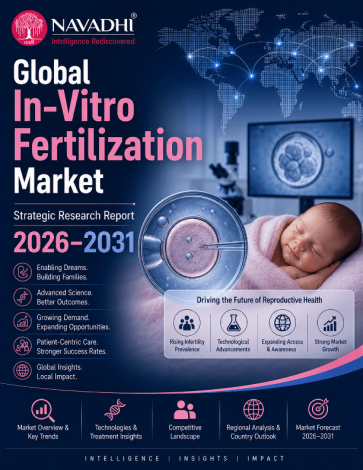
Global In-Vitro Fertilization Market Strategic Research Report 2026-2031

Global In-Vitro Fertilization Market Strategic Research Report 2026-2031
Publication ID: 
NAV0726003
Publication Date: 
July 28, 2026
Pages: 
178
Countries: 
Global [1]
Please choose the suitable license type from above. More details are at given under tab "Report License Types" below.

Global demand for in-vitro fertilization services and supporting technologies has transitioned from a niche clinical segment into a structurally resilient, high-growth healthcare market. An estimated 1-in-6 couples worldwide now experience infertility, while delayed family formation, rising maternal age at first birth, and declining sperm quality across OECD populations continue to expand the addressable patient pool at a rate that outpaces clinical capacity in most geographies.

In 2025, three forces are simultaneously reshaping the market's architecture: the rapid adoption of preimplantation genetic testing (PGT), which improves live birth rates and commands a meaningful price premium over conventional cycles; the industrialization of frozen embryo transfer (FET) protocols, which decouples embryo banking from fresh transfer cycles and multiplies per-patient revenue streams; and the accelerating entry of AI-driven embryo selection platforms, which are compressing the competence gap between tier-1 fertility centers and mid-market clinic networks.

The global IVF market reached an estimated USD 22.01 billion in 2024, advancing from USD 18.42 billion in 2022, representing a historical CAGR of approximately 9.4% over 2022-2024 (Navadhi Market Research Estimate). The base-year estimate for 2025 stands at USD 24.08 billion. The market is projected to reach USD 41.82 billion by 2031, compounding at a 9.6% CAGR over the 2025-2031 forecast period. Volume throughput is expected to grow from 3.51 million cycles in 2025 to 5.60 million cycles by 2031, driven by clinic network expansion in Asia-Pacific and Latin America, rising PGT penetration in North America, and the continued scaling of frozen embryo transfer protocols globally.

Employer-sponsored fertility benefits in the United States now cover IVF at approximately 42% of large employers, up from under 25% five years ago, materially lowering the out-of-pocket barrier for the highest-value demographic. In Europe, public reimbursement programs in Denmark, Belgium, and Israel continue to sustain cycle volumes at above-replacement levels, while rapid middle-class expansion and surging fertility tourism in Southeast Asia, the Gulf Cooperation Council, and India are extending the market's geographic frontier well beyond its historical base.

Segments by Type:

  • Fresh IVF Cycles
  • Frozen Embryo Transfer
  • PGT Genetic Testing

Segments by Applications:

  • ICSI Procedures
  • IVF Pharmaceuticals
  • Fertility Preservation
  1. Executive Summary
    1. 1.1 IVF Emerges as a USD 24 Billion Structural Growth Market
    2. 1.1.1 Market Overview
    3. 1.1.2 Market Size and Historical Trajectory
    4. 1.1.3 Forecast: USD 41.82 Billion by 2031
    5. 1.1.4 Key Findings
    6. 1.1.5 Leading Companies and Market Position
    7. 1.1.6 Regional Highlights
    8. 1.1.7 Strategic Recommendations
  2. Industry Overview & Market Forecast
    1. 2.1 Fertility Medicine Enters Its Expansion Phase
    2. 2.1.1 Historical & Forecast Market Size: 2022–2031
    3. 2.1.2 CAGR Summary
    4. 2.1.3 Market Structure, Sizing Methodology, and Growth Catalysts
    5. 2.1.3.1 Sizing Methodology
    6. 2.1.3.2 Structural Characteristics
    7. 2.1.3.3 Five Demand-Side Catalysts Driving the 2025–2031 Forecast
  3. Market Segmentation by Procedure Type
    1. 3.1 Segmentation Framework and Market Architecture
    2. 3.2 Fresh IVF Cycles
    3. 3.3 Frozen Embryo Transfer
    4. 3.4 PGT Genetic Testing
    5. 3.5 Competitive Implications of the Shifting Segment Mix
  4. Market Segmentation by Application
    1. 4.1 Fertility Clinics Dominate, But Hospital-Based IVF Captures Accelerating Share as Payer Mix Shifts
    2. 4.1.1 Application Segment Revenue — Full Forecast Series (USD Billion)
    3. 4.1.2 Fertility Clinics
    4. 4.1.3 Hospitals and Surgical Centers
    5. 4.1.4 Research and Academic Institutions
  5. Regional Market Forecast & Analysis
    1. 5.1 Regional Market Summary
    2. 5.2 North America
    3. 5.3 Europe
    4. 5.4 Asia-Pacific
    5. 5.5 Middle East & Africa
    6. 5.6 Latin America
  6. Country-Level Market Forecast
    1. 6.1 North America
    2. 6.1.1 Country Summary Table — North America
    3. 6.1.2 United States
    4. 6.1.3 Canada
    5. 6.2 Europe
    6. 6.2.1 Country Summary Table — Europe
    7. 6.2.2 Germany
    8. 6.2.3 France
    9. 6.2.4 United Kingdom
    10. 6.2.5 Italy
    11. 6.2.6 Spain
    12. 6.3 Asia-Pacific
    13. 6.3.1 Country Summary Table — Asia-Pacific
    14. 6.3.2 China
    15. 6.3.3 Japan
    16. 6.3.4 India
    17. 6.3.5 South Korea
    18. 6.3.6 Australia
    19. 6.4 Latin America
    20. 6.4.1 Brazil
    21. 6.4.2 Mexico
    22. 6.4.3 Colombia
    23. 6.4.4 Argentina
    24. 6.5 Middle East & Africa
    25. 6.5.1 Country Summary Table — MEA
    26. 6.5.2 Saudi Arabia
    27. 6.5.3 UAE
    28. 6.5.4 South Africa
  7. Growth Drivers, Restraints & Opportunities
    1. 7.1 Structural Demand Outpaces Capacity Constraints
    2. 7.2 Growth Drivers
    3. 7.3 Market Inhibitors / Challenges
    4. 7.4 Net Assessment
  8. Company Profiles
    1. 8.1 Vitrolife AB
    2. 8.1.1 Company Overview
    3. 8.1.2 Key Products & Segments
    4. 8.1.3 Financial Performance (2023–2025)
    5. 8.1.4 Business Strategy
    6. 8.1.5 Product Strategy
    7. 8.1.6 SWOT Analysis
    8. 8.1.7 Strategic Implications (2025–2031)
    9. 8.2 CooperSurgical (Cooper Companies)
    10. 8.2.1 Company Overview
    11. 8.2.2 Key Products & Segments
    12. 8.2.3 Financial Performance (2023–2025)
    13. 8.2.4 Business Strategy
    14. 8.2.5 Product Strategy
    15. 8.2.6 SWOT Analysis
    16. 8.2.7 Strategic Implications (2025–2031)
    17. 8.3 Merck KGaA (Fertility Division)
    18. 8.3.1 Company Overview
    19. 8.3.2 Key Products & Segments
    20. 8.3.3 Financial Performance (2023–2025)
    21. 8.3.4 Business Strategy
    22. 8.3.5 Product Strategy
    23. 8.3.6 SWOT Analysis
    24. 8.3.7 Strategic Implications (2025–2031)
    25. 8.4 IGENOMIX (Eurofins Group)
    26. 8.4.1 Company Overview
    27. 8.4.2 Key Products & Segments
    28. 8.4.3 Financial Performance (2023–2025)
    29. 8.4.4 Business Strategy
    30. 8.4.5 Product Strategy
    31. 8.4.6 SWOT Analysis
    32. 8.4.7 Strategic Implications (2025–2031)
    33. 8.5 Ferring Pharmaceuticals
    34. 8.5.1 Company Overview
    35. 8.5.2 Key Products & Segments
    36. 8.5.3 Financial Performance (2023–2025)
    37. 8.5.4 Business Strategy
    38. 8.5.5 Product Strategy
    39. 8.5.6 SWOT Analysis
    40. 8.5.7 Strategic Implications (2025–2031)
    41. 8.6 Gedeon Richter
    42. 8.6.1 Company Overview
    43. 8.6.2 Key Products & Segments
    44. 8.6.3 Financial Performance (2023–2025)
    45. 8.6.4 Business Strategy
    46. 8.6.5 Product Strategy
    47. 8.6.6 SWOT Analysis
    48. 8.6.7 Strategic Implications (2025–2031)
    49. 8.7 Origio (Hamilton Thorne)
    50. 8.7.1 Company Overview
    51. 8.7.2 Key Products & Segments
    52. 8.7.3 Financial Performance (2023–2025)
    53. 8.7.4 Business Strategy
    54. 8.7.5 Product Strategy
    55. 8.7.6 SWOT Analysis
    56. 8.7.7 Strategic Implications (2025–2031)
    57. 8.8 IVI-RMA Global
    58. 8.8.1 Company Overview
    59. 8.8.2 Key Products & Segments
    60. 8.8.3 Financial Performance (2023–2025)
    61. 8.8.4 Business Strategy
    62. 8.8.5 Product Strategy
    63. 8.8.6 SWOT Analysis
    64. 8.8.7 Strategic Implications (2025–2031)
    65. 8.9 Care Fertility Group
    66. 8.9.1 Company Overview
    67. 8.9.2 Key Products & Segments
    68. 8.9.3 Financial Performance (2023–2025)
    69. 8.9.4 Business Strategy
    70. 8.9.5 Product Strategy
    71. 8.9.6 SWOT Analysis
    72. 8.9.7 Strategic Implications (2025–2031)
    73. 8.10 Monash IVF Group
    74. 8.10.1 Company Overview
    75. 8.10.2 Key Products & Segments
    76. 8.10.3 Financial Performance (2023–2025)
    77. 8.10.4 Business Strategy
    78. 8.10.5 Product Strategy
    79. 8.10.6 SWOT Analysis
    80. 8.10.7 Strategic Implications (2025–2031)
    81. 8.11 Virtus Health
    82. 8.11.1 Company Overview
    83. 8.11.2 Key Products & Segments
    84. 8.11.3 Financial Performance (2023–2025)
    85. 8.11.4 Business Strategy
    86. 8.11.5 Product Strategy
    87. 8.11.6 SWOT Analysis
    88. 8.11.7 Strategic Implications (2025–2031)
    89. 8.12 Progyny Inc.
    90. 8.12.1 Company Overview
    91. 8.12.2 Key Products & Segments
    92. 8.12.3 Financial Performance (2023–2025)
    93. 8.12.4 Business Strategy
    94. 8.12.5 Product Strategy
    95. 8.12.6 SWOT Analysis
    96. 8.12.7 Strategic Implications (2025–2031)
    97. 8.13 Genea
    98. 8.13.1 Company Overview
    99. 8.13.2 Key Products & Segments
    100. 8.13.3 Financial Performance (2023–2025)
    101. 8.13.4 Business Strategy
    102. 8.13.5 Product Strategy
    103. 8.13.6 SWOT Analysis
    104. 8.13.7 Strategic Implications (2025–2031)
    105. 8.14 Reproductive Medicine Associates (RMA)
    106. 8.14.1 Company Overview
    107. 8.14.2 Key Products & Segments
    108. 8.14.3 Financial Performance (2023–2025)
    109. 8.14.4 Business Strategy
    110. 8.14.5 Product Strategy
    111. 8.14.6 SWOT Analysis
    112. 8.14.7 Strategic Implications (2025–2031)
    113. 8.15 Fujifilm Irvine Scientific
    114. 8.15.1 Company Overview
    115. 8.15.2 Key Products & Segments
    116. 8.15.3 Financial Performance (2023–2025)
    117. 8.15.4 Business Strategy
    118. 8.15.5 Product Strategy
    119. 8.15.6 SWOT Analysis
    120. 8.15.7 Strategic Implications (2025–2031)
    121. 8.16 Cook Medical (Fertility Division)
    122. 8.16.1 Company Overview
    123. 8.16.2 Key Products & Segments
    124. 8.16.3 Financial Performance (2023–2025)
    125. 8.16.4 Business Strategy
    126. 8.16.5 Product Strategy
    127. 8.16.6 SWOT Analysis
    128. 8.16.7 Strategic Implications (2025–2031)
    129. 8.17 Nidacon International
    130. 8.17.1 Company Overview
    131. 8.17.2 Key Products & Segments
    132. 8.17.3 Financial Performance (2023–2025)
    133. 8.17.4 Business Strategy
    134. 8.17.5 Product Strategy
    135. 8.17.6 SWOT Analysis
    136. 8.17.7 Strategic Implications (2025–2031)
    137. 8.18 Gynetics Medical Products
    138. 8.18.1 Company Overview
    139. 8.18.2 Key Products & Segments
    140. 8.18.3 Financial Performance (2023–2025)
    141. 8.18.4 Business Strategy
    142. 8.18.5 Product Strategy
    143. 8.18.6 SWOT Analysis
    144. 8.18.7 Strategic Implications (2025–2031)
  9. Competitive Landscape & Market Share Analysis
    1. 9.1 Fertility Technology Giants vs. Clinic Networks
    2. 9.2 Revenue Concentration Remains Low
    3. 9.3 Competitive Positioning
    4. 9.4 Competitive Dynamics
    5. 9.5 M&A Activity Has Accelerated
    6. 9.6 Technology Differentiation
    7. 9.7 COMPETITIVE LANDSCAPE
    8. 9.7.1 Structural Fragmentation Persists Despite Accelerating Consoli
    9. 9.7.2 Market Share Estimates — 2025
    10. 9.7.3 Competitive Summary Scorecard
    11. 9.7.4 Competitive Dynamics
    12. 9.7.5 M&A Activity Summary: 2022–2025
    13. 9.7.6 Technology Differentiation Matrix
  10. Porter's Five Forces Analysis
    1. 10.1 Regulatory Moats and Capital Barriers Render IVF a Structurall
    2. 10.2 Threat of New Entrants — LOW to MEDIUM
    3. 10.3 Supplier Power — MEDIUM to HIGH
    4. 10.4 Buyer Power — LOW to MEDIUM
    5. 10.5 Threat of Substitutes — LOW
    6. 10.6 Competitive Rivalry — HIGH
    7. 10.7 Porter's Five Forces Summary Table
    8. 10.8 Industry Attractiveness Assessment
    9. 10.9 Porter's Five Forces
    10. 10.9.1 Force 1: Threat of New Entrants — Low-to-Medium
    11. 10.9.2 Force 2: Supplier Power — High
    12. 10.9.3 Force 3: Buyer Power — Low-to-Medium
    13. 10.9.4 Force 4: Threat of Substitutes — Low
    14. 10.9.5 Force 5: Competitive Rivalry — High
    15. 10.10 Summary Table: Five Forces Rating and Primary Driver
    16. 10.11 Overall Industry Attractiveness
  11. PESTLE Analysis
    1. 11.1 Political Factors
    2. 11.2 Economic Factors
    3. 11.3 Social Factors
    4. 11.4 Technological Factors
    5. 11.5 Legal Factors
    6. 11.6 Environmental Factors
    7. 11.7 PESTLE Impact Summary
    8. 11.8 Macro-Environment Implications for Market Participants
    9. 11.9 Regulatory Asymmetry, Demographic Pressure, and Technological
    10. 11.10 Political Factors
    11. 11.11 Economic Factors
    12. 11.12 Social Factors
    13. 11.13 Technological Factors
    14. 11.14 Legal Factors
    15. 11.15 Environmental Factors
    16. 11.16 PESTLE Impact Summary
    17. 11.17 Macro-Environment Implications for Market Participants
  12. Market-Level SWOT Analysis
    1. 12.1 Structural Advantages Meet Demographic Tailwinds
    2. 12.1.1 SWOT Matrix
    3. 12.1.1.1 Internal Factors
    4. 12.1.1.2 External Factors
    5. 12.1.2 Strategic Implications
    6. 12.1.3 Priority Actions for Market Participants Through 2031
    7. 12.2 SWOT Analysis
    8. 12.2.1 SWOT Matrix
    9. 12.2.1.1 Strengths vs. Weaknesses
    10. 12.2.1.2 Opportunities vs. Threats
    11. 12.2.2 Strategic Implications
    12. 12.2.3 Priority Actions for Market Participants Through 2031
  13. Future Trends & Strategic Outlook 2026-2031
    1. 13.1 Seven Structural Trends Redefining the IVF Market Through 2031
    2. 13.1.1 Trend 1
    3. 13.1.2 Trend 2
    4. 13.1.3 Trend 3
    5. 13.1.4 Trend 4
    6. 13.1.5 Trend 5
    7. 13.1.6 Trend 6
    8. 13.1.7 Trend 7
    9. 13.1.8 Trend 8
    10. 13.2 Trend Impact Summary Table
    11. 13.3 Forward Outlook
  1. Vitrolife AB
  2. CooperSurgical (Cooper Companies)
  3. Merck KGaA (Fertility Division)
  4. IGENOMIX (Eurofins Group)
  5. Ferring Pharmaceuticals
  6. Gedeon Richter
  7. Origio (Hamilton Thorne)
  8. IVI-RMA Global
  9. Care Fertility Group
  10. Monash IVF Group
  11. Virtus Health
  12. Progyny Inc.
  13. Genea
  14. Reproductive Medicine Associates (RMA)
  15. Fujifilm Irvine Scientific
  16. Cook Medical (Fertility Division)
  17. Nidacon International
  18. Gynetics Medical Products

Single User License (PDF)

  • This license allows for use of a publication by one person.
  • This person may print out a single copy of the publication.
  • This person can include information given in the publication in presentations and internal reports by providing full copyright credit to the publisher.
  • This person cannot share the publication (or any information contained therein) with any other person or persons.
  • Unless a Enterprise License is purchased, a Single User License must be purchased for every person that wishes to use the publication within the same organization.
  • Customers who infringe these license terms are liable for a Enterprise license fee.


Site License (PDF)*

  • This license allows for use of a publication by all users within one corporate location, e.g. a regional office.
  • These users may print out a single copy of the publication.
  • These users can include information given in the publication in presentations and internal reports by providing full copyright credit to the publisher.
  • These users cannot share the publication (or any information contained therein) with any other person or persons outside the corporate location for which the publication is purchased.
  • Unless a Enterprise License is purchased, a Site User License must be purchased for every corporate location by an organization that wishes to use the publication within the same organization.
  • Customers who infringe these license terms are liable for a Enterprise license fee.


Enterprise License (PDF)*

  • This license allows for use of a publication by unlimited users within the purchasing organization e.g. all employees of a single company.
  • Each of these people may use the publication on any computer, and may print out the report, but may not share the publication (or any information contained therein) with any other person or persons outside of the organization.
  • These employees of purchasing organization can include information given in the publication in presentations and internal reports by providing full copyright credit to the publisher.

*If Applicable.

About Us

NAVADHI is a market research company that helps global firms differentiate themselves, break market entry barriers, track their investments, develop business strategies and plan for future by providing actionable market research intelligence that helps them succeed.

Infomation

  • About Us
  • Publications
  • FAQs
  • Privacy Policy
  • Terms & Conditions
  • Careers
  • Press Releases
  • Contact

Source URL:https://www.navadhi.com/publications/global-vitro-fertilization-market-strategic-research-report-2026-2031

Links
[1] https://www.navadhi.com/countries/global