
NAVADHI Market Research
Published on NAVADHI Market Research (https://www.navadhi.com)

Home > Global Travel & Tourism Industry Strategic Research Report 2026-2031

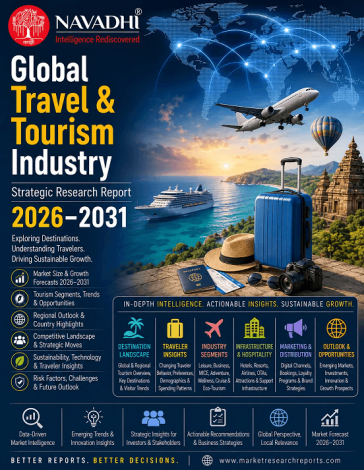
Global Travel & Tourism Industry Strategic Research Report 2026-2031

Global Travel & Tourism Industry Strategic Research Report 2026-2031
Publication ID: 
NAV0826030
Publication Date: 
August 28, 2026
Pages: 
268
Countries: 
Global [1]
Please choose the suitable license type from above. More details are at given under tab "Report License Types" below.

The global travel, tourism, and hospitality industry reached an estimated $10.0 trillion in total economic contribution in 2025, representing one of the largest and most structurally complex consumer-facing sectors in the global economy. This headline valuation represents a consensus midpoint derived from three independently published, methodologically aligned estimates: dataintelo.com ($9.5 trillion), CustomMarketInsights ($9.897 trillion), and ResearchNester ($10.62 trillion), all published with a 2025 reference year and all employing the WTTC-aligned total economic contribution framework -- encompassing direct, indirect, and induced effects across the full value chain, materially distinct from narrower direct-revenue-only estimates, which independent sources typically place in the $1.0-1.1 trillion range for 2025. The industry is forecast to reach approximately $13.79 trillion by 2031, a compound annual growth rate of approximately 5.5%, a calibrated midpoint across the 4.1%-7.2% range published across primary source estimates.

Partnership and consolidation activity since 2022 has concentrated at the intersection of distribution and loyalty. Booking Holdings deepened its strategic investment in Meituan (China) and has sustained its equity stake in Grab (Southeast Asia) as a mechanism for OTA distribution penetration into markets where its own brand awareness trails Trip.com. Expedia completed the integration of Vrbo more substantively into its One Key framework in 2023, a move explicitly targeting Airbnb's alternative-accommodation market share. TUI Group completed its delisting from the London Stock Exchange in 2024, consolidating its primary listing in Frankfurt. IAG moved to acquire Air Europa in a transaction that faced prolonged European Commission scrutiny before receiving conditional approval in 2024, extending its Madrid hub dominance. In the hotel sector, Hilton's 2023 acquisition of Graduate Hotels expanded its lifestyle-boutique footprint, and its 2024 licensing agreement with Small Luxury Hotels of the World added approximately 580 independent properties to its loyalty redemption network without incremental balance-sheet commitment.

Scope of Global Travel, Tourism & Hospitality Industry Strategic Research Report 2026-2031

  • This report provides forecast data by value for the global travel, tourism, and hospitality industry, with 2025 as the base year and forecasting to 2031.
  • This report provides segmentation by travel type (Leisure Travel, Business Travel, Domestic and Other Travel) and by booking/distribution channel (Online Travel Agencies (OTA), Direct Booking (Hotel/Airline/Cruise), Traditional Travel Agents).
  • This report provides region-wise and country-level forecast data across 5 regions and 17 countries.
  • This report identifies key growth drivers and inhibitors, including rising middle-class travel demand, low-cost carrier expansion, and AI-driven booking personalization.
  • This report provides company profiles for the 25 leading travel, tourism, and hospitality companies, each covering Company Overview, Key Products & Segments, Financial Performance, Business Strategy, SWOT Analysis, and Strategic Implications.
  • This report provides Porter's Five Forces, PESTLE, and SWOT analysis.
  • This report identifies key future trends through 2031.

Segment by Type

  • Leisure Travel
  • Business Travel
  • Domestic and Other Travel

Segment by Application

  • Online Travel Agencies (OTA)
  • Direct Booking (Hotel/Airline/Cruise)
  • Traditional Travel Agents

Segment by Region

  • Asia-Pacific (China, Japan, India, South Korea, Thailand, Rest of Asia Pacific)
  • Europe (Spain, France, Germany, United Kingdom, Italy, Rest of Europe)
  • North America (United States, Canada, Rest of North America)
  • Latin America (Mexico, Brazil, Rest of Latin America)
  • Middle East & Africa (Saudi Arabia, UAE, South Africa, Rest of Middle East and Africa)

Who Can Use the Global Travel, Tourism & Hospitality Industry Strategic Research Report?

This research report is ideal for people who wish to gain a thorough understanding of the travel and tourism market. Some of the intended users are:

  • C-level executives and Company Directors at airlines, hotels, cruise lines, and online travel agencies
  • Investment managers, Financial professionals, and Travel/Hospitality sector equity analysts
  • Corporate travel management and procurement professionals benchmarking supplier landscapes
  • M&A advisors assessing consolidation dynamics across the travel value chain
  • Anyone operating in the global travel, tourism, and hospitality value chain
  1. Executive Summary
    1. 1.1 Global Travel & Tourism Industry Strategic Research Report 2026–2031
    2. 1.2 Market Valuation & Growth Trajectory
    3. 1.3 Scope, Methodology & Value-Chain Coverage
    4. 1.4 Segment Dynamics: Travel Type
    5. 1.5 Segment Dynamics: Booking & Distribution Channels
    6. 1.6 Regional Landscape
    7. 1.7 Competitive Landscape: 25-Company Profile Coverage
    8. 1.8 Report Positioning & Pricing
  2. Industry Overview & Forecast
    1. 2.1 Market Size and Baseline Assessment
    2. 2.2 Historical Trajectory and Recovery Context
    3. 2.3 Forecast: 2026–2031
    4. 2.4 Segment by Travel Type
    5. 2.5 Segment by Booking and Distribution Channel
    6. 2.6 Regional Dimension
    7. 2.7 Growth Rate Convergence and Structural Implications
  3. Market Segmentation by Type
    1. 3.1 Overview and Segment Architecture
    2. 3.2 Leisure Travel
    3. 3.2.1 Segment Scale and Historical Trajectory
    4. 3.2.2 Forecast Trajectory to 2031
    5. 3.2.3 Structural Demand Drivers
    6. 3.3 Business Travel
    7. 3.3.1 Segment Scale and Recovery Profile
    8. 3.3.2 Forecast Trajectory to 2031
    9. 3.3.3 Structural Demand Drivers and Constraints
    10. 3.4 Domestic and Other Travel
    11. 3.4.1 Segment Scale and Distinct Growth Profile
    12. 3.4.2 Forecast Trajectory to 2031
    13. 3.5 Cross-Segment Analysis and Strategic Implications
    14. 3.5.1 Segment Share Dynamics
    15. 3.5.2 Investment and Strategic Relevance
  4. Market Segmentation by Application
    1. 4.1 Section Overview
    2. 4.2 Channel Segment Landscape: 2025 Baseline
    3. 4.3 Online Travel Agencies
    4. 4.3.1 Scale, Growth, and Structural Momentum
    5. 4.3.2 Competitive Architecture of the OTA Segment
    6. 4.3.3 Technology Drivers Reshaping OTA Competitive Dynamics
    7. 4.3.4 Regulatory Headwinds for the OTA Segment
    8. 4.4 Direct Booking
    9. 4.4.1 Scale, Growth, and the Loyalty-Led Defensive Strategy
    10. 4.4.2 The Loyalty Programme as the Primary Direct Channel Defence
    11. 4.4.3 Asset-Light Hotel Models and Direct Booking Channel Management
    12. 4.4.4 Airlines and the Low-Cost Carrier Direct Booking Advantage
    13. 4.5 Traditional Travel Agents
    14. 4.5.1 Scale, Resilience, and Structural Repositioning
    15. 4.5.2 The Luxury and Complex Itinerary Premium
    16. 4.5.3 Group and Corporate Segments Supporting Volume
    17. 4.5.4 Technological Adaptation and Hybrid Models
    18. 4.6 Other Channels
    19. 4.6.1 Segment Composition and Scale
    20. 4.6.2 Tour Operators and Integrated Travel Groups
    21. 4.6.3 Corporate Travel Management Companies
    22. 4.6.4 Global Distribution Systems as Infrastructure Layer
    23. 4.7 Cross-Channel Competitive Dynamics and Strategic Themes
    24. 4.7.1 The Commission War and Margin Compression
    25. 4.7.2 Artificial Intelligence and the Future of Channel Architecture
    26. 4.7.3 Sustainability Preferences and Channel Selection
    27. 4.8 Forward-Looking Market Outlook by Channel, 2026–2031
  5. Regional Market Forecast
    1. North America
    2. Europe
    3. Asia-Pacific
    4. Latin America
    5. Middle East & Africa
  6. Country-Level Market Forecast
    1. 6.1 Asia-Pacific
    2. 6.1.1 China
    3. 6.1.2 Japan
    4. 6.1.3 India
    5. 6.1.4 South Korea
    6. 6.1.5 Thailand
    7. 6.1.6 Rest of Asia Pacific
    8. 6.2 Europe
    9. 6.2.1 Spain
    10. 6.2.2 France
    11. 6.2.3 Germany
    12. 6.2.4 United Kingdom
    13. 6.2.5 Italy
    14. 6.2.6 Rest of Europe
    15. 6.3 North America
    16. 6.3.1 United States
    17. 6.3.2 Canada
    18. 6.3.3 Rest of North America
    19. 6.4 Latin America
    20. 6.4.1 Mexico
    21. 6.4.2 Brazil
    22. 6.4.3 Rest of Latin America
    23. 6.5 Middle East & Africa
    24. 6.5.1 Saudi Arabia
    25. 6.5.2 UAE
    26. 6.5.3 South Africa
    27. 6.5.4 Rest of Middle East and Africa
  7. Growth Drivers & Inhibitors
    1. 7.1 Overview
    2. 7.2 Growth Drivers
    3. 7.2.1 Rising Affluence and the Expanding Global Middle Class
    4. 7.2.2 The Structural Shift to Experiential Consumption
    5. 7.2.3 Digitalization, OTA Growth, and the Online Booking Revolution
    6. 7.2.4 Business Travel Recovery and Managed Travel Evolution
    7. 7.2.5 Infrastructure Investment and Government Tourism Policy
    8. 7.2.6 Alternative Accommodation and the Platform Economy
    9. 7.3 Growth Inhibitors
    10. 7.3.1 Macroeconomic Sensitivity and Consumer Confidence Volatility
    11. 7.3.2 Geopolitical Risk and Regional Conflict Exposure
    12. 7.3.3 Overtourism, Resident Pushback, and Carrying Capacity Constraints
    13. 7.3.4 Sustainability Pressures and Carbon Regulation Risk
    14. 7.3.5 Capacity Constraints in Aviation Infrastructure
    15. 7.3.6 Labor Market Tightness and Cost Inflation
    16. 7.4 Balancing the Equation: Net Growth Outlook
  8. Key Company Profiles (Booking Holdings, Marriott International, Carnival Corporation, Expedia Group, Royal Caribbean Group, Airbnb Inc., Hilton Worldwide Holdings, Trip.com Group, Delta Air Lines, American Airlines Group, International Airlines Group (IAG), Deutsche Lufthansa AG, TUI Group, Accor SA, InterContinental Hotels Group (IHG), Southwest Airlines, Ryanair Holdings, easyJet plc, Norwegian Cruise Line Holdings, Wyndham Hotels & Resorts, Choice Hotels International, Tripadvisor Inc., MakeMyTrip Limited, American Express Global Business Travel, Sabre Corporation)
    1. 8.1 Booking Holdings
    2. 8.1.1 Company Overview
    3. 8.1.2 Key Products & Segments
    4. 8.1.3 Financial Performance (2023–2025)
    5. 8.1.4 Business Strategy
    6. 8.1.5 SWOT Analysis
    7. 8.1.6 Strategic Implications (2025–2031)
    8. 8.2 Marriott International
    9. 8.2.1 Company Overview
    10. 8.2.2 Key Products & Segments
    11. 8.2.3 Financial Performance (2023–2025)
    12. 8.2.4 Business Strategy
    13. 8.2.5 SWOT Analysis
    14. 8.2.6 Strategic Implications (2025–2031)
    15. 8.3 Carnival Corporation
    16. 8.3.1 Company Overview
    17. 8.3.2 Key Products & Segments
    18. 8.3.3 Financial Performance (2023–2025)
    19. 8.3.4 Business Strategy
    20. 8.3.5 SWOT Analysis
    21. 8.3.6 Strategic Implications (2025–2031)
    22. 8.4 Expedia Group
    23. 8.4.1 Company Overview
    24. 8.4.2 Key Products & Segments
    25. 8.4.3 Financial Performance (2023–2025)
    26. 8.4.4 Business Strategy
    27. 8.4.5 SWOT Analysis
    28. 8.4.6 Strategic Implications (2025–2031)
    29. 8.5 Royal Caribbean Group
    30. 8.5.1 Company Overview
    31. 8.5.2 Key Products & Segments
    32. 8.5.3 Financial Performance (2023–2025)
    33. 8.5.4 Business Strategy
    34. 8.5.5 SWOT Analysis
    35. 8.5.6 Strategic Implications (2025–2031)
    36. 8.6 Airbnb Inc.
    37. 8.6.1 Company Overview
    38. 8.6.2 Key Products & Segments
    39. 8.6.3 Financial Performance (2023–2025)
    40. 8.6.4 Business Strategy
    41. 8.6.5 SWOT Analysis
    42. 8.6.6 Strategic Implications (2025–2031)
    43. 8.7 Hilton Worldwide Holdings
    44. 8.7.1 Company Overview
    45. 8.7.2 Key Products & Segments
    46. 8.7.3 Financial Performance (2023–2025)
    47. 8.7.4 Business Strategy
    48. 8.7.5 SWOT Analysis
    49. 8.7.6 Strategic Implications (2025–2031)
    50. 8.8 Trip.com Group
    51. 8.8.1 Company Overview
    52. 8.8.2 Key Products & Segments
    53. 8.8.3 Financial Performance (2023–2025)
    54. 8.8.4 Business Strategy
    55. 8.8.5 SWOT Analysis
    56. 8.8.6 Strategic Implications (2025–2031)
    57. 8.9 Delta Air Lines
    58. 8.9.1 Company Overview
    59. 8.9.2 Key Products & Segments
    60. 8.9.3 Financial Performance (2023–2025)
    61. 8.9.4 Business Strategy
    62. 8.9.5 SWOT Analysis
    63. 8.9.6 Strategic Implications (2025–2031)
    64. 8.10 American Airlines Group
    65. 8.10.1 Company Overview
    66. 8.10.2 Key Products & Segments
    67. 8.10.3 Financial Performance (2023–2025)
    68. 8.10.4 Business Strategy
    69. 8.10.5 SWOT Analysis
    70. 8.10.6 Strategic Implications (2025–2031)
    71. 8.11 International Airlines Group (IAG)
    72. 8.11.1 Company Overview
    73. 8.11.2 Key Products & Segments
    74. 8.11.3 Financial Performance (2023–2025)
    75. 8.11.4 Business Strategy
    76. 8.11.5 SWOT Analysis
    77. 8.11.6 Strategic Implications (2025–2031)
    78. 8.12 Deutsche Lufthansa AG
    79. 8.12.1 Company Overview
    80. 8.12.2 Key Products & Segments
    81. 8.12.3 Financial Performance (2023–2025)
    82. 8.12.4 Business Strategy
    83. 8.12.5 SWOT Analysis
    84. 8.12.6 Strategic Implications (2025–2031)
    85. 8.13 TUI Group
    86. 8.13.1 Company Overview
    87. 8.13.2 Key Products & Segments
    88. 8.13.3 Financial Performance (2023–2025)
    89. 8.13.4 Business Strategy
    90. 8.13.5 SWOT Analysis
    91. 8.13.6 Strategic Implications (2025–2031)
    92. 8.14 Accor SA
    93. 8.14.1 Company Overview
    94. 8.14.2 Key Products & Segments
    95. 8.14.3 Financial Performance (2023–2025)
    96. 8.14.4 Business Strategy
    97. 8.14.5 SWOT Analysis
    98. 8.14.6 Strategic Implications (2025–2031)
    99. 8.15 InterContinental Hotels Group (IHG)
    100. 8.15.1 Company Overview
    101. 8.15.2 Key Products & Segments
    102. 8.15.3 Financial Performance (2023–2025)
    103. 8.15.4 Business Strategy
    104. 8.15.5 SWOT Analysis
    105. 8.15.6 Strategic Implications (2025–2031)
    106. 8.16 Southwest Airlines
    107. 8.16.1 Company Overview
    108. 8.16.2 Key Products & Segments
    109. 8.16.3 Financial Performance (2023–2025)
    110. 8.16.4 Business Strategy
    111. 8.16.5 SWOT Analysis
    112. 8.16.6 Strategic Implications (2025–2031)
    113. 8.17 Ryanair Holdings
    114. 8.17.1 Company Overview
    115. 8.17.2 Key Products & Segments
    116. 8.17.3 Financial Performance (2023–2025)
    117. 8.17.4 Business Strategy
    118. 8.17.5 SWOT Analysis
    119. 8.17.6 Strategic Implications (2025–2031)
    120. 8.18 easyJet plc
    121. 8.18.1 Company Overview
    122. 8.18.2 Key Products & Segments
    123. 8.18.3 Financial Performance (2023–2025)
    124. 8.18.4 Business Strategy
    125. 8.18.5 SWOT Analysis
    126. 8.18.6 Strategic Implications (2025–2031)
    127. 8.19 Norwegian Cruise Line Holdings
    128. 8.19.1 Company Overview
    129. 8.19.2 Key Products & Segments
    130. 8.19.3 Financial Performance (2023–2025)
    131. 8.19.4 Business Strategy
    132. 8.19.5 SWOT Analysis
    133. 8.19.6 Strategic Implications (2025–2031)
    134. 8.20 Wyndham Hotels & Resorts
    135. 8.20.1 Company Overview
    136. 8.20.2 Key Products & Segments
    137. 8.20.3 Financial Performance (2023–2025)
    138. 8.20.4 Business Strategy
    139. 8.20.5 SWOT Analysis
    140. 8.20.6 Strategic Implications (2025–2031)
    141. 8.21 Choice Hotels International
    142. 8.21.1 Company Overview
    143. 8.21.2 Key Products & Segments
    144. 8.21.3 Financial Performance (2023–2025)
    145. 8.21.4 Business Strategy
    146. 8.21.5 SWOT Analysis
    147. 8.21.6 Strategic Implications (2025–2031)
    148. 8.22 Tripadvisor Inc.
    149. 8.22.1 Company Overview
    150. 8.22.2 Key Products & Segments
    151. 8.22.3 Financial Performance (2023–2025)
    152. 8.22.4 Business Strategy
    153. 8.22.5 SWOT Analysis
    154. 8.22.6 Strategic Implications (2025–2031)
    155. 8.23 MakeMyTrip Limited
    156. 8.23.1 Company Overview
    157. 8.23.2 Key Products & Segments
    158. 8.23.3 Financial Performance (2023–2025)
    159. 8.23.4 Business Strategy
    160. 8.23.5 SWOT Analysis
    161. 8.23.6 Strategic Implications (2025–2031)
    162. 8.24 American Express Global Business Travel
    163. 8.24.1 Company Overview
    164. 8.24.2 Key Products & Segments
    165. 8.24.3 Financial Performance (2023–2025)
    166. 8.24.4 Business Strategy
    167. 8.24.5 SWOT Analysis
    168. 8.24.6 Strategic Implications (2025–2031)
    169. 8.25 Sabre Corporation
    170. 8.25.1 Company Overview
    171. 8.25.2 Key Products & Segments
    172. 8.25.3 Financial Performance (2023–2025)
    173. 8.25.4 Business Strategy
    174. 8.25.5 SWOT Analysis
    175. 8.25.6 Strategic Implications (2025–2031)
  9. Competitive Landscape
    1. 9.1 Competitive Landscape Overview
    2. 9.1.1 Market Structure by Value-Chain Layer
    3. 9.1.2 Concentration Analysis
    4. 9.1.3 Overall Competitive Intensity
    5. 9.2 Competitive Intensity Assessment
    6. 9.2.1 Tier Classification by Revenue Scale
    7. 9.2.2 Capacity vs. Demand Dynamics by Layer
    8. 9.2.3 Pricing Environment
    9. 9.2.4 Barriers to Entry and Exit
    10. 9.3 Key Player Strategies & Positioning
    11. 9.3.1 Strategic Group Mapping
    12. 9.3.2 Differentiation Strategies by Strategic Group
    13. 9.3.3 Selected Key Player Financial & Strategic Summary (FY2025)
    14. 9.3.4 M&A and Partnership Activity (2022–Present)
    15. 9.3.5 R&D and Technology Investment
    16. 9.4 Competitive Dynamics & Strategic Outlook
    17. 9.4.1 Emerging Competitive Threats
    18. 9.4.2 Consolidation vs. Fragmentation Outlook
    19. 9.4.3 Competitive Response Matrix
    20. 9.4.4 Strategic Recommendations for 2025–2031
  10. Porter's Five Forces Analysis
    1. 10.1 Threat of New Entrants
    2. 10.1.1 Key Factors
    3. 10.1.2 Market-Specific Context
    4. 10.1.3 Trend
    5. 10.1.4 Strategic Implication
    6. 10.2 Bargaining Power of Buyers
    7. 10.3 Bargaining Power of Suppliers
    8. 10.3.1 Key Factors
    9. 10.3.2 Market-Specific Context
    10. 10.3.3 Trend: Strengthening
    11. 10.3.4 Strategic Implication
    12. 10.4 Threat of Substitutes
    13. 10.4.1 Key Factors
    14. 10.4.2 Market-Specific Context
    15. 10.4.3 Trend: Strengthening — Selectively and Non-Uniformly
    16. 10.4.4 Strategic Implication
    17. 10.5 Competitive Rivalry
  11. PESTLE Analysis
    1. 11.1 Overview
    2. 11.2 Political
    3. 11.3 Economic
    4. 11.4 Sociocultural
    5. 11.5 Technological
    6. 11.6 Legal
    7. 11.7 Environmental
  12. SWOT Analysis
    1. 12.1 Overview
    2. 12.2 Strengths
    3. 12.2.1 Scale and Economic Indispensability
    4. 12.2.2 Dominant Leisure Travel Engine
    5. 12.2.3 Concentrated Corporate Leadership and Balance-Sheet Depth
    6. 12.2.4 Digital Distribution Infrastructure and OTA Dominance
    7. 12.2.5 Asia-Pacific as a Structural Growth Engine
    8. 12.3 Weaknesses
    9. 12.3.1 Structural Vulnerability to Exogenous Shocks
    10. 12.3.2 Labour Market Pressures and Skills Shortages
    11. 12.3.3 Dependence on Concentrated Demand Origins
    12. 12.3.4 Environmental and Social Licence Pressures
    13. 12.3.5 Fragmented Quality and Regulatory Environments Across Geographies
    14. 12.4 Opportunities
    15. 12.4.1 Asia-Pacific Middle-Class Expansion and Outbound Growth
    16. 12.4.2 Sustainable and Responsible Tourism as a Premium Growth Segment
    17. 12.4.3 Technology-Driven Personalisation and Ancillary Revenue Expansion
    18. 12.4.4 OTA and Digital Platform Growth in Underpenetrated Markets
    19. 12.4.5 Middle East Tourism Infrastructure Investment and Destination Development
    20. 12.4.6 Cruise Line Capacity Expansion and Demographic Broadening
    21. 12.5 Threats
    22. 12.5.1 Macroeconomic Volatility and Consumer Spending Compression
    23. 12.5.2 Geopolitical Disruption and Destination Insecurity
    24. 12.5.3 Climate Change and Environmental Regulatory Escalation
    25. 12.5.4 Platform and Technology Disruption to Traditional Business Models
    26. 12.5.5 Rising Environmental and Overtourism Regulation at Destination Level
    27. 12.5.6 Cybersecurity Vulnerabilities and Data Privacy Exposure
    28. 12.6 Strategic Synthesis
  13. Future Trends & Outlook
    1. 13.1 Overview of the Forward Trajectory
    2. 13.2 Digitalisation and Platform Consolidation
    3. 13.3 Artificial Intelligence and Predictive Personalisation
    4. 13.4 Sustainability as a Strategic and Regulatory Imperative
    5. 13.5 Experiential and Wellness Travel
    6. 13.6 Regional Growth Corridors
    7. 13.7 Business Travel Recovery and Evolution
    8. 13.8 Risk Factors and Forecast Sensitivity
    9. 13.9 Strategic Implications for Industry Participants

List of Exhibits

  • 2.1 Exhibit 2.1: Forecast of Global Market YoY Growth Rate & CAGR Summary (in %)
  • 2.2 Exhibit 2.2: Forecast of Global (in USD Bn)
  • 2.3 Exhibit 2.3: Forecast of Asia-Pacific (in USD Bn)
  • 2.4 Exhibit 2.4: Forecast of Europe (in USD Bn)
  • 2.5 Exhibit 2.5: Forecast of North America (in USD Bn)
  • 2.6 Exhibit 2.6: Forecast of Latin America (in USD Bn)
  • 2.7 Exhibit 2.7: Forecast of Middle East & Africa (in USD Bn)
  • 3.8 Exhibit 3.8: Forecast of Leisure Travel (in USD Bn)
  • 3.9 Exhibit 3.9: Forecast of Business Travel (in USD Bn)
  • 3.10 Exhibit 3.10: Forecast of Domestic & Other Travel (residual) (in USD Bn)
  • 4.11 Exhibit 4.11: Forecast of Online Travel Agencies (OTA) (in USD Bn)
  • 4.12 Exhibit 4.12: Forecast of Direct Booking (Hotel/Airline/Cruise) (in USD Bn)
  • 4.13 Exhibit 4.13: Forecast of Traditional Travel Agents (in USD Bn)
  • 4.14 Exhibit 4.14: Forecast of Segment Application (in USD Bn)
  • 6.15 Exhibit 6.15: Forecast of Asia-Pacific (in USD Bn)
  • 6.16 Exhibit 6.16: Forecast of China (in USD Bn)
  • 6.17 Exhibit 6.17: Forecast of Japan (in USD Bn)
  • 6.18 Exhibit 6.18: Forecast of India (in USD Bn)
  • 6.19 Exhibit 6.19: Forecast of South Korea (in USD Bn)
  • 6.20 Exhibit 6.20: Forecast of Thailand (in USD Bn)
  • 6.21 Exhibit 6.21: Forecast of Rest of Asia Pacific (in USD Bn)
  • 6.22 Exhibit 6.22: Forecast of Europe (in USD Bn)
  • 6.23 Exhibit 6.23: Forecast of Spain (in USD Bn)
  • 6.24 Exhibit 6.24: Forecast of France (in USD Bn)
  • 6.25 Exhibit 6.25: Forecast of Germany (in USD Bn)
  • 6.26 Exhibit 6.26: Forecast of United Kingdom (in USD Bn)
  • 6.27 Exhibit 6.27: Forecast of Italy (in USD Bn)
  • 6.28 Exhibit 6.28: Forecast of Rest of Europe (in USD Bn)
  • 6.29 Exhibit 6.29: Forecast of North America (in USD Bn)
  • 6.30 Exhibit 6.30: Forecast of United States (in USD Bn)
  • 6.31 Exhibit 6.31: Forecast of Canada (in USD Bn)
  • 6.32 Exhibit 6.32: Forecast of Rest of North America (in USD Bn)
  • 6.33 Exhibit 6.33: Forecast of Latin America (in USD Bn)
  • 6.34 Exhibit 6.34: Forecast of Mexico (in USD Bn)
  • 6.35 Exhibit 6.35: Forecast of Brazil (in USD Bn)
  • 6.36 Exhibit 6.36: Forecast of Rest of Latin America (in USD Bn)
  • 6.37 Exhibit 6.37: Forecast of Middle East & Africa (in USD Bn)
  • 6.38 Exhibit 6.38: Forecast of Saudi Arabia (in USD Bn)
  • 6.39 Exhibit 6.39: Forecast of UAE (in USD Bn)
  • 6.40 Exhibit 6.40: Forecast of South Africa (in USD Bn)
  • 6.41 Exhibit 6.41: Forecast of Rest of Middle East and Africa (in USD Bn)

Booking Holdings, Marriott International, Carnival Corporation, Expedia Group, Royal Caribbean Group, Airbnb Inc., Hilton Worldwide Holdings, Trip.com Group, Delta Air Lines, American Airlines Group, International Airlines Group (IAG), Deutsche Lufthansa AG, TUI Group, Accor SA, InterContinental Hotels Group (IHG), Southwest Airlines, Ryanair Holdings, easyJet plc, Norwegian Cruise Line Holdings, Wyndham Hotels & Resorts, Choice Hotels International, Tripadvisor Inc., MakeMyTrip Limited, American Express Global Business Travel, Sabre Corporation

Single User License (PDF)

  • This license allows for use of a publication by one person.
  • This person may print out a single copy of the publication.
  • This person can include information given in the publication in presentations and internal reports by providing full copyright credit to the publisher.
  • This person cannot share the publication (or any information contained therein) with any other person or persons.
  • Unless a Enterprise License is purchased, a Single User License must be purchased for every person that wishes to use the publication within the same organization.
  • Customers who infringe these license terms are liable for a Enterprise license fee.


Site License (PDF)*

  • This license allows for use of a publication by all users within one corporate location, e.g. a regional office.
  • These users may print out a single copy of the publication.
  • These users can include information given in the publication in presentations and internal reports by providing full copyright credit to the publisher.
  • These users cannot share the publication (or any information contained therein) with any other person or persons outside the corporate location for which the publication is purchased.
  • Unless a Enterprise License is purchased, a Site User License must be purchased for every corporate location by an organization that wishes to use the publication within the same organization.
  • Customers who infringe these license terms are liable for a Enterprise license fee.


Enterprise License (PDF)*

  • This license allows for use of a publication by unlimited users within the purchasing organization e.g. all employees of a single company.
  • Each of these people may use the publication on any computer, and may print out the report, but may not share the publication (or any information contained therein) with any other person or persons outside of the organization.
  • These employees of purchasing organization can include information given in the publication in presentations and internal reports by providing full copyright credit to the publisher.

*If Applicable.

About Us

NAVADHI is a market research company that helps global firms differentiate themselves, break market entry barriers, track their investments, develop business strategies and plan for future by providing actionable market research intelligence that helps them succeed.

Infomation

  • About Us
  • Publications
  • FAQs
  • Privacy Policy
  • Terms & Conditions
  • Careers
  • Press Releases
  • Contact

Source URL:https://www.navadhi.com/publications/global-travel-tourism-industry-strategic-research-report-2026-2031

Links
[1] https://www.navadhi.com/countries/global