
NAVADHI Market Research
Published on NAVADHI Market Research (https://www.navadhi.com)

Home > Global Telecommunications & Wireless Industry Strategic Research Report 2026-2031

Global Telecommunications & Wireless Industry Strategic Research Report 2026-2031

Global Telecommunications & Wireless Industry Strategic Research Report 2026-2031
Publication ID: 
NAV0926010
Publication Date: 
September 19, 2026
Pages: 
289
Countries: 
Global [1]
Please choose the suitable license type from above. More details are at given under tab "Report License Types" below.

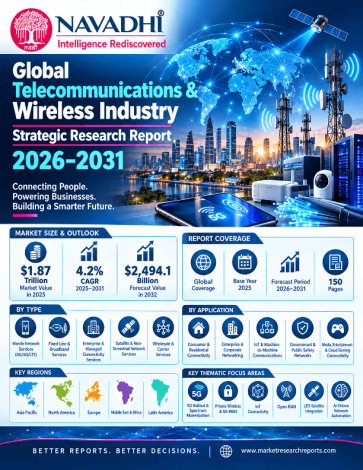
The global telecommunications and wireless market is valued at approximately USD 1.87 trillion in 2025 and is projected to grow at a 4.2% CAGR through 2031, reaching an estimated USD 2.39 trillion. This mother report spans the full value chain, from mobile network services through satellite and non-terrestrial networks, across five major end-use applications, and profiles 21 companies across 17 countries in five global regions.

Real, Current Competitive Intelligence

AT&T completed a real USD 23 billion acquisition of wireless spectrum licenses from EchoStar (announced August 26, 2025; FCC-approved May 12, 2026; closed July 28, 2026) -- one of the largest spectrum transactions in the industry's recent history. This is part of a genuine, current, global wave of consolidation: Verizon completed a real acquisition of Frontier Communications' fiber assets; Orange acquired exclusive control of MasOrange, reshaping the Spanish market; MTN Group posted a real, dramatic swing from a 2024 net loss to a 2025 net profit; Telefónica divested its Argentina subsidiary to Telecom Argentina; and Telecom Italia sold its network infrastructure business to KKR for approximately EUR 18.8 billion. This is real, current evidence of active, well-capitalized restructuring across multiple major markets simultaneously, not an isolated development.

Scope of the Global Telecommunications & Wireless Industry Strategic Research Report

This mother report provides market sizing (value) across service type and end-use application segments, and regional/country splits, through 2031, grounded in real, current competitive intelligence spanning 21 profiled operators across every major producing region.

Segment by Type

  • Mobile Network Services (4G/5G/LTE)
  • Fixed-Line & Broadband Services
  • Enterprise & Managed Connectivity Services
  • Satellite & Non-Terrestrial Network Services
  • Wholesale & Carrier Services

Segment by Application

  • Consumer & Residential Connectivity
  • Enterprise & Corporate Networking
  • IoT & Machine-to-Machine Communications
  • Government & Public Safety Networks
  • Media, Entertainment & Cloud Gaming Connectivity

Who Can Use This Report?

This mother report is ideal for people who need a broad, foundational view of the global telecommunications and wireless industry grounded in real, current company-level developments. Some of the intended users are:

  • Corporate strategy teams evaluating network investment and spectrum acquisition decisions
  • Investment analysts modeling operator free cash flow and spectrum portfolio value amid real, current consolidation activity
  • M&A advisors assessing further consolidation opportunities across multiple concurrently-active markets
  • Procurement managers benchmarking equipment and managed-service sourcing strategies across a globally diverse operator base
  1. Executive Summary
    1. 1.1 Market Synopsis
    2. 1.2 Key Findings
    3. 1.3 Methodology Transparency Note — Real 2025–2026 Consolidati…
  2. Industry Overview & Forecast
    1. 2.1 Market Definition & Scope
    2. 2.2 Market Value Forecast, 2026–2031
    3. 2.2.1 Regional Forecast Trajectories
    4. 2.3 Historical Market Review, 2022–2025
    5. 2.4 Scenario Analysis
    6. 2.5 Structural Context
  3. Market Segmentation by Type
    1. 3.1 Market by Type Overview
    2. 3.2 Mobile Network Services (4G/5G/LTE)
    3. 3.3 Fixed-Line & Broadband Services
    4. 3.4 Enterprise & Managed Connectivity Services
    5. 3.5 Satellite & Non-Terrestrial Network Services
    6. 3.6 Wholesale & Carrier Services
    7. 3.7 Synthesised Type Segmentation Outlook
  4. Market Segmentation by Application
    1. 4.1 Market by Application Overview
    2. 4.2 Consumer & Residential Connectivity
    3. 4.3 Enterprise & Corporate Networking
    4. 4.4 IoT & Machine-to-Machine Communications
    5. 4.5 Government & Public Safety Networks
    6. 4.6 Media, Entertainment & Cloud Gaming Connectivity
    7. 4.7 Cross-Segment Analysis and Forecast Synthesis
  5. Regional Market Forecast
    1. 5.1 Asia Pacific
    2. 5.1.1 Regional Overview
    3. 5.1.2 Key Growth Drivers
    4. 5.1.3 Regulatory & Infrastructure Landscape
    5. 5.1.4 Country-Level Analysis
    6. 5.1.5 Market Forecast 2025–2031
    7. 5.2 North America
    8. 5.2.1 Regional Overview
    9. 5.2.2 Key Growth Drivers
    10. 5.2.3 Regulatory & Infrastructure Landscape
    11. 5.2.4 Country-Level Analysis
    12. 5.2.5 Market Forecast 2025–2031
    13. 5.3 Europe
    14. 5.3.1 Regional Overview
    15. 5.3.2 Key Growth Drivers
    16. 5.3.3 Regulatory & Infrastructure Landscape
    17. 5.3.4 Country-Level Analysis
    18. 5.3.5 Market Forecast 2025–2031
    19. 5.4 Latin America
    20. 5.4.1 Regional Overview
    21. 5.4.2 Key Growth Drivers
    22. 5.4.3 Regulatory & Infrastructure Landscape
    23. 5.4.4 Country-Level Analysis
    24. 5.4.5 Market Forecast 2025–2031
    25. 5.5 Middle East & Africa
    26. 5.5.1 Regional Overview
    27. 5.5.2 Key Growth Drivers
    28. 5.5.3 Regulatory & Infrastructure Landscape
    29. 5.5.4 Country-Level Analysis
    30. 5.5.5 Market Forecast 2025–2031
  6. Country-Level Market Forecast
    1. 6.1 Asia Pacific
    2. 6.1.1 China
    3. 6.1.2 Japan
    4. 6.1.3 India
    5. 6.1.4 South Korea
    6. 6.1.5 Australia
    7. 6.1.6 Rest of Asia-Pacific
    8. 6.2 North America
    9. 6.2.1 United States
    10. 6.2.2 Canada
    11. 6.2.3 Rest of North America
    12. 6.3 Europe
    13. 6.3.1 Germany
    14. 6.3.2 United Kingdom
    15. 6.3.3 France
    16. 6.3.4 Italy
    17. 6.3.5 Rest of Europe
    18. 6.4 Latin America
    19. 6.4.1 Brazil
    20. 6.4.2 Mexico
    21. 6.4.3 Argentina
    22. 6.4.4 Rest of Latin America
    23. 6.5 Middle East & Africa
    24. 6.5.1 Saudi Arabia
    25. 6.5.2 United Arab Emirates
    26. 6.5.3 South Africa
    27. 6.5.4 Nigeria
    28. 6.5.5 Rest of Middle East & Africa
  7. Growth Drivers & Inhibitors
    1. 7.2 Chapter Introduction
    2. 7.3 Global 5G Network Rollout & Spectrum Monetization
    3. 7.3.1 Scale and Trajectory of 5G Deployment
    4. 7.3.2 Spectrum as a Monetizable Strategic Asset
    5. 7.4 Real 2025–2026 Spectrum and Fiber Consolidation Activity
    6. 7.4.1 Fiber-Broadband Infrastructure as a Competitive Moat
    7. 7.4.2 Strategic Rationale and Competitive Implications
    8. 7.5 Enterprise Private Wireless & SD-WAN Adoption
    9. 7.5.1 Enterprise Demand-Side Dynamics
    10. 7.5.2 SD-WAN and Managed Connectivity
    11. 7.6 Market Restraints & Regulatory Approval Complexity
    12. 7.6.1 Capital Expenditure Intensity and Free Cash Flow Compression
    13. 7.6.2 Regulatory Approval Timelines
    14. 7.6.3 Legacy Service Revenue Decline
    15. 7.7 Opportunities & White-Space Analysis
    16. 7.7.1 Spectrum Portfolio Consolidation as a Replicable Model
    17. 7.7.2 Fiber-Broadband Convergence and Fixed-Mobile Integration
    18. 7.7.3 Enterprise Private Wireless White Space
    19. 7.8 Structural Challenges
    20. 7.8.1 Return-on-Investment Assessment for Large-Scale Spectrum Trans…
    21. 7.8.2 Distinguishing Structural from Promotional Subscriber Growth
    22. 7.8.3 Managing the Legacy-to-Advanced Connectivity Transition
    23. 7.9 Chapter Summary
  8. Key Company Profiles
    1. 8.1 AT&T Inc.
    2. 8.1.1 Company Overview
    3. 8.1.2 Key Products & Segments
    4. 8.1.3 Financial Performance (2023–2025)
    5. 8.1.4 Business Strategy
    6. 8.1.5 SWOT Analysis
    7. 8.1.6 Strategic Implications (2025–2031)
    8. 8.2 Verizon Communications Inc.
    9. 8.2.1 Company Overview
    10. 8.2.2 Key Products & Segments
    11. 8.2.3 Financial Performance (2023–2025)
    12. 8.2.4 Business Strategy
    13. 8.2.5 SWOT Analysis
    14. 8.2.6 Strategic Implications (2025–2031)
    15. 8.3 Deutsche Telekom AG
    16. 8.3.1 Company Overview
    17. 8.3.2 Key Products & Segments
    18. 8.3.3 Financial Performance (2023–2025)
    19. 8.3.4 Business Strategy
    20. 8.3.5 SWOT Analysis
    21. 8.3.6 Strategic Implications (2025–2031)
    22. 8.4 China Mobile Limited
    23. 8.4.1 Company Overview
    24. 8.4.2 Key Products & Segments
    25. 8.4.3 Financial Performance (2023–2025)
    26. 8.4.4 Business Strategy
    27. 8.4.5 SWOT Analysis
    28. 8.4.6 Strategic Implications (2025–2031)
    29. 8.5 Comcast Corporation
    30. 8.5.1 Company Overview
    31. 8.5.2 Key Products & Segments
    32. 8.5.3 Financial Performance (2023–2025)
    33. 8.5.4 Business Strategy
    34. 8.5.5 SWOT Analysis
    35. 8.5.6 Strategic Implications (2025–2031)
    36. 8.6 SoftBank Group Corp.
    37. 8.6.1 Company Overview
    38. 8.6.2 Key Products & Segments
    39. 8.6.3 Financial Performance (2023–2025)
    40. 8.6.4 Business Strategy
    41. 8.6.5 SWOT Analysis
    42. 8.6.6 Strategic Implications (2025–2031)
    43. 8.7 Bharti Airtel Limited
    44. 8.7.1 Company Overview
    45. 8.7.2 Key Products & Segments
    46. 8.7.3 Financial Performance (2023–2025)
    47. 8.7.4 Business Strategy
    48. 8.7.5 SWOT Analysis
    49. 8.7.6 Strategic Implications (2025–2031)
    50. 8.8 Telefónica S.A.
    51. 8.8.1 Company Overview
    52. 8.8.2 Key Products & Segments
    53. 8.8.3 Financial Performance (2023–2025)
    54. 8.8.4 Business Strategy
    55. 8.8.5 SWOT Analysis
    56. 8.8.6 Strategic Implications (2025–2031)
    57. 8.9 T-Mobile US Inc.
    58. 8.9.1 Company Overview
    59. 8.9.2 Key Products & Segments
    60. 8.9.3 Financial Performance (2023–2025)
    61. 8.9.4 Business Strategy
    62. 8.9.5 SWOT Analysis
    63. 8.9.6 Strategic Implications (2025–2031)
    64. 8.10 Vodafone Group Plc
    65. 8.10.1 Company Overview
    66. 8.10.2 Key Products & Segments
    67. 8.10.3 Financial Performance (2023–2025)
    68. 8.10.4 Business Strategy
    69. 8.10.5 SWOT Analysis
    70. 8.10.6 Strategic Implications (2025–2031)
    71. 8.11 Orange S.A.
    72. 8.11.1 Company Overview
    73. 8.11.2 Key Products & Segments
    74. 8.11.3 Financial Performance (2023–2025)
    75. 8.11.4 Business Strategy
    76. 8.11.5 SWOT Analysis
    77. 8.11.6 Strategic Implications (2025–2031)
    78. 8.12 América Móvil, S.A.B. de C.V.
    79. 8.12.1 Company Overview
    80. 8.12.2 Key Products & Segments
    81. 8.12.3 Financial Performance (2023–2025)
    82. 8.12.4 Business Strategy
    83. 8.12.5 SWOT Analysis
    84. 8.12.6 Strategic Implications (2025–2031)
    85. 8.13 MTN Group Limited
    86. 8.13.1 Company Overview
    87. 8.13.2 Key Products & Segments
    88. 8.13.3 Financial Performance (2023–2025)
    89. 8.13.4 Business Strategy
    90. 8.13.5 SWOT Analysis
    91. 8.13.6 Strategic Implications (2025–2031)
    92. 8.14 Saudi Telecom Company (stc)
    93. 8.14.1 Company Overview
    94. 8.14.2 Key Products & Segments
    95. 8.14.3 Financial Performance (2023–2025)
    96. 8.14.4 Business Strategy
    97. 8.14.5 SWOT Analysis
    98. 8.14.6 Strategic Implications (2025–2031)
    99. 8.15 Emirates Telecommunications Group Company (e&)
    100. 8.15.1 Company Overview
    101. 8.15.2 Key Products & Segments
    102. 8.15.3 Financial Performance (2023–2025)
    103. 8.15.4 Business Strategy
    104. 8.15.5 SWOT Analysis
    105. 8.15.6 Strategic Implications (2025–2031)
    106. 8.16 Nippon Telegraph and Telephone Corporation (NTT)
    107. 8.16.1 Company Overview
    108. 8.16.2 Key Products & Segments
    109. 8.16.3 Financial Performance (2023–2025)
    110. 8.16.4 Business Strategy
    111. 8.16.5 SWOT Analysis
    112. 8.16.6 Strategic Implications (2025–2031)
    113. 8.17 Telstra Group Limited
    114. 8.17.1 Company Overview
    115. 8.17.2 Key Products & Segments
    116. 8.17.3 Financial Performance (2023–2025)
    117. 8.17.4 Business Strategy
    118. 8.17.5 SWOT Analysis
    119. 8.17.6 Strategic Implications (2025–2031)
    120. 8.18 Rogers Communications Inc.
    121. 8.18.1 Company Overview
    122. 8.18.2 Key Products & Segments
    123. 8.18.3 Financial Performance (2023–2025)
    124. 8.18.4 Business Strategy
    125. 8.18.5 SWOT Analysis
    126. 8.18.6 Strategic Implications (2025–2031)
    127. 8.19 Reliance Jio Infocomm Limited
    128. 8.19.1 Company Overview
    129. 8.19.2 Key Products & Segments
    130. 8.19.3 Financial Performance (2023–2025)
    131. 8.19.4 Business Strategy
    132. 8.19.5 SWOT Analysis
    133. 8.19.6 Strategic Implications (2025–2031)
    134. 8.20 Telecom Italia S.p.A. (TIM)
    135. 8.20.1 Company Overview
    136. 8.20.2 Key Products & Segments
    137. 8.20.3 Financial Performance (2023–2025)
    138. 8.20.4 Business Strategy
    139. 8.20.5 SWOT Analysis
    140. 8.20.6 Strategic Implications (2025–2031)
    141. 8.21 Telecom Argentina S.A.
    142. 8.21.1 Company Overview
    143. 8.21.2 Key Products & Segments
    144. 8.21.3 Financial Performance (2023–2025)
    145. 8.21.4 Business Strategy
    146. 8.21.5 SWOT Analysis
    147. 8.21.6 Strategic Implications (2025–2031)
  9. Competitive Landscape
    1. 9.1 Competitive Landscape Overview
    2. 9.2 Competitive Intensity Assessment
    3. 9.2.1 Tier Structure and Revenue Positioning
    4. 9.2.2 Capacity versus Demand Dynamics
    5. 9.2.3 Pricing Environment
    6. 9.2.4 Barriers to Entry and Exit
    7. 9.3 Key Player Strategies & Positioning
    8. 9.3.1 Strategic Group Mapping: Three Distinct Competitive Tiers
    9. 9.3.2 Differentiation Strategies Across Major Players
    10. 9.3.3 Geographic Strongholds
    11. 9.3.4 M&A and Partnership Activity (2022–Present)
    12. 9.3.5 R&D and Technology Investment Trends
    13. 9.4 Competitive Dynamics & Strategic Outlook
    14. 9.4.1 Emerging Competitive Threats and Adjacent-Player Disruption
    15. 9.4.2 Consolidation vs. Fragmentation Outlook
    16. 9.4.3 Competitive Response Matrix
    17. 9.4.4 Strategic Recommendations for 2025–2031
  10. Porter's Five Forces Analysis
    1. 10.1 Threat of New Entrants
    2. 10.2 Bargaining Power of Buyers
    3. 10.3 Bargaining Power of Suppliers
    4. 10.4 Threat of Substitutes
    5. 10.5 Competitive Rivalry
  11. PESTLE Analysis
    1. 11.1 Political Factors
    2. 11.1.1 Spectrum Policy and Government Allocation Authority
    3. 11.1.2 National Security and Foreign Investment Scrutiny
    4. 11.1.3 Industrial Policy and Digital Sovereignty
    5. 11.1.4 Geopolitical Fragmentation and Supply Chain Bifurcation
    6. 11.2 Economic Factors
    7. 11.2.1 Macroeconomic Growth and Consumer Spending
    8. 11.2.2 Capital Markets Conditions and Cost of Capital
    9. 11.2.3 Currency and Inflation Dynamics
    10. 11.2.4 Enterprise Digitalisation Tailwinds
    11. 11.2.5 Investment in Emerging Market Infrastructure
    12. 11.3 Social and Demographic Factors
    13. 11.3.1 Urbanisation and the Digital Divide
    14. 11.3.2 Generational Shifts in Consumption Patterns
    15. 11.3.3 Rising Data Consumption and Mobile-First Lifestyles
    16. 11.3.4 Workforce Transformation and Future Skills
    17. 11.4 Technological Factors
    18. 11.4.1 5G Deployment Maturation and the Path to Advanced 5G
    19. 11.4.2 Open RAN and Network Architecture Transformation
    20. 11.4.3 Fibre Infrastructure and Fixed-Mobile Convergence
    21. 11.4.4 Artificial Intelligence and Autonomous Network Operations
    22. 11.4.5 Low Earth Orbit Satellite Integration
    23. 11.5 Legal and Regulatory Factors
    24. 11.5.1 Spectrum Licensing and Auction Frameworks
    25. 11.5.2 Mergers, Acquisitions, and Competition Law
    26. 11.5.3 Data Protection and Privacy Regulation
    27. 11.5.4 Cybersecurity Regulation and Network Resilience
    28. 11.5.5 Consumer Protection and Net Neutrality
    29. 11.6 Environmental Factors
    30. 11.6.1 Energy Consumption and the Carbon Footprint of Networks
    31. 11.6.2 E-Waste and the Circular Economy
    32. 11.6.3 Climate Risk and Physical Infrastructure Resilience
    33. 11.6.4 Green Network Innovation and Energy Efficiency
  12. SWOT Analysis
    1. 12.1 Introduction
    2. 12.2 Market-Level Strengths
    3. 12.2.1 Unrivalled Scale and Recurring Revenue Architecture
    4. 12.2.2 5G Infrastructure Deployment as a Multi-Year Growth Catalyst
    5. 12.2.3 Spectrum Holdings as Durable, Appreciating Strategic Assets
    6. 12.2.4 Global Operator Scale and Geographic Diversification
    7. 12.2.5 Strong Free Cash Flow Generation Supporting Capital Returns an…
    8. 12.3 Market-Level Weaknesses
    9. 12.3.1 Persistent Capital Intensity and Return-on-Investment Pressure
    10. 12.3.2 Revenue Growth Constraints in Saturated Developed Markets
    11. 12.3.3 High Debt Loads Constraining Strategic Flexibility
    12. 12.3.4 Talent Acquisition and Retention Challenges in a Technology-In…
    13. 12.3.5 Legacy Infrastructure and Network Complexity
    14. 12.4 Strategic Opportunities
    15. 12.4.1 Fixed Wireless Access as a Broadband Market Expansion Vector
    16. 12.4.2 Enterprise Digital Transformation and Private Network Demand
    17. 12.4.3 AI-Driven Network Optimisation and Operational Efficiency
    18. 12.4.4 Low Earth Orbit Satellite Integration and Non-Terrestrial Netw…
    19. 12.4.5 Emerging Market Subscriber Growth and ARPU Expansion
    20. 12.4.6 Spectrum Auction Opportunities and Network Modernisation Inves…
    21. 12.5 External Threats
    22. 12.5.1 Intensifying Price Competition and Structural ARPU Erosion
    23. 12.5.2 Hyperscale Technology Company Encroachment on the Connectivity…
    24. 12.5.3 Regulatory and Spectrum Policy Uncertainty
    25. 12.5.4 Cybersecurity Threats and Critical Infrastructure Vulnerability
    26. 12.5.5 Macroeconomic Headwinds and Currency Risk in Emerging Markets
    27. 12.5.6 Technology Disruption from Non-Traditional Connectivity Providers
    28. 12.6 Synthesis and Strategic Implications
  13. Future Trends & Outlook
    1. 13.1 Open RAN Architecture Adoption & Vendor Disaggregation
    2. 13.1.1 Current State and Momentum
    3. 13.1.2 Vendor Disaggregation Dynamics
    4. 13.1.3 Outlook Through 2031
    5. 13.2 Low Earth Orbit Satellite Integration into Terrestrial Networks
    6. 13.2.1 Market Context and Strategic Relevance
    7. 13.2.2 Integration Pathways with Terrestrial Networks
    8. 13.2.3 Competitive and Regulatory Implications
    9. 13.2.4 Outlook Through 2031
    10. 13.3 AI-Driven Network Automation & Autonomous Network Operations
    11. 13.3.1 From Operational Tool to Strategic Differentiator
    12. 13.3.2 Key Application Domains
    13. 13.3.3 Workforce and Organizational Implications
    14. 13.3.4 Outlook Through 2031
    15. 13.4 Long-Term Market Outlook (2032–2035)
    16. 13.4.1 Structural Growth Drivers Beyond the Forecast Period
    17. 13.4.2 Market Size Trajectory Post-2031
    18. 13.5 Investment & M&A Activity Outlook Post-EchoStar/Frontier
    19. 13.5.1 Precedent-Setting Transactions and Their Market Signaling Value
    20. 13.5.2 Investment Themes Likely to Dominate 2026–2031 M&A Activity
    21. 13.5.3 Capital Allocation Discipline and Shareholder Return Considera…
    22. 13.5.4 Regulatory Oversight and Transaction Risk

List of Exhibits

  • 2.1 Exhibit 2.1: Forecast of Global (in USD Bn)
  • 2.2 Exhibit 2.2: Forecast of Global Market YoY Growth Rate & CAGR Summary (in %)
  • 2.3 Exhibit 2.3: Forecast of Asia Pacific (in USD Bn)
  • 2.4 Exhibit 2.4: Forecast of North America (in USD Bn)
  • 2.5 Exhibit 2.5: Forecast of Europe (in USD Bn)
  • 2.6 Exhibit 2.6: Forecast of Latin America (in USD Bn)
  • 2.7 Exhibit 2.7: Forecast of Middle East & Africa (in USD Bn)
  • 3.8 Exhibit 3.8: Forecast of Mobile Network Services (4G/5G/LTE) (in USD Bn)
  • 3.9 Exhibit 3.9: Forecast of Fixed-Line & Broadband Services (in USD Bn)
  • 3.10 Exhibit 3.10: Forecast of Enterprise & Managed Connectivity Services (in USD Bn)
  • 3.11 Exhibit 3.11: Forecast of Satellite & Non-Terrestrial Network Services (in USD Bn)
  • 3.12 Exhibit 3.12: Forecast of Wholesale & Carrier Services (in USD Bn)
  • 4.13 Exhibit 4.13: Forecast of Consumer & Residential Connectivity (in USD Bn)
  • 4.14 Exhibit 4.14: Forecast of Enterprise & Corporate Networking (in USD Bn)
  • 4.15 Exhibit 4.15: Forecast of IoT & Machine-to-Machine Communications (in USD Bn)
  • 4.16 Exhibit 4.16: Forecast of Government & Public Safety Networks (in USD Bn)
  • 4.17 Exhibit 4.17: Forecast of Media, Entertainment & Cloud Gaming Connectivity (in USD Bn)
  • 6.18 Exhibit 6.18: Forecast of Asia Pacific (in USD Bn)
  • 6.19 Exhibit 6.19: Forecast of China (in USD Bn)
  • 6.20 Exhibit 6.20: Forecast of Japan (in USD Bn)
  • 6.21 Exhibit 6.21: Forecast of India (in USD Bn)
  • 6.22 Exhibit 6.22: Forecast of South Korea (in USD Bn)
  • 6.23 Exhibit 6.23: Forecast of Australia (in USD Bn)
  • 6.24 Exhibit 6.24: Forecast of Rest of Asia-Pacific (in USD Bn)
  • 6.25 Exhibit 6.25: Forecast of North America (in USD Bn)
  • 6.26 Exhibit 6.26: Forecast of United States (in USD Bn)
  • 6.27 Exhibit 6.27: Forecast of Canada (in USD Bn)
  • 6.28 Exhibit 6.28: Forecast of Rest of North America (in USD Bn)
  • 6.29 Exhibit 6.29: Forecast of Europe (in USD Bn)
  • 6.30 Exhibit 6.30: Forecast of Germany (in USD Bn)
  • 6.31 Exhibit 6.31: Forecast of United Kingdom (in USD Bn)
  • 6.32 Exhibit 6.32: Forecast of France (in USD Bn)
  • 6.33 Exhibit 6.33: Forecast of Italy (in USD Bn)
  • 6.34 Exhibit 6.34: Forecast of Rest of Europe (in USD Bn)
  • 6.35 Exhibit 6.35: Forecast of Latin America (in USD Bn)
  • 6.36 Exhibit 6.36: Forecast of Brazil (in USD Bn)
  • 6.37 Exhibit 6.37: Forecast of Mexico (in USD Bn)
  • 6.38 Exhibit 6.38: Forecast of Argentina (in USD Bn)
  • 6.39 Exhibit 6.39: Forecast of Rest of Latin America (in USD Bn)
  • 6.40 Exhibit 6.40: Forecast of Middle East & Africa (in USD Bn)
  • 6.41 Exhibit 6.41: Forecast of Saudi Arabia (in USD Bn)
  • 6.42 Exhibit 6.42: Forecast of United Arab Emirates (in USD Bn)
  • 6.43 Exhibit 6.43: Forecast of South Africa (in USD Bn)
  • 6.44 Exhibit 6.44: Forecast of Nigeria (in USD Bn)
  • 6.45 Exhibit 6.45: Forecast of Rest of Middle East & Africa (in USD Bn)

AT&T Inc., Verizon Communications Inc., Deutsche Telekom AG, China Mobile Limited, Comcast Corporation, SoftBank Group Corp., Bharti Airtel Limited, Telefónica S.A., T-Mobile US Inc., Vodafone Group Plc, Orange S.A., América Móvil, MTN Group Limited, Saudi Telecom Company (stc), Emirates Telecommunications Group (e&), Nippona Telegraph and Telephone Corporation (NTT), Telstra Group Limited, Rogers Communications Inc., Reliancea Jio Infocomm Limited, Telecom Italia S.p.A. (TIM), Telecom Argentina S.A.

Single User License (PDF)

  • This license allows for use of a publication by one person.
  • This person may print out a single copy of the publication.
  • This person can include information given in the publication in presentations and internal reports by providing full copyright credit to the publisher.
  • This person cannot share the publication (or any information contained therein) with any other person or persons.
  • Unless a Enterprise License is purchased, a Single User License must be purchased for every person that wishes to use the publication within the same organization.
  • Customers who infringe these license terms are liable for a Enterprise license fee.


Site License (PDF)*

  • This license allows for use of a publication by all users within one corporate location, e.g. a regional office.
  • These users may print out a single copy of the publication.
  • These users can include information given in the publication in presentations and internal reports by providing full copyright credit to the publisher.
  • These users cannot share the publication (or any information contained therein) with any other person or persons outside the corporate location for which the publication is purchased.
  • Unless a Enterprise License is purchased, a Site User License must be purchased for every corporate location by an organization that wishes to use the publication within the same organization.
  • Customers who infringe these license terms are liable for a Enterprise license fee.


Enterprise License (PDF)*

  • This license allows for use of a publication by unlimited users within the purchasing organization e.g. all employees of a single company.
  • Each of these people may use the publication on any computer, and may print out the report, but may not share the publication (or any information contained therein) with any other person or persons outside of the organization.
  • These employees of purchasing organization can include information given in the publication in presentations and internal reports by providing full copyright credit to the publisher.

*If Applicable.

About Us

NAVADHI is a market research company that helps global firms differentiate themselves, break market entry barriers, track their investments, develop business strategies and plan for future by providing actionable market research intelligence that helps them succeed.

Infomation

  • About Us
  • Publications
  • FAQs
  • Privacy Policy
  • Terms & Conditions
  • Careers
  • Press Releases
  • Contact

Source URL:https://www.navadhi.com/publications/global-telecommunications-wireless-industry-strategic-research-report-2026-2031

Links
[1] https://www.navadhi.com/countries/global