
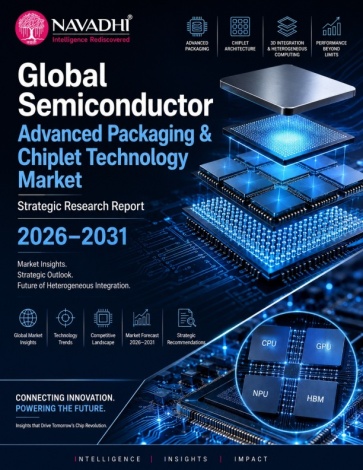

The global semiconductor advanced packaging and chiplet technology market is undergoing its most consequential structural transformation since the late 1990s shift from wire-bond to flip-chip interconnect architectures. Advanced packaging has elevated from a traditional cost-optimization discipline to the primary vector of semiconductor performance scaling. This profound shift is propelled by three irreversible forces: the deceleration of classical Moore’s Law transistor scaling below the 5-nanometer node boundary, the exponential compute intensity requirements of artificial intelligence (AI) workloads, and the economic imperative of heterogeneous die integration.
This structural transformation is driving unprecedented expansion. Anchored to a 2025 base market estimate of USD 29.6 billion, the global advanced packaging market is projected to reach USD 93.8 billion by 2031. This trajectory represents a compound annual growth rate (CAGR) of 21.2% over the six-year forecast horizon, delivering an absolute value expansion of USD 64.2 billion. This historic tripling within a single forecast window mirrors the magnitude of the global semiconductor equipment market in the mid-2010s, building upon a three-year market ascent from USD 16.8 billion in 2022 to USD 29.6 billion in 2025 (a 20.9% historical CAGR).
This growth reflects a fundamental reweighting of value capture across the semiconductor lifecycle, shifting from silicon fabrication toward integration and packaging architecture. Advanced packaging revenue constituted roughly 5.5–6.0% of total global semiconductor revenue in 2020, grew to an estimated 8.4% share in 2025 (out of a total semiconductor revenue base of approximately USD 630–650 billion), and is projected to capture 14–16% of total semiconductor revenue by 2031.The
The disaggregation of a monolithic System-on-Chip (SoC) into smaller, specialized dies integrated via advanced packaging—known as chiplet architecture—has transitioned from a niche design technique to a mainstream competitive strategy for leading fabless firms and integrated device manufacturers (IDMs). The architecture yields compelling strategic benefits: smaller dies achieve higher manufacturing yield rates than large monolithic layouts, distinct functional blocks can be fabricated at their optimal individual process nodes (such as analog at 28nm and digital at 3nm), and multi-vendor differentiated chiplets can be successfully combined into a single package.
AMD: Demonstrating the commercial weight of this design paradigm, AMD CEO Dr. Lisa Su declared chiplet architecture as the company's "defining competitive advantage." This positioning is validated by AMD's FY2024 10-K financial performance, showcasing market share capture in AI accelerators through its MI300X chiplet architecture, competing directly against NVIDIA's monolithic-adjacent, interposer-dependent approach.
Intel: Intel’s FY2024 10-K documents structural progress in its Foveros Direct technology, which utilizes copper-to-copper hybrid bonding at a 3μm pitch. This enables interconnect densities exceeding 1,000 I/Os per mm², representing a 10- to 100-fold improvement over conventional microbump interconnects. This advance allows the stacking of active logic dies on active logic dies, building the foundational architecture for next-generation "3D SoCs."
Technological demand is reordering the market's segment hierarchy. Flip-Chip Ball Grid Array (FC-BGA) and advanced substrates retain the highest revenue share in 2025 at 19.0% (USD 5.6 billion) due to their ubiquitous deployment in server CPU and GPU packaging. However, Chip-on-Wafer-on-Substrate (CoWoS) class 2.5D interposer packaging is projected to surpass FC-BGA to become the largest technology segment by revenue around 2028–2029. Driven by AI accelerator demand expanding at a 22%+ CAGR, CoWoS is forecast to reach a 20.0% market share (USD 18.8 billion) by 2031.
Geographically, the Asia-Pacific region dominates the marketplace, holding an estimated 62.0% revenue share in 2025. This dominance stems from a massive concentration of advanced packaging capacity in Taiwan (via TSMC's CoWoS and InFO platforms alongside ASE operations), South Korea (Samsung, SK Hynix), China (JCET, Tongfu, Tianshui Huatian), and Japan (Shinko Electric, Ibiden). Taiwan alone accounts for an estimated 28–32% of global advanced packaging capacity.
The market exhibits a moderately concentrated competitive structure. The top six industry vendors—TSMC, ASE Technology, Amkor Technology, Intel (IFS), Samsung Electronics, and SK Hynix—collectively accounted for an estimated 79–83% of total global advanced packaging revenue in 2024. The remainder of the market is captured by operators such as JCET Group, Tongfu Microelectronics, Shinko Electric, Ibiden, Unimicron, AT&S, and specialized packaging providers.
Despite historic growth indicators, the sector remains highly sensitive to Hyperscaler AI infrastructure capital expenditure, which serves as the primary demand engine for CoWoS and High Bandwidth Memory (HBM) packaging. Any future moderation in AI model scaling ambitions, disappointing returns on investment, or macroeconomic constraints on corporate capex could compress near-term growth. In a designated bear-case scenario where AI packaging growth slows to a 24% CAGR (compared to the 32.4% baseline projection), the total advanced packaging market size is modeled to reach a compressed, yet resilient, USD 78 billion by 2031.
Asia-Pacific
North America
Europe
Middle East & Africa
Latin America
List of Exhibits
*If Applicable.

NAVADHI is a market research company that helps global firms differentiate themselves, break market entry barriers, track their investments, develop business strategies and plan for future by providing actionable market research intelligence that helps them succeed.