


The Global Robot Hands & Dexterous Grippers market represents one of the fastest-evolving intersections of industrial automation, artificial intelligence, and humanoid robotics. This report covers the full spectrum of robotic end-effectors designed for grasping and manipulation - from industrial pneumatic grippers to multi-fingered dexterous humanoid hands - across all major global markets for the forecast period 2026–2031, with 2025 as the base year. The Global Robot Hands & Dexterous Grippers market represents one of the fastest-evolving intersections of industrial automation, artificial intelligence, and humanoid robotics. This report covers the full spectrum of robotic end-effectors designed for grasping and manipulation - from industrial pneumatic grippers to multi-fingered dexterous humanoid hands - across all major global markets for the forecast period 2026–2031, with 2025 as the base year
As per this report, the global robot hands / dexterous grippers market encompassing industrial grippers, adaptive grippers, dexterous multi-finger hands, and soft gripper systems which was worth USD 2820 million in 2025 is expected to grow at a CAGR of 23.41% between 2026 and 2031. The global robot hands / dexterous grippers market is expected to be worth USD 9610 million by 2031.
Industrial Grippers is the largest segment in global robot hands / dexterous grippers market at 67.62% share and is expected to grow at a 11.79% CAGR during 2026-2031, consistent with the global industrial robot installation growth rate disclosed by the International Federation of Robotics (IFR).
Dexterous / Multi-Finger is expected to record highest CAGR growth of 43.75% during the 2026-2031 period due to increasing humanoid robot deployments. AGIBOT alone shipped 5,168 humanoid units in 2025 (each requiring two dexterous hands), while INSPIRE-ROBOTS announced 10,000 standalone dexterous hand deliveries. Each new humanoid platform - AGIBOT A2, Tesla Optimus Gen 2, Fourier GR-1, Unitree G1 - requires a dedicated hand system, creating a multiplier effect on dexterous hand demand.
Soft Grippers segment is expected to grow at 26.51% CAGR during 2026-2031.
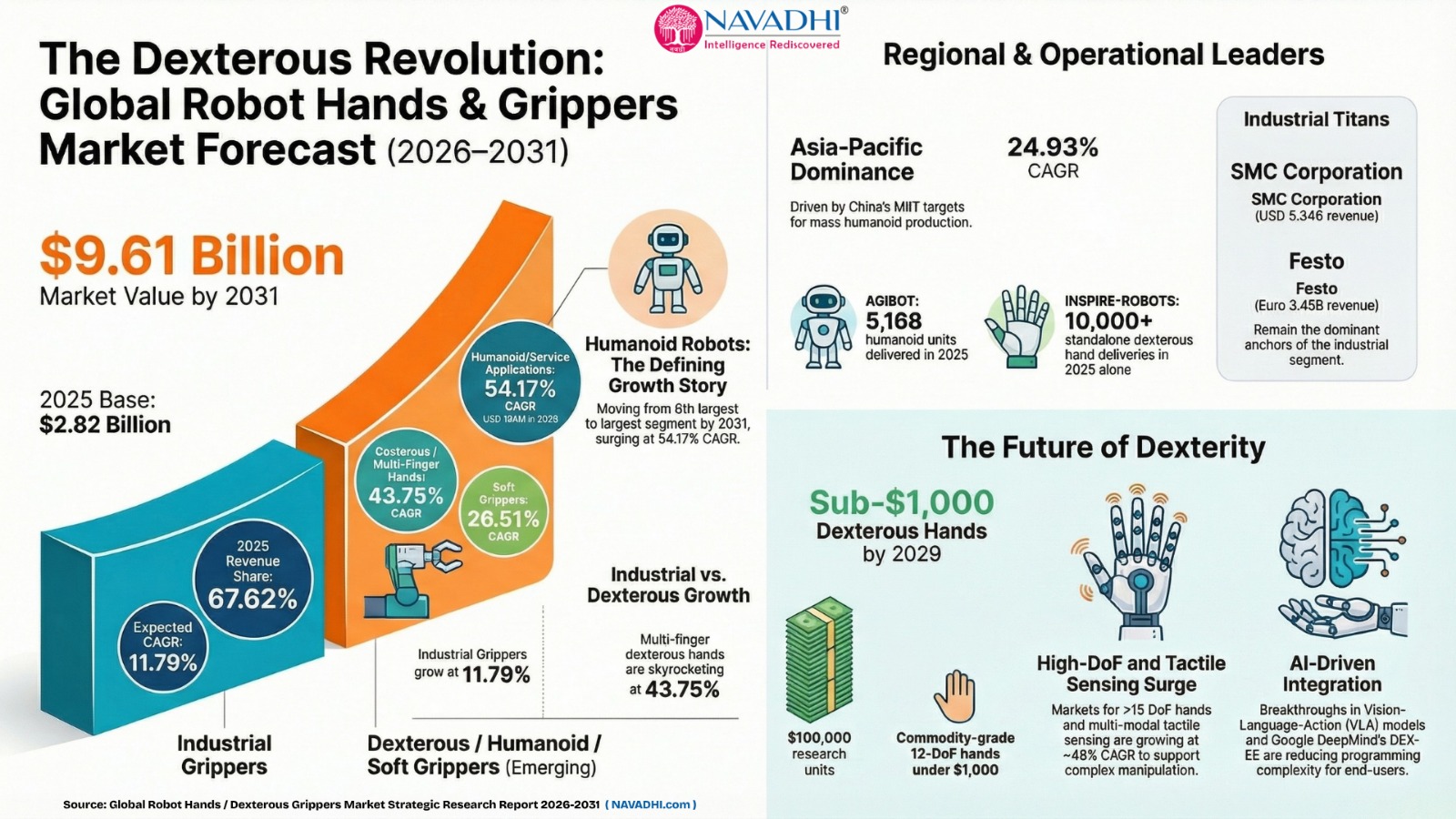
The Asia-Pacific region dominates the global robot hands / dexterous grippers landscape and maintains its leadership through the forecast period. The Asia Pacific robot hands / dexterous grippers market is expected to grow at a CAGR of 24.93% between 2026-2031 driven primarily by China's state-backed humanoid robotics program and the rapid scaling of domestic manufacturers including AGIBOT, INSPIRE-ROBOTS, Unitree, and dozens of emerging dexterous hand startups. China's Ministry of Industry and Information Technology (MIIT) has set explicit targets for mass humanoid robot production by 2025 and global leadership by 2027. Japan's service robot ecosystem - caring for an aging population where 29% are over 65 - and South Korea's semiconductor and electronics precision automation are expected to drive additional demand for robot hands / dexterous grippers.
The Middle East & Africa is the fastest-growing region due to Saudi Vision 2030 smart factories, UAE robotics hub and Israel medtech applications.
Global >15 DoF full dexterous hands market among degrees of freedom (DoF) segment expected to grow at highest CAGR of approximately 48.14% during 2026-2031 driven entirely by humanoid robot deployment.
Global Proprioceptive + Multi-modal robot hands market among tactile/sensing technology segment is expected to grow at the highest CAGR of approximately 47.64% over the next five years. This growth is fueled by the increasing market of humanoid robots which require joint torque, fingertip force, and visual sensing to operate safely and perform complex manipulation tasks.
Global electroadhesion / gecko-inspired and tendon/cable-driven robot hands market among actuation / manipulation technology segment is expected to grow at the highest CAGR of approximately 41.93% and 40.71% respectively over the next five years. This growth is fueled by the increasing demand for precision cobots and humanoid robots which require the high-DoF dexterous hands.
The Humanoid/Service Robots application segment is the defining growth story of this market - from USD 164 million (6th largest in 2025) to USD 2883 million (largest application by 2031) at 54.17% CAGR. Automotive Manufacturing remains largest application segment for global robot hands market with (34.6% market share in 2025) but declines proportionally as humanoid and logistics applications expand rapidly. Healthcare & Surgical (28.53% CAGR) and Logistics & Warehousing (23.16% CAGR) are the second and third fastest-growing applications.
Several macro forces are converging to drive this market beyond historical automation trends. China's national policy mandating mass production of humanoid robots by 2025–2027 has already catalyzed extraordinary shipment velocity: AGIBOT (Shanghai) delivered 5,168 humanoid robots in 2025 - leading all competitors globally per Omdia - while Beijing Inspire Robots (INSPIRE-ROBOTS) crossed 10,000 dexterous hand deliveries in the same year. Each humanoid robot requires two fully functional dexterous hands, creating a direct demand multiplier for this market.
On the industrial side, collaborative robot (cobot) deployments are growing at 62% year-over-year, with each cobot requiring at least one end-effector. Schunk, Festo, SMC Corporation, Zimmer Group, and Robotiq continue to anchor the industrial segment, which accounts for approximately 72% of total market revenue in 2025. Festo's 2024 annual report confirmed Euro 3.45 billion in total revenue with 8.8% invested in R&D, signaling continued innovation leadership. SMC Corporation's trailing-twelve-month revenue of USD 5.34 billion positions it as the world's dominant pneumatic component supplier, with grippers representing an estimated 3–4% of that base.
Technology differentiation is accelerating. Breakthroughs in AI-driven grasp planning (Google DeepMind's collaboration with Shadow Robot on DEX-EE), tactile sensing integration (XELA Robotics' uSkin), and vision-language-action (VLA) models are compressing the programming complexity that previously constrained adoption. The dexterous hand cost curve - from USD 100,000+ research-grade units to USD 3,000–USD 8,000 commercial products from INSPIRE - is expected to reach sub-USD 1,000 for commodity-grade 12-DoF hands by 2029, transforming this from a niche technology to a mass-market industrial component.
This research report is ideal for people who wish to gain a thorough understanding of the robot hands / dexterous grippers market. Some of intended user for this report are:
Key Companies
Emerging Companies
*If Applicable.

NAVADHI is a market research company that helps global firms differentiate themselves, break market entry barriers, track their investments, develop business strategies and plan for future by providing actionable market research intelligence that helps them succeed.