
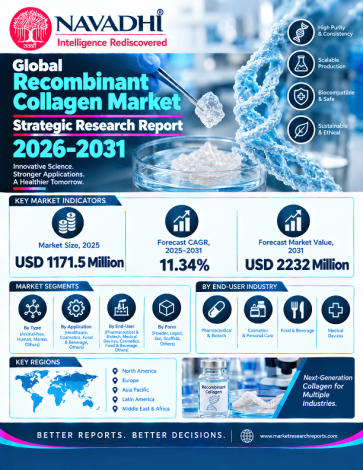

The global recombinant collagen market is valued at approximately US$1,171.5 million (US$1.17 billion) in 2025 and is forecast to reach approximately US$2,232 million (US$2.23 billion) by 2031, a compound annual growth rate (CAGR) of 11.3% over 2025–2031. Recombinant collagen – human or humanized collagen produced by microbial or plant-based expression rather than extracted from animal tissue - is moving from a niche biomaterial into mainstream medical aesthetics, functional skincare and biomedical applications.
The report covers value for every segment, region and country from 2022 to 2031, with 2025 as the base year. Asia Pacific, led by China, accounts for the large majority of 2025 revenue, while North America, Europe, Latin America and Middle East & Africa are small but fast-growing from a low base. Medical aesthetics is the fastest-growing application at about 17% a year, and nine leading developers and manufacturers are profiled.
Scope of the Global Recombinant Collagen Market Strategic Research Report
This report provides market sizing in value (US$ million) across collagen-type and application segments and regional and country splits, from 2022 to 2031. It also includes growth drivers and inhibitors, regulatory landscape, competitive landscape, company profiles with SWOT analysis, Porter's Five Forces, PESTLE and SWOT analysis, and future trends.
Segment by Type
Segment by Application
Who Can Use This Report?
| 1. Executive Summary 1.1.1 Market Definition and Measured Scope 1.1.2 Headline Market Size and Growth Trajectory 1.1.3 The Three to Four Strongest Growth Drivers with Quantification 1.1.4 Segment Highlights 1.1.5 Regional and Country Highlights 1.1.6 Competitive Structure and Key Strategic Developments 1.1.7 Principal Risks 1.1.8 Closing Outlook 2. Industry Overview & Forecast 2.1 Market Definition and Scope 2.1.1 Market Size and Historical Performance 2.1.2 Forecast and Growth Logic 2.1.3 Volume Analysis 2.1.4 Value Chain and Pricing Dynamics 3. Market Segmentation by Type 3.1 Structural Overview and Confidence Framework 3.1.1 Recombinant Type III Collagen 3.1.2 Recombinant Type I Collagen 3.1.3 Recombinant Type XVII Collagen 3.1.4 Other Collagen Types (Types IV, VI and Engineered Fragments) 3.2 Comparative Analysis and Mix Shift Outlook 4. Market Segmentation by Application 4.1 Structural Overview and Segment Architecture 4.1.1 Medical Aesthetics 4.1.2 Functional Skincare Products 4.1.3 Others (Medical Dressings, Biomaterials, Functional Foods and Wound Care) 4.1.4 Comparative Assessment Across Application Segments 5. Regional Market Forecast North America Asia Pacific Europe Latin America MEA 6. Country-Level Market Forecast 6.1 North America 6.1.1 United States 6.1.2 Canada 6.1.3 Mexico 6.2 Asia Pacific 6.2.1 China 6.2.2 Japan 6.2.3 South Korea 6.2.4 Southeast Asia 6.2.5 India 6.2.6 Australia 6.2.7 Rest of Asia Pacific 6.3 Europe 6.3.1 Germany 6.3.2 France 6.3.3 United Kingdom 6.3.4 Italy 6.3.5 Russia 6.3.6 Rest of Europe 6.4 Latin America 6.4.1 Brazil 6.4.2 Rest of Latin America 6.5 Middle East & Africa 6.5.1 Egypt 6.5.2 South Africa 6.5.3 Israel 6.5.4 Turkey 6.5.5 GCC Countries 6.5.6 Rest of MEA 7. Growth Drivers & Inhibitors 7.1 Executive Summary of Market Dynamics 7.2 Growth Drivers 7.2.1 Accelerating Regulatory Approvals Expanding the High-Value Medical Device Segment 7.2.2 Animal-Free Origin and Sequence Precision Meeting Evolving Consumer and Regulatory Preferences 7.2.3 Unprecedented Manufacturing Scale-Up Driving Cost Reduction and Supply Security 7.2.4 Government Biohealth Investment Catalysing Technology Development and Clinical Validation 7.2.5 Ex-China Regulatory Filings Establishing International Commercial Footholds 7.2.6 AbbVie-CollPlant Clinical Programme Creating a Western Approval Pathway 7.3 Market Inhibitors 7.3.1 Structural Price Compression Limiting Value Growth 7.3.2 Deceleration of Chinese Functional Skincare Growth Compressing the Core Revenue Segment 7.3.3 Regulatory Complexity, Classification Ambiguity, and Approval Timeline Risk 7.3.4 Limited Long-Term Clinical Evidence Relative to Established Aesthetic Medicine Comparators 7.3.5 Concentrated Supplier and Customer Base Creating Revenue Concentration Risk 7.4 Integrated Impact Assessment 8. Key Company Profiles 8.1 Giant Biogene Holding Co., Ltd. 8.1.1 Company Overview 8.1.2 Key Products & Segments 8.1.3 Financial Performance (2023–2025) 8.1.4 Business Strategy 8.1.5 SWOT Analysis 8.1.6 Strategic Implications (2025–2031) 8.2 Shanxi Jinbo Bio-Pharmaceutical Co., Ltd. 8.2.1 Company Overview 8.2.2 Key Products & Segments 8.2.3 Financial Performance (2023–2025) 8.2.4 Business Strategy 8.2.5 SWOT Analysis 8.2.6 Strategic Implications (2025–2031) 8.3 Bloomage Biotechnology Corporation Limited 8.3.1 Company Overview 8.3.2 Key Products & Segments 8.3.3 Financial Performance (2023–2025) 8.3.4 Business Strategy 8.3.5 SWOT Analysis 8.3.6 Strategic Implications (2025–2031) 8.4 CollPlant Biotechnologies Ltd. 8.4.1 Company Overview 8.4.2 Key Products & Segments 8.4.3 Financial Performance (2023–2025) 8.4.4 Business Strategy 8.4.5 SWOT Analysis 8.4.6 Strategic Implications (2025–2031) 8.5 Jiangsu Jland Biotech Co., Ltd. 8.5.1 Company Overview 8.5.2 Key Products & Segments 8.5.3 Financial Performance (2023–2025) 8.5.4 Business Strategy 8.5.5 SWOT Analysis 8.5.6 Strategic Implications (2025–2031) 8.6 Jiangsu Trautec Medical Technology Co., Ltd. 8.6.1 Company Overview 8.6.2 Key Products & Segments 8.6.3 Financial Performance (2023–2025) 8.6.4 Business Strategy 8.6.5 SWOT Analysis 8.6.6 Strategic Implications (2025–2031) 8.7 HTL Biotechnology SAS 8.7.1 Company Overview 8.7.2 Key Products & Segments 8.7.3 Financial Performance (2023–2025) 8.7.4 Business Strategy 8.7.5 SWOT Analysis 8.7.6 Strategic Implications (2025–2031) 8.8 Jellatech Inc. 8.8.1 Company Overview 8.8.2 Key Products & Segments 8.8.3 Financial Performance (2023–2025) 8.8.4 Business Strategy 8.8.5 SWOT Analysis 8.8.6 Strategic Implications (2025–2031) 8.9 Geltor, Inc. 8.9.1 Company Overview 8.9.2 Key Products & Segments 8.9.3 Financial Performance (2023–2025) 8.9.4 Business Strategy 8.9.5 SWOT Analysis 8.9.6 Strategic Implications (2025–2031) 9. Competitive Landscape 9.1 Competitive Landscape Overview 9.1.1 Market Structure and Concentration 9.1.2 Active Participant Count and Secondary-Tier Composition 9.1.3 Top-Five Market Share Analysis 9.1.4 Herfindahl–Hirschman Index Assessment 9.1.5 Competitive Intensity Rating 9.1.6 Outlook Through 2031 9.2 Competitive Intensity Assessment 9.2.1 Tier Structure and Revenue Ranges 9.2.2 Tier 1: Dominant Incumbents 9.2.3 Tier 2: Scale Challengers and Platform Holders 9.2.4 Tier 3: Pre-Commercial and Pipeline Players 9.2.5 Capacity vs. Demand Dynamics 9.2.6 Pricing Environment 9.2.7 Barriers to Entry and Exit 9.3 Key Player Strategies & Positioning 9.3.1 Strategic Group Architecture 9.3.2 Giant Biogene: Approval-Led Diversification from a Skincare Base 9.3.3 Jinbo Bio: Volume Defence Under Pricing Pressure 9.3.4 CollPlant and the Western Approval Bet 9.3.5 HTL Biotechnology: European Platform Consolidation 9.3.6 Jellatech, Geltor, and the Cell-Culture and Food Frontiers 9.3.7 M&A and Partnership Activity Summary (2022–Present) 9.3.8 R&D and Technology Investment Trends 9.4 Competitive Dynamics & Strategic Outlook 9.4.1 The Competitive Configuration Entering the Forecast Period 9.4.2 Emerging Competitive Threats 9.4.3 Consolidation vs. Fragmentation Outlook 9.4.4 Competitive Response Matrix 9.4.5 Strategic Recommendations for 2026–2031 10. Porter's Five Forces Analysis 10.1 Threat of New Entrants 10.2 Bargaining Power of Buyers 10.3 Bargaining Power of Suppliers 10.4 Threat of Substitutes 10.5 Competitive Rivalry 11. PESTLE Analysis 11.1 Political 11.2 Economic 11.3 Social 11.4 Technological 11.5 Legal 11.6 Environmental 11.7 PESTLE Summary 12. SWOT Analysis 12.1.1 Detailed Analysis 12.1.1.1 Strengths 12.1.1.2 Weaknesses 12.1.1.3 Opportunities 12.1.1.4 Threats 12.1.2 Strategic Implications and Priority Actions 13. Future Trends & Outlook 13.1 Overview 13.2 Trend Analysis 13.2.1 Regulatory Pipeline Expansion and Class III Device Approvals 13.2.2 Internationalisation and Ex-China Market Registration 13.2.3 Western Market Entry via the AbbVie–CollPlant Programme 13.2.4 Platform Technology Maturation 13.2.5 Combination Products and Composite Formulation Innovation 13.2.6 Premiumisation of Skincare and Device-Grade Cosmeceutical Positioning 13.2.7 Channel Concentration and Clinic Chain Pricing Power Dynamics 13.2.8 Fermentation Scale Economics and Supply Chain Localisation 13.3 Summary of Trend Assessment 13.4 Forward Outlook: 2026–2031 List of Exhibits Exhibit 2.1: Forecast of Global Market YoY Growth Rate & CAGR Summary (in %) Exhibit 2.2: Forecast of Global (in USD Mn) Exhibit 2.3: Forecast of North America (in USD Mn) Exhibit 2.4: Forecast of Asia Pacific (in USD Mn) Exhibit 2.5: Forecast of Europe (in USD Mn) Exhibit 2.6: Forecast of Latin America (in USD Mn) Exhibit 2.7: Forecast of Middle East & Africa (in USD Mn) Exhibit 3.8: Forecast of Recombinant Type III (in USD Mn) Exhibit 3.9: Forecast of Recombinant Type I (in USD Mn) Exhibit 3.10: Forecast of Recombinant Type XVII (in USD Mn) Exhibit 3.11: Forecast of Other types (in USD Mn) Exhibit 4.12: Forecast of Medical Aesthetics (in USD Mn) Exhibit 4.13: Forecast of Functional Skincare Products (in USD Mn) Exhibit 4.14: Forecast of Others (in USD Mn) Exhibit 6.15: Forecast of North America (in USD Mn) Exhibit 6.16: Forecast of United States (in USD Mn) Exhibit 6.17: Forecast of Canada (in USD Mn) Exhibit 6.18: Forecast of Mexico (in USD Mn) Exhibit 6.19: Forecast of Asia Pacific (in USD Mn) Exhibit 6.20: Forecast of China (in USD Mn) Exhibit 6.21: Forecast of Japan (in USD Mn) Exhibit 6.22: Forecast of South Korea (in USD Mn) Exhibit 6.23: Forecast of Southeast Asia (in USD Mn) Exhibit 6.24: Forecast of India (in USD Mn) Exhibit 6.25: Forecast of Australia (in USD Mn) Exhibit 6.26: Forecast of Rest of Asia Pacific (in USD Mn) Exhibit 6.27: Forecast of Europe (in USD Mn) Exhibit 6.28: Forecast of Germany (in USD Mn) Exhibit 6.29: Forecast of France (in USD Mn) Exhibit 6.30: Forecast of United Kingdom (in USD Mn) Exhibit 6.31: Forecast of Italy (in USD Mn) Exhibit 6.32: Forecast of Russia (in USD Mn) Exhibit 6.33: Forecast of Rest of Europe (in USD Mn) Exhibit 6.34: Forecast of Latin America (in USD Mn) Exhibit 6.35: Forecast of Brazil (in USD Mn) Exhibit 6.36: Forecast of Rest of Latin America (in USD Mn) Exhibit 6.37: Forecast of Middle East & Africa (in USD Mn) Exhibit 6.38: Forecast of Egypt (in USD Mn) Exhibit 6.39: Forecast of South Africa (in USD Mn) Exhibit 6.40: Forecast of Israel (in USD Mn) Exhibit 6.41: Forecast of Turkey (in USD Mn) Exhibit 6.42: Forecast of GCC Countries (in USD Mn) Exhibit 6.43: Forecast of Rest of MEA (in USD Mn) |
*If Applicable.

NAVADHI is a market research company that helps global firms differentiate themselves, break market entry barriers, track their investments, develop business strategies and plan for future by providing actionable market research intelligence that helps them succeed.