

The global peptide therapy market is undergoing an unprecedented structural transformation driven by the GLP-1 revolution - the extraordinary commercial success of GLP-1 receptor agonist drugs for diabetes and obesity, representing one of the most significant pharmaceutical market growth stories of the decade.
This report covers the full spectrum of peptide therapy industry across all major global markets for the forecast period 2026–2031, with 2025 as the base year.
As per this report, the global peptide therapy market, which was worth USD 84.2 billion in 2025, is expected to grow at a CAGR of 14.74% between 2026 and 2031 thus making peptide therapeutics the fastest-growing major drug class in pharmaceutical history, on track to surpass oncology as the world's largest therapeutic market category by 2028–2030. The global peptide therapy market is expected to be worth USD 196.5 billion by 2031.
The global peptide therapy market volume, which was 20.2 billion dosage units in 2025, is expected to grow at a CAGR of 21.24% between 2026 and 20231. The global peptide therapy market volume is expected to reach 65.5 billion dosage units by 2031. The global peptide therapy volume is expected to grow substantially faster than value, indicating expansion into price-sensitive populations and geographies.
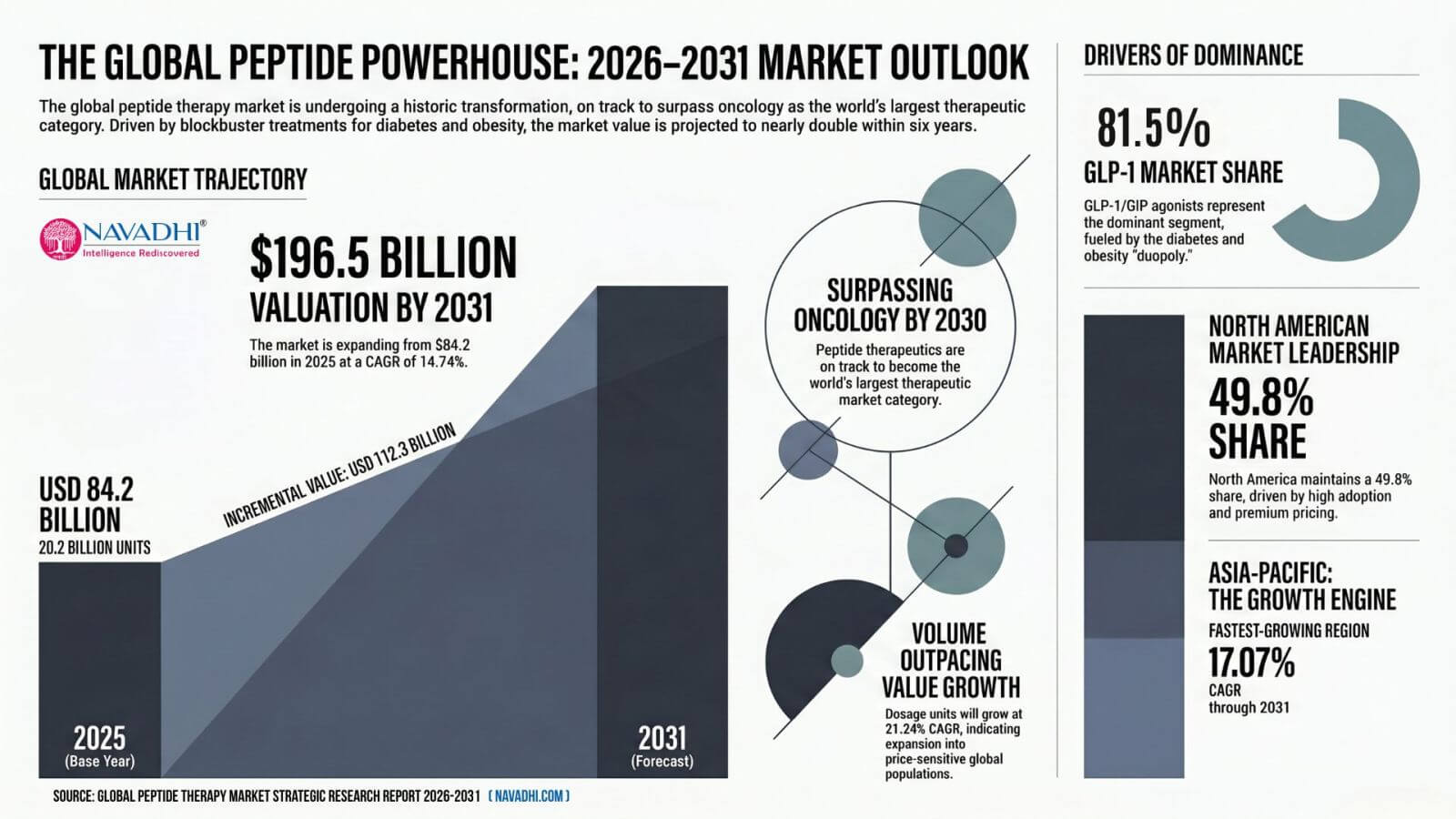
GLP-1/GIP Receptor Agonist Therapy is the largest segment type in the global peptide therapy market at estimated 81.5% market share by value in 2026 and is expected to grow at a CAGR of 15.92% by value and 23.40% by volume during 2026-2031. This segment is led by Novo Nordisk's semaglutide (Ozempic/Wegovy) and Eli Lilly's tirzepatide (Mounjaro/Zepbound) which are expected to command 57.4% of the market in 2026. This duopoly reflects the blockbuster nature of GLP-1 therapies, though pricing pressure from biosimilar and generic competition is evident in the declining average selling price.
Oncology Peptide Therapy which are estimated to have 4.1% market share by value in 2026 and is expected to grow second fastest at a CAGR of 11.79% by value and 17.98% by volume during 2026-2031.
Diabetes & Obesity is the largest application segment in the global peptide therapy market. The growth of this segment is driven by the approval of GLP-1 therapies for obesity treatment (particularly Novo Nordisk's Wegovy and Lilly's Zepbound) has unlocked an enormous new patient population, transforming semaglutide and tirzepatide from diabetes-focused drugs into blockbuster obesity treatments.
Oncology (Cancer Treatment) application segment is expected to grow at a CAGR of 8.84% by value and 15.25% by volume during 2026-2031.
North America leads with estimated 49.8% market share in 2026, driven by United States which dominates the North American market, benefiting from the highest drug pricing globally and fastest GLP-1 adoption rates. United States GLP-1 prescriptions reached $32 billion in 2024, positioning the country as the critical revenue driver for pharmaceutical manufacturers.
Asia-Pacific is the fastest growing region at a CAGR of 17.07% by value and 21.43% by volume during 2026-2031, driven by China’s 140 million diabetics and NMPA approval of Ozempic in 2021, Japan's strong adoption following PMDA approval of Ozempic (2021) and Wegovy (2023) and South Korea's accelerate GLP-1 access.
India emerges as the fastest-growing Asia Pacific sub-market (19.89% CAGR) leveraging GLP-1 biosimilar production and growing middle-class population.
Europe is the expected to have second largest market share by value at 24.4% in 2026 and grow at a CAGR of 12.59% by value and 19.52% by volume during the forecast period of 2026-2031. But Europe’s peptide therapy market is expected to decline in relative share as the United States market grows faster. Key Europe peptide therapy markets include Germany (16.5% of European market), France (13.1%), and the United Kingdom (13.4%), where NHS reimbursement decisions significantly impact adoption.
Middle East & Africa peptide therapy market is expected to show second highest growth potential (16.26% CAGR) fueled by Saudi Arabia highest global T2D prevalence (24%, International Diabetes Federation (IDF) 2024) and UAE premium market.
The global peptide therapy market is experiencing a structural inflection point driven by GLP-1/GIP agonists for diabetes and obesity. Market value will nearly double to USD 196.5 billion by 2031, representing historic pharma market expansion. However, this growth masks significant price deflation and competitive consolidation among incumbent players. Success will require sustained innovation in next-generation peptides, geographic diversification beyond North America, and proactive management of pricing pressure in mature markets. The next five years will reshape the competitive landscape in favor of companies with strong GLP-1 pipelines and emerging market capabilities.
This research report is ideal for people who wish to gain a thorough understanding of the peptide therapy market. Some of intended user for this report are:
*If Applicable.

NAVADHI is a market research company that helps global firms differentiate themselves, break market entry barriers, track their investments, develop business strategies and plan for future by providing actionable market research intelligence that helps them succeed.