

The Global Peptide Market Strategic Intelligence Suite 2026–2031 is Navadhi Market Research's most comprehensive intelligence offering on the global peptide industry. This suite bundles three full-length strategic research reports — covering the entire peptide value chain from raw ingredient manufacturing through finished therapeutic drugs to cosmetic active ingredients — together with an exclusive Executive Presentation, a cross-market Summary Document, and an interactive Infographic. Each report in the suite is individually priced at USD 3,500; the suite provides all three reports plus the three bonus deliverables in a single integrated package.
The global peptide industry spans three distinct but interconnected markets that collectively represent one of the most strategically significant growth opportunities in the pharmaceutical and personal care sectors:
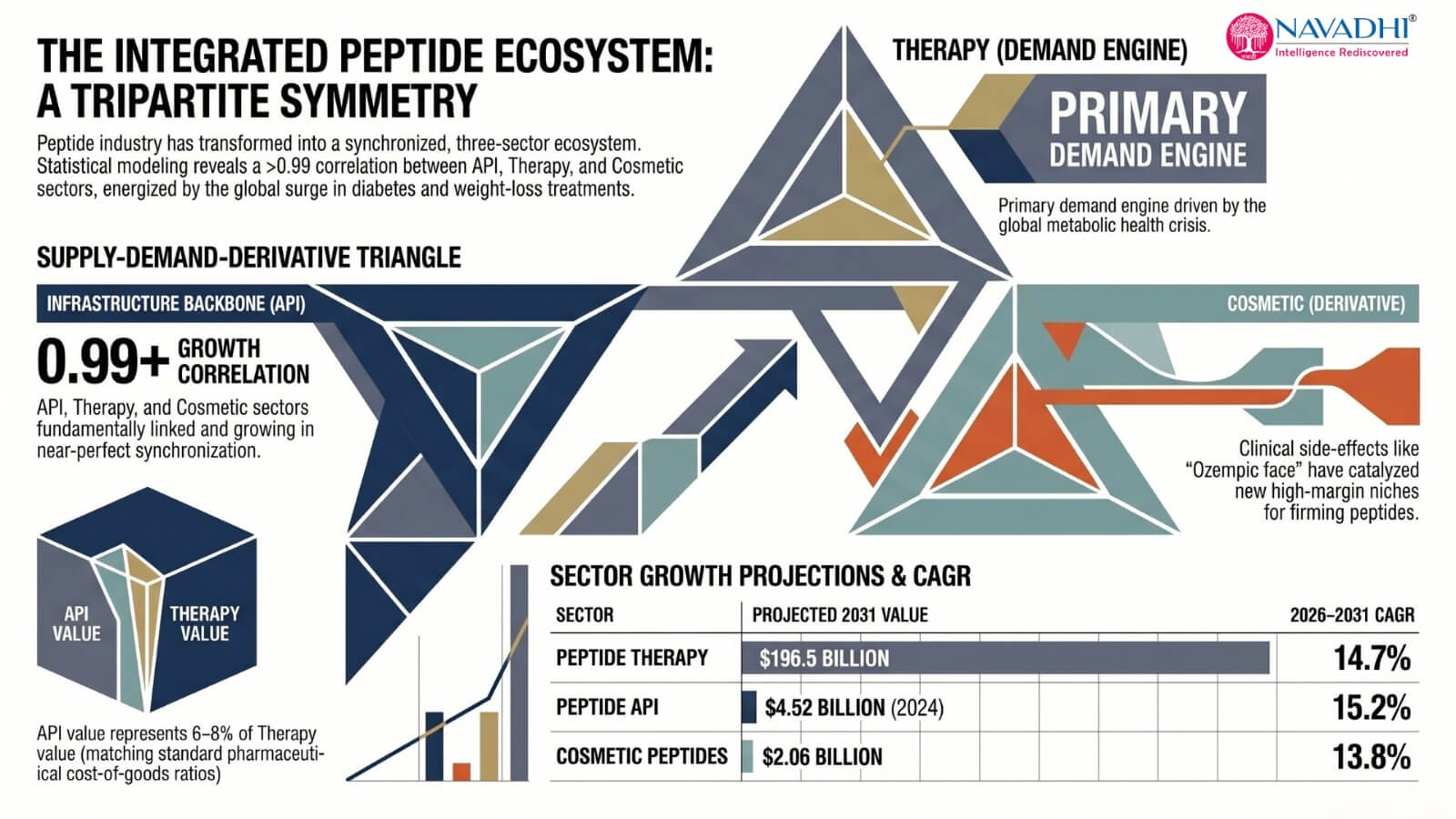
The Global Peptide Therapy Market [2] — covering the full spectrum of commercial peptide therapeutics — was worth USD 84.2 billion in 2025 and is expected to grow at a CAGR of 14.74% to reach USD 196.5 billion by 2031, making peptide therapeutics the fastest-growing major drug class in pharmaceutical history and on track to surpass oncology as the world's largest therapeutic market category by 2028–2030. Market volume is expected to grow even faster at a CAGR of 21.24%, reaching 65.5 billion dosage units by 2031. This extraordinary growth is driven primarily by the GLP-1 revolution — the commercial success of GLP-1 receptor agonist drugs for diabetes and obesity, led by Novo Nordisk's semaglutide (Ozempic/Wegovy) and Eli Lilly's tirzepatide (Mounjaro/Zepbound), which together command an estimated 57.4% of the market in 2026. The GLP-1/GIP Receptor Agonist Therapy segment alone represents 81.5% of peptide therapy market value in 2026 and is growing at a CAGR of 15.92% by value and 23.40% by volume through 2031. Beyond GLP-1, oncology peptide therapy (4.1% share, 11.79% CAGR), LHRH analogs, somatostatin analogs, and hormonal peptide therapies provide significant revenue diversification across ten profiled companies including Novo Nordisk A/S, Eli Lilly and Company, Novartis AG, Ipsen SA, AbbVie Inc., Teva Pharmaceutical Industries, AstraZeneca plc, Ferring Pharmaceuticals, Pfizer Inc., and Amgen Inc.
The Global Peptide API Market [3] — covering the active pharmaceutical ingredient supply chain that underpins all peptide drug manufacturing — was worth USD 5.15 billion in 2025 and is expected to grow at a CAGR of 15.24% to reach USD 12.05 billion by 2031. Market volume is expected to grow at a CAGR of 21.72%, from 265 metric tonnes in 2025 to 855 metric tonnes by 2031 — volume growth outpacing value growth reflecting the combination of increased production scale and declining average selling prices as manufacturing matures. The GLP-1 Receptor Agonist API segment — encompassing semaglutide, liraglutide, and tirzepatide API — is the largest segment at 33.9% market share by value in 2026, growing at an extraordinary CAGR of 22.65% by value and 32.27% by volume through 2031, with nearly half of all global peptide API market revenue expected to derive from GLP-1 products alone by 2031. Asia-Pacific leads with an estimated 38% value market share in 2026 and the highest volume CAGR of 23.19%, driven by China's WuXi STA, GL Biochem, and Hybio Pharmaceutical; India is the fastest-growing Asia-Pacific sub-market at 17.97% CAGR. Switzerland maintains its position as the global peptide manufacturing powerhouse at 33.2% of European market value in 2026, anchored by Bachem (46.2% gross margin) and PolyPeptide Group. Eleven companies are profiled including Bachem, PolyPeptide Group, CordenPharma International, WuXi STA (WuXi AppTec Peptide), Hybio Pharmaceutical, AmbioPharm Inc., ScinoPharm Taiwan, Almac Group, Piramal Pharma Solutions, CPC Scientific Inc., and GL Biochem (Shanghai) Ltd.
The Global Cosmetic Peptides Market [4] — covering peptide active ingredients supplied to cosmetics and personal care formulators — was worth USD 950 million in 2025 and is expected to grow at a CAGR of 13.84% to reach USD 2,065 million by 2031. Market volume is expected to grow at a CAGR of 13.49%, from 248 metric tonnes in 2025 to 531 metric tonnes by 2031, indicating peptides are transitioning from niche, ultra-premium ingredients to mainstream formulation components. Signal Peptides (Matrixyl, Palmitoyl) represent the largest segment at 27.2% market share by value in 2026 (CAGR 12.29%), while Bioidentical Peptides & Mimetics are the fastest growing at a CAGR of 18.46% by value and 17.95% by volume. Anti-Aging & Wrinkle Reduction is the dominant application at 42.4% market share by value in 2026 (CAGR 14.64%), while Hair Growth & Scalp Care is the fastest-growing application at a CAGR of 16.69%. An unexpected and powerful structural tailwind is provided by GLP-1 anti-obesity pharmaceuticals: rapid weight loss causing facial skin laxity is creating heightened demand for collagen-stimulating, firming, and lifting peptides. Asia-Pacific leads all regions with 31.9% market share in 2026, driven by Chinese beauty (C-beauty) brands, Japan's established cosmeceutical culture, and South Korea's K-beauty innovation leadership. Middle East & Africa shows disproportionately high growth potential at 13.93% CAGR fuelled by UAE luxury beauty hubs and Saudi Arabia's Vision 2030 initiatives. Ten companies are profiled including Croda International, Lubrizol (Lipotec Active Ingredients), Clariant (Lucas Meyer Cosmetics), Evonik, Givaudan, BASF SE, Symrise AG, DSM-Firmenich, GL Biochem (Shanghai), and Spec-Chem Industry (China).
In addition to the three full-length research reports, the suite includes three exclusive deliverables prepared by Navadhi Market Research to help subscribers rapidly synthesise and communicate the intelligence across all three markets: an Executive Presentation providing a cross-market visual summary of key findings and linkages; a Summary Document highlighting how the three markets interconnect across the peptide value chain; and an Interactive Infographic providing a high-impact visual overview of the suite's key data points for use in executive briefings and stakeholder communication.
The peptide market strategic intelligence suite is designed for:
Please Note: You can purchase individual reports as well based on your data needs. Please use the links given in this page to know more about the individual reports covering Peptide API, Cosmetic Peptides and Peptide Therapy market.
Suite Introduction: The Global Peptide Value Chain 2026–2031
How the Three Reports Interconnect
Suite Bonus Deliverables: Presentation, Summary Document and Infographic
Publication ID: NAV0426005 | 161 Pages | April 22, 2026
Scope of Global Peptide Therapy Market Strategic Research Report 2026-2031 Research Methodology
11.1 Political (P) · 11.2 Economic (E) · 11.3 Social (S) · 11.4 Technological (T) · 11.5 Legal (L) · 11.6 Environmental (E)
Publication ID: NAV0426003 | 201 Pages | April 22, 2026
Scope of Global Peptide API Market Strategic Research Report 2026-2031 Research Methodology
11.1 Political (P) · 11.2 Economic (E) · 11.3 Social (S) · 11.4 Technological (T) · 11.5 Legal (L) · 11.6 Environmental (E)
Publication ID: NAV0426004 | 168 Pages | April 22, 2026
Scope of Global Cosmetic Peptides Market Strategic Research Report 2026-2031 Research Methodology
11.1 Political (P) · 11.2 Economic (E) · 11.3 Social (S) · 11.4 Technological (T) · 11.5 Legal (L) · 11.6 Environmental (E)
Executive Presentation A cross-market PowerPoint presentation synthesising the key findings, market sizes, growth rates, segment leaders, regional dynamics, and strategic linkages across all three reports into a single executive-ready deck.
Cross-Market Summary Document A structured summary document explaining how the three peptide markets interconnect across the value chain — from raw API synthesis through therapeutic drug manufacturing to cosmetic active ingredients — with a publisher's methodology note explaining how figures across the three reports relate to one another.
Interactive Infographic A high-impact visual infographic presenting the key headline data from all three markets in a format designed for executive briefings, investor presentations, and stakeholder communication.
Peptide Therapy (10): Novo Nordisk A/S · Eli Lilly and Company · Novartis AG · Ipsen SA · AbbVie Inc. · Teva Pharmaceutical Industries · AstraZeneca plc · Ferring Pharmaceuticals · Pfizer Inc. · Amgen Inc.
Peptide API (11): Bachem (Julius Bachem AG) · PolyPeptide Group · CordenPharma International · WuXi STA (WuXi AppTec Peptide) · Hybio Pharmaceutical · AmbioPharm Inc. · ScinoPharm Taiwan · Almac Group (Almac Sciences) · Piramal Pharma Solutions · CPC Scientific Inc. · GL Biochem (Shanghai) Ltd.
Cosmetic Peptides (10): Croda International · Lubrizol (Lipotec Active Ingredients) · Clariant (Lucas Meyer Cosmetics) · Evonik · Givaudan · BASF SE · Symrise AG · DSM-Firmenich · GL Biochem (Shanghai) · Spec-Chem Industry (China)
*If Applicable.

NAVADHI is a market research company that helps global firms differentiate themselves, break market entry barriers, track their investments, develop business strategies and plan for future by providing actionable market research intelligence that helps them succeed.
Links
[1] https://www.navadhi.com/countries/global
[2] https://www.navadhi.com/publications/global-peptide-therapy-market-strategic-research-report-2026-2031
[3] https://www.navadhi.com/publications/global-peptide-api-market-strategic-research-report-2026-2031
[4] https://www.navadhi.com/publications/global-cosmetic-peptides-market-strategic-research-report-2026-2031