
NAVADHI Market Research
Published on NAVADHI Market Research (https://www.navadhi.com)

Home > Global Nuclear Energy Renaissance & Small Modular Reactor (SMR) Market Strategic Research Report 2026-2031

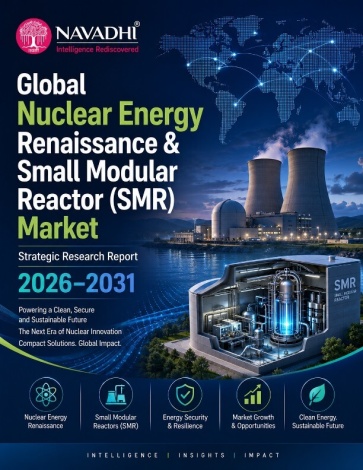
Global Nuclear Energy Renaissance & Small Modular Reactor (SMR) Market Strategic Research Report 2026-2031

Global Nuclear Energy Renaissance & Small Modular Reactor (SMR) Market Strategic Research Report 2026-2031
Publication ID: 
NAV0626001
Publication Date: 
June 04, 2026
Pages: 
279
Countries: 
Global [1]
Please choose the suitable license type from above. More details are at given under tab "Report License Types" below.

The global nuclear energy renaissance and Small Modular Reactor (SMR) market is valued at USD 120.0 billion in 2025, anchored by primary financial data from major value-chain leaders including EDF, Constellation Energy, GE Vernova, Rolls-Royce, Cameco, and BWX Technologies.

The market is projected to reach USD 206.9 billion by 2031, representing a 1.72× expansion (72.4% absolute growth). This trajectory reflects a compound annual growth rate (CAGR) of 9.5%, making it the fastest sustained growth rate recorded across all major energy infrastructure verticals in the current forecast cycle.

Key Market Drivers and Application Segments

1. The AI Data Centre Catalyst

The structural, 24/7 non-interruptible, and gigawatt-scale power demands of AI training and inference have established tech giants (Microsoft, Google, Amazon, Meta) as primary nuclear procurement drivers. Committed to securing over 10 GW of capacity through 2031, these hyperscalers view nuclear as the only viable, dispatchable, zero-carbon generation source capable of meeting their needs without economically prohibitive battery storage.

  • Growth Dynamics: The AI Data Centre & Commercial & Industrial Power application is the fastest-growing segment in the report, expanding at a 21.6% CAGR from USD 9.6 billion (8% market share) in 2025 to USD 31.0 billion (15% share) by 2031.
  • Historical Context: This constitutes the most consequential new source of nuclear procurement since the 1979 Three Mile Island accident structurally suppressed US nuclear development.

2. Baseload Power Generation & Grid Supply

Remaining the dominant application by market share, this segment is valued at USD 57.6 billion (42% share) in 2025 and is forecast to grow to USD 86.9 billion by 2031 at a 7.1% CAGR, driven by steady revenue streams from the existing global reactor fleet.

3. Industrial Process Heat & Green Hydrogen

Driven by decarbonization mandates in hard-to-abate sectors, this segment is growing at a 13.7% CAGR. Key catalysts include China's HTGR-PM-200 commercial precedent, X-energy’s high-temperature (935°C) Xe-100 reactor capabilities, and the integration of nuclear-derived hydrogen into the US DOE Clean Hydrogen Production Standard.

Technology and Construction Trends

NPP Construction & Engineering

As the largest industrial segment, Construction & Engineering commands USD 42.0 billion (35% share) in 2025, growing to USD 62.1 billion by 2031 (6.7% CAGR). While it experiences a modest market share dilution to 30% due to the rapid rise of SMRs, the segment remains robustly anchored by large-scale global projects:

  • China: Driven by an aggressive domestic buildout program.
  • Rosatom: Supported by 25+ international projects across Turkey (Akkuyu), Egypt (El Dabaa), and Bangladesh (Rooppur).
  • Westinghouse: Anchored by the AP1000 4-unit program in Poland (targeted construction starting 2033).
  • EDF: Driven by the EPR2 fleet program (6 confirmed, 8 proposed), bolstered by the Flamanville EPR grid connection in December 2024 providing a vital operational proof-of-concept.

Regional Performance: Asia-Pacific Dominance

Asia-Pacific stands as both the largest and fastest-growing regional market, set to expand from USD 50.4 billion (42% share) in 2025 to USD 95.2 billion (46% share) by 2031 at an 11.2% CAGR. Key country-level drivers include:

  • China: Expanding from USD 27.7 billion to USD 54.3 billion to remain the dominant regional market driver.
  • India: Scaling from USD 6.0 billion to USD 12.4 billion at a 12.9% CAGR, propelled by 10 new reactor approvals and a long-term target of 100 GW by 2047.
  • Japan: Rising from USD 6.0 billion to USD 9.5 billion, driven by policy shifts enabling 12+ reactor restart approvals.
  • South Korea: Increasing from USD 5.0 billion to USD 8.6 billion, accelerated by export successes such as the fully operational Barakah plant.

Strategic Competitive Landscape

The geopolitical and commercial landscape of the nuclear renaissance is defined by intense sovereign competition over technology exports. Three primary entities lead the race to secure global sovereign nuclear programs:

  • Rosatom: Leading global project volume with 25+ active overseas deployments.
  • Westinghouse: Expanding Western influence with major procurement wins across Poland, Bulgaria, and the Czech Republic.
  • CGN / CNNC: Capitalizing on international partnerships to deploy Chinese reactor technology across the UK, Argentina, and Kenya.

Scope of Global Nuclear Energy Renaissance & Small Modular Reactor (SMR) Market Report

  • This report provides forecast data by value (in USD billion) till 2031 for the global Nuclear Energy Renaissance & Small Modular Reactor (SMR) market.
  • This report provides a segment by type (Nuclear Power Plant Construction & Engineering, Small Modular Reactor (SMR) Dev. & Deployment, Nuclear Fuel Cycle (Uranium, Enrichment, Fab.), Nuclear Operations, Maintenance & Services, Nuclear Decommissioning & Waste Management, Nuclear Safety, Components & Equipment) forecast data by value (in USD billion) for the global Nuclear Energy Renaissance & Small Modular Reactor (SMR) market till 2031.
  • This report provides application segments (Baseload Power Generation & Grid Supply, AI Data Centre & High-Reliability C&I Power, Industrial Process Heat & Green Hydrogen, Naval & Defense Nuclear Applications, Grid Stability & Long-Duration Energy Storage, Nuclear Desalination & Water Production, Remote & Off-Grid Energy Supply, Research Reactors & Medical Isotope Production) forecast data by value (in USD billion) for the global Nuclear Energy Renaissance & Small Modular Reactor (SMR) market till 2031.
  • This report provides region-wise (Asia-Pacific, North America, Europe, Middle East & Africa, Latin America) forecast data by value (in USD billion) for the global Nuclear Energy Renaissance & Small Modular Reactor (SMR) market till 2031.
  • This report also provides country-wise forecast data by value (in USD billion) for China, India, South Korea, Japan, Rest APAC, USA, Canada, Rest of North America, France, Russia, UK, Rest Europe, UAE, Saudi Arabia, Egypt, South Africa, Rest MEA, Brazil, Argentina, Mexico, Rest of LatAm.
  • This report identifies key growth drivers and inhibitors (pain points) affecting the global Nuclear Energy Renaissance & Small Modular Reactor (SMR) market.
  • This report provides SWOT (Strengths, Weaknesses, Opportunities and Threats) analysis, company profile including revenue (in USD billion) and gross margin (%) for 2020-2025 along with competitive landscape for 7 key companies (EDF (Électricité de France), Constellation Energy, GE Vernova, Rolls-Royce Holdings, Cameco Corporation, BWX Technologies and NuScale Power) in the global Nuclear Energy Renaissance & Small Modular Reactor (SMR) market.
  • This report provides Porter’s Five Forces analysis for global Nuclear Energy Renaissance & Small Modular Reactor (SMR) market.
  • This report provides PESTLE (political, economic, social, technological, legal and environmental) analysis for global Nuclear Energy Renaissance & Small Modular Reactor (SMR) market.
  • This report provides SWOT (Strengths, Weaknesses, Opportunities and Threats) analysis for the global Nuclear Energy Renaissance & Small Modular Reactor (SMR) market.
  • This report identifies key future trends in the global Nuclear Energy Renaissance & Small Modular Reactor (SMR) market.

Segment by Type in the Global Nuclear Energy Renaissance & Small Modular Reactor (SMR) Market

  • Nuclear Power Plant Construction & Engineering
  • Small Modular Reactor (SMR) Dev. & Deployment
  • Nuclear Fuel Cycle (Uranium, Enrichment, Fab.)
  • Nuclear Operations, Maintenance & Services
  • Nuclear Decommissioning & Waste Management
  • Nuclear Safety, Components & Equipment

Segment by Application in the Global Nuclear Energy Renaissance & Small Modular Reactor (SMR) Market

  • Baseload Power Generation & Grid Supply
  • AI Data Centre & High-Reliability C&I Power
  • Industrial Process Heat & Green Hydrogen
  • Naval & Defense Nuclear Applications
  • Grid Stability & Long-Duration Energy Storage
  • Nuclear Desalination & Water Production
  • Remote & Off-Grid Energy Supply
  • Research Reactors & Medical Isotope Production

Segment by Region in the Global Nuclear Energy Renaissance & Small Modular Reactor (SMR) Market

  • Asia-Pacific
    • China
    • India
    • South Korea
    • Japan
    • Rest of Asia-Pacific
  • North America
    • USA
    • Canada
    • Rest of North America
  • Europe
    • France
    • Russia
    • UK
    • Rest Europe
  • Middle East & Africa
    • UAE
    • Saudi Arabia
    • Egypt
    • South Africa
    • Rest of Middle East & Africa
  • Latin America
    • Brazil
    • Argentina
    • Mexico
    • Rest of Latin America

Who can use the Global Nuclear Energy Renaissance & Small Modular Reactor (SMR) Market Research Report?

  • C-level executives and energy procurement directors at hyperscale cloud providers and AI data center operators
  • Utility directors, grid operators, and power generation executives managing national and regional electricity grids
  • Investment managers, infrastructure fund directors, and energy-focused Venture Capitalists tracking green tech assets
  • Policy analysts, energy regulatory officials, and government procurement officers managing atomic energy programs
  • Project managers, design engineers, and technical consultants specialized in civil nuclear engineering and plant development
  • Strategic sourcing and global procurement professionals at heavy industrial facilities, green hydrogen developers, and desalination plants
  • Corporate development and M&A managers at engineering, procurement, and construction (EPC) companies within the infrastructure space
  1. Executive Summary
    • 1.1 Market Headline & Scale
    • 1.1.1 Defining Inflection Events: The 2024 Nuclear Renaissance Pivot
    • 1.1.2 Four Structural Growth Catalysts Underpinning 9.5% CAGR
    • 1.1.3 Technology Segment Summary
    • 1.1.4 Application Segment Summary
    • 1.1.5 Regional Landscape
    • 1.1.6 Competitive & Strategic Landscape Overview
    • 1.1.7 Key Forecast Metrics at a Glance
  2. Industry Overview & Forecast
    • 2.1 Market Overview & Headline Sizing
    • 2.1.1 The Nuclear Renaissance Thesis: Three Defining 2024 Catalysts
    • 2.1.2 Four Structural Growth Drivers Sustaining the 9.5% CAGR
    • 2.1.3 Technology Segment Forecast
    • 2.1.4 Application Segment Forecast
    • 2.1.5 Regional Forecast
    • 2.1.6 Country-Level Forecast and Competitive Concentration
    • 2.1.7 Market Sizing Methodology and Analytical Calibration
  3. Market Segmentation by Type
    • 3.1 Technology Segment Overview
    • 3.1.1 Nuclear Power Plant Construction & Engineering
    • 3.1.2 Small Modular Reactor Development & Deployment
    • 3.1.3 Nuclear Fuel Cycle
    • 3.1.4 Nuclear Operations, Maintenance & Services
    • 3.1.5 Nuclear Decommissioning & Waste Management
    • 3.1.6 Nuclear Safety, Components & Equipment
    • 3.1.7 Comparative Segment Positioning: 2025 vs. 2031
  4. 4. Market Segmentation by Application
    • 4.1 Global Nuclear Energy Renaissance & SMR Market: Application Segment Analysis, 2025–2031
    • 4.1.1 Overview & Structural Framework
    • 4.1.2 Segment 1 — Baseload Power Generation & Grid Supply
    • 4.1.3 Segment 2 — AI Data Centre & High-Reliability Commercial & Industrial Power
    • 4.1.4 Segment 3 — Industrial Process Heat & Green Hydrogen Production
    • 4.1.5 Segment 4 — Naval & Defense Nuclear Applications
    • 4.1.6 Segment 5 — Grid Stability & Long-Duration Energy Storage
    • 4.1.7 Segment 6 — Nuclear Desalination & Water Production
    • 4.1.8 Segment 7 — Remote & Off-Grid Energy Supply
    • 4.1.9 Segment 8 — Research Reactors & Medical Isotope Production
    • 4.1.10 Application Segment Synthesis: Structural Implications for Investment & Strategic Positioning
  5. Regional Market Forecast
    • 5.1 Asia-Pacific
    • 5.1.1 Regional Overview
    • 5.1.2 Key Growth Drivers
    • 5.1.3 Regulatory & Infrastructure Landscape
    • 5.1.4 Country-Level Analysis
    • 5.1.5 Market Forecast 2025–2031
    • 5.2 Europe
    • 5.2.1 Regional Overview
    • 5.2.2 Key Growth Drivers
    • 5.2.3 Regulatory & Infrastructure Landscape
    • 5.2.4 Country-Level Analysis
    • 5.2.5 Market Forecast 2025–2031
    • 5.3 North America
    • 5.3.1 Regional Overview
    • 5.3.2 Key Growth Drivers
    • 5.3.3 Regulatory & Infrastructure Landscape
    • 5.3.4 Country-Level Analysis
    • 5.3.5 Market Forecast 2025–2031
    • 5.4 Middle East & Africa
    • 5.4.1 Regional Overview
    • 5.4.2 Key Growth Drivers
    • 5.4.3 Regulatory & Infrastructure Landscape
    • 5.4.4 Country-Level Analysis
    • 5.4.5 Market Forecast 2025–2031
    • 5.5 Latin America
    • 5.5.1 Regional Overview
    • 5.5.2 Key Growth Drivers
    • 5.5.3 Regulatory & Infrastructure Landscape
    • 5.5.4 Country-Level Analysis
    • 5.5.5 Market Forecast 2025–2031
  6. Country-Level Market Forecast
    • 6.1 Asia-Pacific
    • 6.1.1 China
    • 6.1.2 India
    • 6.1.3 South Korea
    • 6.1.4 Japan
    • 6.1.5 Rest APAC
    • 6.2 Europe
    • 6.2.1 France
    • 6.2.2 Russia
    • 6.2.3 UK
    • 6.2.4 Rest Europe
    • 6.3 North America
    • 6.3.1 USA
    • 6.3.2 Canada
    • 6.4 Middle East & Africa
    • 6.4.1 UAE
    • 6.4.2 Saudi Arabia
    • 6.4.3 Egypt
    • 6.4.4 South Africa
    • 6.4.5 Rest MEA
    • 6.5 Latin America
    • 6.5.1 Brazil
    • 6.5.2 Argentina
    • 6.5.3 Mexico
    • 6.5.4 Rest of LatAm
  7. Growth Drivers & Inhibitors
    • 7.1 Section Overview
    • 7.2 Growth Drivers
    • 7.2.1 Decarbonisation Imperative and Net-Zero Electricity Demand
    • 7.2.2 AI-Driven Hyperscale Data Centre Electricity Demand
    • 7.2.3 Energy Security and Supply Chain Resilience
    • 7.2.4 Inflation Reduction Act and Supportive Policy Architecture
    • 7.2.5 SMR Technology Maturation and Commercial Pipeline Development
    • 7.2.6 Nuclear-Enabled Industrial Decarbonisation
    • 7.3 Growth Inhibitors
    • 7.3.1 Construction Cost Escalation and Schedule Overrun Track Record
    • 7.3.2 Nuclear Financing and Capital Cost Barriers
    • 7.3.3 Regulatory Complexity and Licensing Duration
    • 7.3.4 Geopolitical Fragmentation of the Nuclear Supply Chain
    • 7.3.5 Ageing Fleet Reliability and Maintenance Complexity
    • 7.3.6 Competitive Pressure from Renewables and Storage
    • 7.3.7 Geopolitical Competition and Lost Tender Risk
    • 7.4 Driver-Inhibitor Equilibrium Assessment
  8. Key Company Profiles
    • 8.1 EDF (Électricité de France)
    • 8.1.1 Company Overview
    • 8.1.2 Key Products & Segments
    • 8.1.3 Financial Performance (2023–2025)
    • 8.1.4 Business Strategy
    • 8.1.5 SWOT Analysis
    • 8.1.6 Strategic Implications (2025–2031)
    • 8.2 Constellation Energy
    • 8.2.1 Company Overview
    • 8.2.2 Key Products & Segments
    • 8.2.3 Financial Performance (2023–2025)
    • 8.2.4 Business Strategy
    • 8.2.5 SWOT Analysis
    • 8.2.6 Strategic Implications (2025–2031)
    • 8.3 GE Vernova
    • 8.3.1 Company Overview
    • 8.3.2 Key Products & Segments
    • 8.3.3 Financial Performance (2023–2025)
    • 8.3.4 Business Strategy
    • 8.3.5 SWOT Analysis
    • 8.3.6 Strategic Implications (2025–2031)
    • 8.4 Rolls-Royce Holdings
    • 8.4.1 Company Overview
    • 8.4.2 Key Products & Segments
    • 8.4.3 Financial Performance (2023–2025)
    • 8.4.4 Business Strategy
    • 8.4.5 SWOT Analysis
    • 8.4.6 Strategic Implications (2025–2031)
    • 8.5 Cameco Corporation
    • 8.5.1 Company Overview
    • 8.5.2 Key Products & Segments
    • 8.5.3 Financial Performance (2023–2025)
    • 8.5.4 Business Strategy
    • 8.5.5 SWOT Analysis
    • 8.5.6 Strategic Implications (2025–2031)
    • 8.6 BWX Technologies
    • 8.6.1 Company Overview
    • 8.6.2 Key Products & Segments
    • 8.6.3 Financial Performance (2023–2025)
    • 8.6.4 Business Strategy
    • 8.6.5 SWOT Analysis
    • 8.6.6 Strategic Implications (2025–2031)
    • 8.7 NuScale Power
    • 8.7.1 Company Overview
    • 8.7.2 Key Products & Segments
    • 8.7.3 Financial Performance (2023–2025)
    • 8.7.4 Business Strategy
    • 8.7.5 SWOT Analysis
    • 8.7.6 Strategic Implications (2025–2031)
  9. Competitive Landscape
    • 9.1 Competitive Landscape Overview
    • 9.1.1 Market Concentration and HHI Assessment
    • 9.1.2 Top 5 Player Market Share Estimate — 2025E
    • 9.1.3 Structural Dynamics Driving Competitive Intensity
    • 9.1.4 Overall Competitive Intensity Rating
    • 9.2 Competitive Intensity Assessment
    • 9.2.1 Tier Classification Framework
    • 9.2.2 Tier 1: State-Backed National Champions (Revenue Range USD 7B–USD 30B+)
    • 9.2.3 Tier 2: Diversified Industrials with Nuclear Divisions (Revenue Range USD 1.5B–USD 23.8B)
    • 9.2.4 Tier 3: Pure-Play SMR Developers & Specialist Suppliers (Revenue Range USD 60M–USD 2.6B)
    • 9.2.5 Pricing Environment: Premium, Value, and Emerging Commoditisation
    • 9.2.6 Barriers to Entry and Exit
    • 9.3 Key Player Strategies & Positioning
    • 9.3.1 Strategic Group Architecture
    • 9.3.2 Differentiation Strategies by Major Player
    • 9.3.3 M&A and Partnership Activity, 2022–Present
    • 9.3.4 R&D and Technology Investment Trends
    • 9.4 Competitive Dynamics & Strategic Outlook
    • 9.4.1 Emerging Competitive Threats & New Entrant Disruption
    • 9.4.2 Consolidation vs. Fragmentation Outlook
    • 9.4.3 Competitive Response Matrix
    • 9.4.4 Strategic Recommendations for Market Participants, 2025–2031
  10.  Porter's Five Forces Analysis
    • 10.1 Threat of New Entrants
    • 10.2 Bargaining Power of Buyers
    • 10.2.1 Key Factors
    • 10.2.2 Market-Specific Context
    • 10.2.3 Trend
    • 10.2.4 Strategic Implication
    • 10.3 Bargaining Power of Suppliers
    • 10.4 Threat of Substitutes
    • 10.4.1 Key Factors
    • 10.4.2 Market-Specific Context
    • 10.4.3 Trend
    • 10.4.4 Strategic Implication
    • 10.5 Competitive Rivalry
    • 10.5.1 Overview
    • 10.5.2 Key Factors
    • 10.5.3 Market-Specific Context
    • 10.5.4 Trend
    • 10.5.5 Strategic Implication
  11. PESTLE Analysis
    • 11.1 Strategic Macro-Environmental Assessment | 2026–2031
    • 11.1.1 Introduction & Analytical Framework
    • 11.1.2 PESTLE Summary Matrix
    • 11.2 P — Political Factors
    • 11.2.1 National Energy Security as a Nuclear Catalyst
    • 11.2.2 US Federal Nuclear Policy: From Subsidy to Strategic Priority
    • 11.2.3 Chinese Industrial Policy as Market-Defining Force
    • 11.2.4 Geopolitical Competition in Nuclear Export Markets
    • 11.2.5 SMR Policy Support Frameworks
    • 11.3 E — Economic Factors
    • 11.3.1 Market Economics and Capital Cost Dynamics
    • 11.3.2 Uranium Fuel Economics: Structural Tightening
    • 11.3.3 Technology Company PPAs as New Economic Demand Vector
    • 11.3.4 Inflation, Supply Chain, and Labour Cost Pressures
    • 11.3.5 Financial Structures and Investment Models
    • 11.4 S — Social Factors
    • 11.4.1 Public Acceptance and the Post-Fukushima Recovery
    • 11.4.2 Climate Consciousness and the Nuclear Renaissance Social Narrative
    • 11.4.3 Community Engagement and Host Community Dynamics
    • 11.4.4 Workforce Development and Nuclear Skills Pipeline
    • 11.5 T — Technological Factors
    • 11.5.1 SMR Technology Maturation: The Defining Technological Shift
    • 11.5.2 Advanced Reactor Technology Diversity
    • 11.5.3 Digital Technology Integration: AI and Nuclear Operations
    • 11.5.4 Fuel Cycle Technology Advancement
    • 11.5.5 Micro-Reactor Technology for Remote Applications
    • 11.6 L — Legal Factors
    • 11.6.1 Nuclear Regulatory Framework Evolution
    • 11.6.2 International Nuclear Trade Law and Export Controls
    • 11.6.3 Liability, Indemnification, and the Price-Anderson Framework
    • 11.6.4 Waste Management Legal Obligations
    • 11.7 E — Environmental Factors
    • 11.7.1 Climate Policy as the Primary Environmental Driver
    • 11.7.2 Carbon Accounting and Lifecycle Analysis
    • 11.7.3 Radioactive Waste and Environmental Risk Management
    • 11.7.4 Water Use and Thermal Environmental Impact
    • 11.7.5 Land Use and Environmental Footprint
    • 11.8 PESTLE Synthesis: Cross-Factor Interaction Analysis
  12.  SWOT Analysis
    • 12.1 Global Nuclear Energy Renaissance & Small Modular Reactor (SMR) Market
    • 12.1.1 Strategic Intelligence Assessment
    • 12.1.2 Prefatory Note on Analytical Framework
    • 12.1.3 S — STRENGTHS
    • 12.1.3.1 S1. Unmatched 24/7 Carbon-Free Baseload Generation Capability
    • 12.1.3.2 S2. Mature Value Chain with Established Industrial Infrastructure
    • 12.1.3.3 S3. Proven Large-Scale Reactor Technologies with Growing Operational Evidence
    • 12.1.3.4 S4. SMR Technology Transition Reaching Commercial Inflection
    • 12.1.3.5 S5. Diversifying Application Portfolio Reduces Single-Market Dependence
    • 12.1.4 W — WEAKNESSES
    • 12.1.4.1 W1. Chronic Large-Scale Construction Cost Overruns and Schedule Delays
    • 12.1.4.2 W2. Extended Development Lead Times Create Market Timing Vulnerability
    • 12.1.4.3 W3. Uranium Supply Chain Concentration and Western Enrichment Deficit
    • 12.1.4.4 W4. Public Acceptance, Political Risk, and Social License Uncertainty
    • 12.1.4.5 W5. Nuclear Workforce and Supply Chain Attrition
    • 12.1.5 O — OPPORTUNITIES
    • 12.1.5.1 O1. AI Data Centre Nuclear PPA — A Transformational New Demand Category
    • 12.1.5.2 O2. China's Sustained Nuclear Expansion as a Global Demand and Technology Anchor
    • 12.1.5.3 O3. Energy Security Imperative Driving New Nuclear Country Commitments
    • 12.1.5.4 O4. SMR Commercial Deployment Window: 2029–2031 First Commercial Milestone
    • 12.1.5.5 O5. Nuclear Fuel Cycle Westernisation — Supply Chain Restructuring Opportunity
    • 12.1.5.6 O6. Industrial Decarbonisation and Hydrogen — Nuclear's Expanding Non-Power Market
    • 12.1.6 T — THREATS
    • 12.1.6.1 T1. Renewable Energy Cost Decline and Storage Technology Competition
    • 12.1.6.2 T2. Rosatom Geopolitical Risk and Russian Nuclear Supply Chain Disruption
    • 12.1.6.3 T3. SMR Technology Execution Risk and First-of-a-Kind Cost Uncertainty
    • 12.1.6.4 T4. Regulatory Complexity and Licensing Timeline Risk
    • 12.1.6.5 T5. Nuclear Waste Management and Public Policy Deadlock
    • 12.1.6.6 T6. Capital Market Risk and Project Finance Constraint
    • 12.1.7 SWOT Synthesis: Strategic Implications for 2026–2031
  13.  Future Trends & Outlook
    • 13.1 Section Overview & Analytical Framework
    • 13.2 Trend 1: AI Data Centre Nuclear PPAs — The Most Significant New Nuclear Demand Vector Since 1979
    • 13.2.1 Market Significance and Demand Quantification
    • 13.2.2 Forward Demand Pipeline and Market Size Implications
    • 13.2.3 Regulatory and Contractual Risk Factors
    • 13.3 Trend 2: SMR Commercial Deployment — Technology Inflection 2029–2031
    • 13.3.1 From Development to Deployment: The Commercial Threshold
    • 13.3.2 SMR Economics: Factory Manufacturing vs. Field Construction
    • 13.3.3 SMR Supply Chain Investment Requirements
    • 13.4 Trend 3: China's Nuclear Expansion Programme — Structural Market Leadership
    • 13.4.1 Programme Scale and Investment Velocity
    • 13.4.2 Implications for Global Technology Competition
    • 13.5 Trend 4: Western Nuclear Fuel Cycle Restructuring — Strategic Decoupling from Russia
    • 13.5.1 Policy Catalyst and Market Response
    • 13.5.2 Enrichment Capacity Investment Requirements
    • 13.5.3 HALEU as a Strategic Constraint
    • 13.6 Trend 5: Existing Fleet Life Extension and Operations Revenue Growth
    • 13.6.1 Fleet Longevity as a Near-Term Revenue Driver
    • 13.6.2 60-Year and 80-Year Life Extension Economics
    • 13.7 Trend 6: Industrial Decarbonisation — Process Heat and Green Hydrogen Applications
    • 13.7.1 Beyond Power Generation: The Industrial Heat Market
    • 13.7.2 Nuclear Hydrogen Economics
    • 13.8 Trend 7: Remote and Off-Grid Microreactor Deployment
    • 13.8.1 Micro-SMR Technology Maturation
    • 13.9 Trend 8: Geopolitical Realignment and the Rosatom Competitive Dynamic
    • 13.9.1 Rosatom's Persistent Market Presence vs. Western Displacement Ambition
    • 13.9.2 Chinese Export Competition
    • 13.10 Scenario Analysis: Bull, Base, and Bear Cases 2031
    • 13.10.1 Base Case: USD 206.9 Billion (9.5% CAGR) — Assigned Probability: 55%
    • 13.10.2 Bull Case: USD 235–245 Billion (~12–13% CAGR) — Assigned Probability: 25%
    • 13.10.3 Bear Case: USD 165–175 Billion (~5.5–6.5% CAGR) — Assigned Probability: 20%
    • 13.11 Critical Success Factors and Market Enablers 2026–2031
    • 13.12 Outlook Summary: 2031 Market Architecture

List of Exhibits

  • Exhibit 2.1: Forecast of Global (in USD Bn)
  • Exhibit 2.2: Forecast of Asia-Pacific (in USD Bn)
  • Exhibit 2.3: Forecast of Europe (in USD Bn)
  • Exhibit 2.4: Forecast of North America (in USD Bn)
  • Exhibit 2.5: Forecast of Middle East & Africa (in USD Bn)
  • Exhibit 2.6: Forecast of Latin America (in USD Bn)
  • Exhibit 3.7: Forecast of Nuclear Power Plant Construction & Engineering (in USD Bn)
  • Exhibit 3.8: Forecast of Small Modular Reactor (SMR) Dev. & Deployment (in USD Bn)
  • Exhibit 3.9: Forecast of Nuclear Fuel Cycle (Uranium, Enrichment, Fab.) (in USD Bn)
  • Exhibit 3.10: Forecast of Nuclear Operations, Maintenance & Services (in USD Bn)
  • Exhibit 3.11: Forecast of Nuclear Decommissioning & Waste Management (in USD Bn)
  • Exhibit 3.12: Forecast of Nuclear Safety, Components & Equipment (in USD Bn)
  • Exhibit 4.13: Forecast of Baseload Power Generation & Grid Supply (in USD Bn)
  • Exhibit 4.14: Forecast of AI Data Centre & High-Reliability C&I Power (in USD Bn)
  • Exhibit 4.15: Forecast of Industrial Process Heat & Green Hydrogen (in USD Bn)
  • Exhibit 4.16: Forecast of Naval & Defense Nuclear Applications (in USD Bn)
  • Exhibit 4.17: Forecast of Grid Stability & Long-Duration Energy Storage (in USD Bn)
  • Exhibit 4.18: Forecast of Nuclear Desalination & Water Production (in USD Bn)
  • Exhibit 4.19: Forecast of Remote & Off-Grid Energy Supply (in USD Bn)
  • Exhibit 4.20: Forecast of Research Reactors & Medical Isotope Production (in USD Bn)
  • Exhibit 5.21: Forecast of Asia-Pacific (in USD Bn)
  • Exhibit 5.22: Forecast of China (in USD Bn)
  • Exhibit 5.23: Forecast of India (in USD Bn)
  • Exhibit 5.24: Forecast of South Korea (in USD Bn)
  • Exhibit 5.25: Forecast of Japan (in USD Bn)
  • Exhibit 5.26: Forecast of Rest APAC (in USD Bn)
  • Exhibit 5.27: Forecast of Europe (in USD Bn)
  • Exhibit 5.28: Forecast of France (in USD Bn)
  • Exhibit 5.29: Forecast of Russia (in USD Bn)
  • Exhibit 5.30: Forecast of UK (in USD Bn)
  • Exhibit 5.31: Forecast of Rest Europe (in USD Bn)
  • Exhibit 5.32: Forecast of North America (in USD Bn)
  • Exhibit 5.33: Forecast of USA (in USD Bn)
  • Exhibit 5.34: Forecast of Canada (in USD Bn)
  • Exhibit 5.35: Forecast of Rest of North America (in USD Bn)
  • Exhibit 5.36: Forecast of Middle East & Africa (in USD Bn)
  • Exhibit 5.37: Forecast of UAE (in USD Bn)
  • Exhibit 5.38: Forecast of Saudi Arabia (in USD Bn)
  • Exhibit 5.39: Forecast of Egypt (in USD Bn)
  • Exhibit 5.40: Forecast of South Africa (in USD Bn)
  • Exhibit 5.41: Forecast of Rest MEA (in USD Bn)
  • Exhibit 5.42: Forecast of Latin America (in USD Bn)
  • Exhibit 5.43: Forecast of Brazil (in USD Bn)
  • Exhibit 5.44: Forecast of Argentina (in USD Bn)
  • Exhibit 5.45: Forecast of Mexico (in USD Bn)
  • Exhibit 5.46: Forecast of Rest of LatAm (in USD Bn)
  1. EDF (Électricité de France)
  2. Constellation Energy
  3. GE Vernova
  4. Rolls-Royce Holdings
  5. Cameco Corporation
  6. BWX Technologies
  7. NuScale Power

Single User License (PDF)

  • This license allows for use of a publication by one person.
  • This person may print out a single copy of the publication.
  • This person can include information given in the publication in presentations and internal reports by providing full copyright credit to the publisher.
  • This person cannot share the publication (or any information contained therein) with any other person or persons.
  • Unless a Enterprise License is purchased, a Single User License must be purchased for every person that wishes to use the publication within the same organization.
  • Customers who infringe these license terms are liable for a Enterprise license fee.


Site License (PDF)*

  • This license allows for use of a publication by all users within one corporate location, e.g. a regional office.
  • These users may print out a single copy of the publication.
  • These users can include information given in the publication in presentations and internal reports by providing full copyright credit to the publisher.
  • These users cannot share the publication (or any information contained therein) with any other person or persons outside the corporate location for which the publication is purchased.
  • Unless a Enterprise License is purchased, a Site User License must be purchased for every corporate location by an organization that wishes to use the publication within the same organization.
  • Customers who infringe these license terms are liable for a Enterprise license fee.


Enterprise License (PDF)*

  • This license allows for use of a publication by unlimited users within the purchasing organization e.g. all employees of a single company.
  • Each of these people may use the publication on any computer, and may print out the report, but may not share the publication (or any information contained therein) with any other person or persons outside of the organization.
  • These employees of purchasing organization can include information given in the publication in presentations and internal reports by providing full copyright credit to the publisher.

*If Applicable.

About Us

NAVADHI is a market research company that helps global firms differentiate themselves, break market entry barriers, track their investments, develop business strategies and plan for future by providing actionable market research intelligence that helps them succeed.

Infomation

  • About Us
  • Publications
  • FAQs
  • Privacy Policy
  • Terms & Conditions
  • Careers
  • Press Releases
  • Contact

Source URL:https://www.navadhi.com/publications/global-nuclear-energy-renaissance-small-modular-reactor-smr-market-strategic-research

Links
[1] https://www.navadhi.com/countries/global