
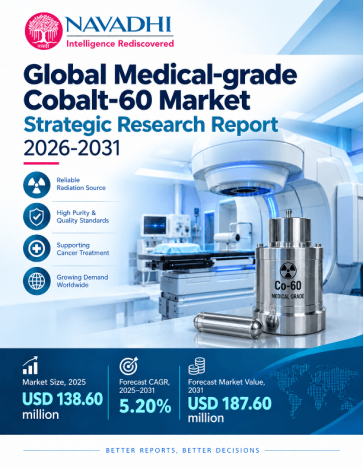

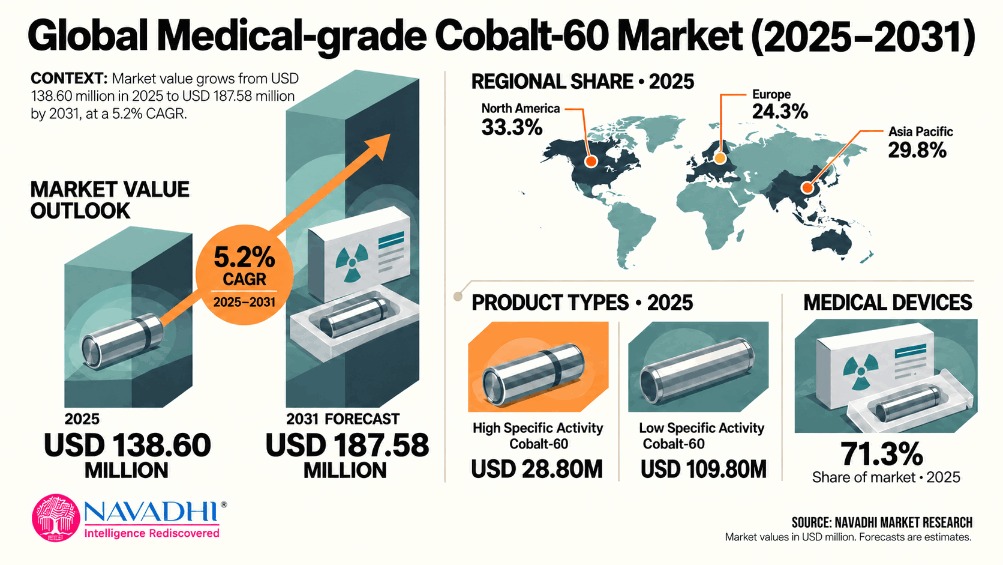
The global medical-grade cobalt-60 market is estimated at US$138.6 million in 2025 and is forecast to reach US$187.6 million by 2031, a compound annual growth rate (CAGR) of 5.2% over 2025-2031. Supply volume is estimated at 47.4 million curies (MCi) in 2025, rising to 57.6 MCi in 2031. North America is both the largest and the fastest-growing region, at US$44.4 million (32.0% share) in 2025 and a 5.4% CAGR.
Medical-grade cobalt-60 is a sealed-source radioisotope produced by neutron activation of cobalt-59 in power and research reactors. It is used for gamma sterilization of medical devices, for Gamma Knife radiosurgery sources, for cobalt teletherapy units and for high-dose-rate brachytherapy. Supply is concentrated in a small number of reactor operators and processors, and the report treats licensing, reactor availability and source replacement cycles as the main drivers of the market.
Scope of the Global Medical-grade Cobalt-60 Market Strategic Research Report
This report covers market value (US$ million) and supply volume (million curies) for 2022-2031, with 2025 as the base year and 2026-2031 as the forecast period. It analyses two source types, three applications, three source-application groups, five regions and 25 country-level markets, and profiles 11 companies. The market size is a bottom-up estimate from sourced installed-base, source-replacement and sterilization-stock data, reconciled to published company disclosures; where a figure could not be verified from a public source, the report says so.
Segment by Type
Segment by Application
Segment by Source Application
Segment by Region
Companies Profiled
Nordion (Sotera Health), China National Nuclear Corporation (CNNC), Rosatom (JSC Isotope), Eckert & Ziegler, POLATOM, NTP Radioisotopes, BEBIG Medical, Elekta, Best Theratronics, Bruce Power, Dioxitek.
Who Can Use This Report?
| 1. Executive Summary 1.1 Market Definition and Sizing 1.2 Principal Growth Drivers 1.3 Segment Highlights 1.4 Regional and Country Highlights 1.5 Competitive Structure 1.6 Principal Risks 1.7 Outlook 2. Industry Overview & Forecast 2.1 Market Definition and Scope 2.2 Market Size and Historical Performance 2.3 Forecast and Growth Logic 2.4 Volume Analysis 2.5 Value Chain and Pricing Structure 3. Market Segmentation by Type 3.1 Overview and Structural Context 3.2 High Specific Activity Cobalt-60 3.2.1 Definition and Applications 3.2.2 Market Size, Share, and Forecast 3.2.3 Demand Drivers and Technology Dynamics 3.2.4 Key Suppliers and Risks 3.3 Low Specific Activity Cobalt-60 3.3.1 Definition and Applications 3.3.2 Market Size, Share, and Forecast 3.3.3 Demand Drivers and Technology Dynamics 3.3.4 Key Suppliers and Risks 3.4 Volume Analysis 3.4.1 Global Volume by Year, 2025–2031 3.5 Comparative Segment Analysis and Mix Shift 4. Market Segmentation by Application 4.1 Overview and Structural Logic 4.1.1 Medical Devices 4.1.1.1 Segment Definition and Supply-Chain Context 4.1.1.2 Market Size, Share, and Forecast 4.1.1.3 Buyer Behaviour and Procurement Patterns 4.1.1.4 Facility Cobalt Content and Renewal Cadence 4.1.1.5 Risks 4.1.2 Medical Radiotherapy 4.1.2.1 Segment Definition and Supply-Chain Context 4.1.2.2 Market Size, Share, and Forecast 4.1.2.3 Buyer Behaviour and Procurement Patterns 4.1.2.4 Facility Cobalt Content and Renewal Cadence 4.1.2.5 Risks 4.1.3 Others 4.1.3.1 Segment Definition and Supply-Chain Context 4.1.3.2 Market Size, Share, and Forecast 4.1.3.3 Buyer Behaviour and Procurement Patterns 4.1.3.4 Facility Cobalt Content and Renewal Cadence 4.1.3.5 Risks 4.1.4 Comparative Analysis Across Application Segments 4.2 Segmentation by Source Application 4.2.1 Source for Gamma Knife 4.2.2 Source for Cobalt Radiotherapy System 4.2.3 Other 4.2.4 Comparative Analysis Across Source Applications 5. Regional Market Forecast 5.1 North America 5.1.1 Regional Overview 5.1.2 Key Growth Drivers 5.1.3 Regulatory & Infrastructure Landscape 5.1.4 Country-Level Analysis 5.1.5 Market Forecast 2025–2031 5.2 Europe 5.2.1 Regional Overview 5.2.2 Key Growth Drivers 5.2.3 Regulatory & Infrastructure Landscape 5.2.4 Country-Level Analysis 5.2.5 Market Forecast 2025–2031 5.3 Asia Pacific 5.3.1 Regional Overview 5.3.2 Key Growth Drivers 5.3.3 Regulatory & Infrastructure Landscape 5.3.4 Country-Level Analysis 5.3.5 Market Forecast 2025–2031 5.4 Latin America 5.4.1 Regional Overview 5.4.2 Key Growth Drivers 5.4.3 Regulatory & Infrastructure Landscape 5.4.4 Country-Level Analysis 5.4.5 Market Forecast 2025–2031 5.5 Middle East and Africa 5.5.1 Regional Overview 5.5.2 Key Growth Drivers 5.5.3 Regulatory & Infrastructure Landscape 5.5.4 Country-Level Analysis 5.5.5 Market Forecast 2025–2031 6. Country-Level Market Forecast 6.1 North America 6.1.1 United States 6.1.2 Canada 6.1.3 Mexico 6.1.4 Rest of North America 6.2 Europe 6.2.1 Germany 6.2.2 France 6.2.3 United Kingdom 6.2.4 Italy 6.2.5 Russia 6.2.6 Rest of Europe 6.3 Asia Pacific 6.3.1 China 6.3.2 Japan 6.3.3 South Korea 6.3.4 Southeast Asia 6.3.5 India 6.3.6 Australia 6.3.7 Rest of Asia Pacific 6.4 Latin America 6.4.1 Brazil 6.4.2 Rest of Latin America 6.5 Middle East and Africa 6.5.1 Egypt 6.5.2 South Africa 6.5.3 Israel 6.5.4 Turkey 6.5.5 GCC Countries 6.5.6 Rest of Middle East and Africa 7. Growth Drivers & Inhibitors 7.1 Strategic Context 7.2 Growth Drivers 7.3 Growth Inhibitors 7.4 Impact Assessment Summary 7.5 Integrated Assessment 8. Key Company Profiles 8.1 Nordion (Sotera Health) 8.1.1 Company Overview 8.1.2 Key Products & Segments 8.1.3 Financial Performance (2023–2025) 8.1.4 Business Strategy 8.1.5 SWOT Analysis 8.1.6 Strategic Implications (2025–2031) 8.2 China National Nuclear Corporation (CNNC) 8.2.1 Company Overview 8.2.2 Key Products & Segments 8.2.3 Financial Performance (2023–2025) 8.2.4 Business Strategy 8.2.5 SWOT Analysis 8.2.6 Strategic Implications (2025–2031) 8.3 Rosatom (JSC Isotope) 8.3.1 Company Overview 8.3.2 Key Products & Segments 8.3.3 Financial Performance (2023–2025) 8.3.4 Business Strategy 8.3.5 SWOT Analysis 8.3.6 Strategic Implications (2025–2031) 8.4 Eckert & Ziegler Strahlen- und Medizintechnik AG 8.4.1 Company Overview 8.4.2 Key Products & Segments 8.4.3 Financial Performance (2023–2025) 8.4.4 Business Strategy 8.4.5 SWOT Analysis 8.4.6 Strategic Implications (2025–2031) 8.5 POLATOM (NCBJ Radioisotope Centre) 8.5.1 Company Overview 8.5.2 Key Products & Segments 8.5.3 Financial Performance (2023–2025) 8.5.4 Business Strategy 8.5.5 SWOT Analysis 8.5.6 Strategic Implications (2025–2031) 8.6 NTP Radioisotopes SOC Ltd 8.6.1 Company Overview 8.6.2 Key Products & Segments 8.6.3 Financial Performance (2023–2025) 8.6.4 Business Strategy 8.6.5 SWOT Analysis 8.6.6 Strategic Implications (2025–2031) 8.7 BEBIG Medical GmbH 8.7.1 Company Overview 8.7.2 Key Products & Segments 8.7.3 Financial Performance (2023–2025) 8.7.4 Business Strategy 8.7.5 SWOT Analysis 8.7.6 Strategic Implications (2025–2031) 8.8 Elekta AB 8.8.1 Company Overview 8.8.2 Key Products & Segments 8.8.3 Financial Performance (2023–2025) 8.8.4 Business Strategy 8.8.5 SWOT Analysis 8.8.6 Strategic Implications (2025–2031) 8.9 Best Theratronics Ltd 8.9.1 Company Overview 8.9.2 Key Products & Segments 8.9.3 Financial Performance (2023–2025) 8.9.4 Business Strategy 8.9.5 SWOT Analysis 8.9.6 Strategic Implications (2025–2031) 8.10 Bruce Power 8.10.1 Company Overview 8.10.2 Key Products & Segments 8.10.3 Financial Performance (2023–2025) 8.10.4 Business Strategy 8.10.5 SWOT Analysis 8.10.6 Strategic Implications (2025–2031) 8.11 Dioxitek S.A. 8.11.1 Company Overview 8.11.2 Key Products & Segments 8.11.3 Financial Performance (2023–2025) 8.11.4 Business Strategy 8.11.5 SWOT Analysis 8.11.6 Strategic Implications (2025–2031) 9. Competitive Landscape 9.1 Competitive Landscape Overview 9.1.1 Structure of the Global Medical-grade Cobalt-60 Supply Chain 9.1.2 Profiled Companies: Verified Facts 9.1.3 Why Market Concentration Cannot Be Precisely Measured 9.1.4 Overall Competitive Intensity Assessment 9.2 Competitive Intensity Assessment 9.2.1 Structural Character of the Competitive Arena 9.2.2 Capacity Versus Demand Dynamics 9.2.3 Competitive Positioning of Key Participants 9.2.4 Pricing Environment 9.2.5 Barriers to Entry and Exit 9.3 Key Player Strategies & Positioning 9.3.1 Strategic Group Architecture 9.3.2 Nordion (Sotera Health) 9.3.3 Rosatom / JSC Isotope 9.3.4 China National Nuclear Corporation (CNNC) 9.3.5 Dioxitek S.A. 9.3.6 BEBIG Medical GmbH and the HDR Brachytherapy Niche 9.3.7 Elekta AB: Installed Base Management as the Primary Strategy 9.3.8 Bruce Power: Upstream Operator Moving Downstream 9.3.9 Key Player Comparison: Selected Strategic Metrics 9.3.10 M&A and Partnership Activity, 2022–Present 9.3.11 R&D and Technology Investment Trends 9.4 Competitive Dynamics & Strategic Outlook 9.4.1 Structural Context: A Concentrated Arena Under Mounting Pressure 9.4.2 Emerging Competitive Threats 9.4.3 Consolidation vs. Fragmentation Outlook 9.4.4 Competitive Response Matrix 9.4.5 Strategic Recommendations for Market Participants, 2025–2031 10. Porter's Five Forces Analysis 10.1 Threat of New Entrants 10.2 Bargaining Power of Buyers 10.3 Bargaining Power of Suppliers 10.4 Threat of Substitutes 10.5 Competitive Rivalry 11. PESTLE Analysis 11.1 Political 11.2 Economic 11.3 Social 11.4 Technological 11.5 Legal 11.6 Environmental 11.7 PESTLE Summary 12. SWOT Analysis 12.1 Industry SWOT Analysis 12.1.1 Detailed Analysis 12.1.1.1 Strengths 12.1.1.2 Weaknesses 12.1.1.3 Opportunities 12.1.1.4 Threats 12.1.2 Strategic Implications 13. Future Trends & Outlook 13.1 Overview 13.2 Trend Analysis 13.2.1 Sustained Demand from Medical-Device Sterilization as the Dominant Volume Channel 13.2.2 Gamma Knife Fleet Renewal as a High-Value, High-Specific-Activity Growth Vector 13.2.3 Geopolitical Supply-Chain Reconfiguration and De-risking from Russian Sources 13.2.4 Expansion of Cobalt-60 Infrastructure in Emerging and Lower-Income Markets 13.2.5 China's Accelerating Self-Sufficiency and Regional Supply Ambitions 13.2.6 Long-Term Reactor Contracting as the Structural Basis for Supply Security 13.2.7 Radiation Sterilisation Capacity Growth Driven by Post-Pandemic Supply-Chain Investments 13.2.8 Regulatory and Licensing Evolution Affecting Source Manufacturers and End-Users 13.3 Summary of Trend Assessment 13.4 Forward Outlook: 2026–2031 List of Exhibits Exhibit 2.1: Forecast of Global Market YoY Growth Rate & CAGR Summary (in %) Exhibit 2.2: Forecast of Global Market YoY Growth Rate & CAGR Summary (in %) Exhibit 2.3: Forecast of Global (in USD Mn) Exhibit 2.4: Forecast of North America (in USD Mn) Exhibit 2.5: Forecast of Europe (in USD Mn) Exhibit 2.6: Forecast of Asia Pacific (in USD Mn) Exhibit 2.7: Forecast of Latin America (in USD Mn) Exhibit 2.8: Forecast of Middle East and Africa (in USD Mn) Exhibit 2.9: Forecast of Global (in MCi) Exhibit 2.10: Forecast of North America (in MCi) Exhibit 2.11: Forecast of Europe (in MCi) Exhibit 2.12: Forecast of Asia Pacific (in MCi) Exhibit 2.13: Forecast of Latin America (in MCi) Exhibit 2.14: Forecast of Middle East and Africa (in MCi) Exhibit 3.15: Forecast of High Specific Activity Cobalt-60 (in USD Mn) Exhibit 3.16: Forecast of High Specific Activity Cobalt-60 (in MCi) Exhibit 3.17: Forecast of Low Specific Activity Cobalt-60 (in USD Mn) Exhibit 3.18: Forecast of Low Specific Activity Cobalt-60 (in MCi) Exhibit 4.19: Forecast of Medical Devices (in USD Mn) Exhibit 4.20: Forecast of Medical Devices (in MCi) Exhibit 4.21: Forecast of Medical Radiotherapy (in USD Mn) Exhibit 4.22: Forecast of Medical Radiotherapy (in MCi) Exhibit 4.23: Forecast of Others (in USD Mn) Exhibit 4.24: Forecast of Others (in MCi) Exhibit 6.25: Forecast of North America (in USD Mn) Exhibit 6.26: Forecast of United States (in USD Mn) Exhibit 6.27: Forecast of Canada (in USD Mn) Exhibit 6.28: Forecast of Mexico (in USD Mn) Exhibit 6.29: Forecast of Rest of North America (in USD Mn) Exhibit 6.30: Forecast of North America (in MCi) Exhibit 6.31: Forecast of United States (in MCi) Exhibit 6.32: Forecast of Canada (in MCi) Exhibit 6.33: Forecast of Mexico (in MCi) Exhibit 6.34: Forecast of Rest of North America (in MCi) Exhibit 6.35: Forecast of Europe (in USD Mn) Exhibit 6.36: Forecast of Germany (in USD Mn) Exhibit 6.37: Forecast of France (in USD Mn) Exhibit 6.38: Forecast of United Kingdom (in USD Mn) Exhibit 6.39: Forecast of Italy (in USD Mn) Exhibit 6.40: Forecast of Russia (in USD Mn) Exhibit 6.41: Forecast of Rest of Europe (in USD Mn) Exhibit 6.42: Forecast of Europe (in MCi) Exhibit 6.43: Forecast of Germany (in MCi) Exhibit 6.44: Forecast of France (in MCi) Exhibit 6.45: Forecast of United Kingdom (in MCi) Exhibit 6.46: Forecast of Italy (in MCi) Exhibit 6.47: Forecast of Russia (in MCi) Exhibit 6.48: Forecast of Rest of Europe (in MCi) Exhibit 6.49: Forecast of Asia Pacific (in USD Mn) Exhibit 6.50: Forecast of China (in USD Mn) Exhibit 6.51: Forecast of Japan (in USD Mn) Exhibit 6.52: Forecast of South Korea (in USD Mn) Exhibit 6.53: Forecast of Southeast Asia (in USD Mn) Exhibit 6.54: Forecast of India (in USD Mn) Exhibit 6.55: Forecast of Australia (in USD Mn) Exhibit 6.56: Forecast of Rest of Asia Pacific (in USD Mn) Exhibit 6.57: Forecast of Asia Pacific (in MCi) Exhibit 6.58: Forecast of China (in MCi) Exhibit 6.59: Forecast of Japan (in MCi) Exhibit 6.60: Forecast of South Korea (in MCi) Exhibit 6.61: Forecast of Southeast Asia (in MCi) Exhibit 6.62: Forecast of India (in MCi) Exhibit 6.63: Forecast of Australia (in MCi) Exhibit 6.64: Forecast of Rest of Asia Pacific (in MCi) Exhibit 6.65: Forecast of Latin America (in USD Mn) Exhibit 6.66: Forecast of Brazil (in USD Mn) Exhibit 6.67: Forecast of Rest of Latin America (in USD Mn) Exhibit 6.68: Forecast of Latin America (in MCi) Exhibit 6.69: Forecast of Brazil (in MCi) Exhibit 6.70: Forecast of Rest of Latin America (in MCi) Exhibit 6.71: Forecast of Middle East and Africa (in USD Mn) Exhibit 6.72: Forecast of Egypt (in USD Mn) Exhibit 6.73: Forecast of South Africa (in USD Mn) Exhibit 6.74: Forecast of Israel (in USD Mn) Exhibit 6.75: Forecast of Turkey (in USD Mn) Exhibit 6.76: Forecast of GCC Countries (in USD Mn) Exhibit 6.77: Forecast of Rest of Middle East and Africa (in USD Mn) Exhibit 6.78: Forecast of Middle East and Africa (in MCi) Exhibit 6.79: Forecast of Egypt (in MCi) Exhibit 6.80: Forecast of South Africa (in MCi) Exhibit 6.81: Forecast of Israel (in MCi) Exhibit 6.82: Forecast of Turkey (in MCi) Exhibit 6.83: Forecast of GCC Countries (in MCi) Exhibit 6.84: Forecast of Rest of Middle East and Africa (in MCi) |
*If Applicable.

NAVADHI is a market research company that helps global firms differentiate themselves, break market entry barriers, track their investments, develop business strategies and plan for future by providing actionable market research intelligence that helps them succeed.