
NAVADHI Market Research
Published on NAVADHI Market Research (https://www.navadhi.com)

Home > Global Grid Modernisation & Transmission Infrastructure Investment Market Strategic Research Report 2026-2031

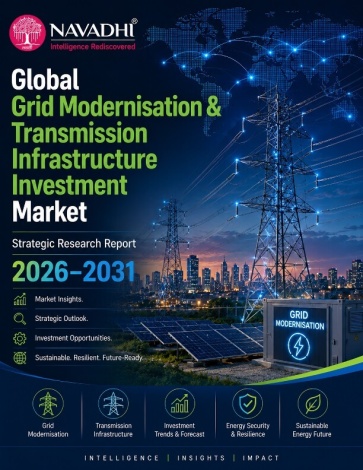
Global Grid Modernisation & Transmission Infrastructure Investment Market Strategic Research Report 2026-2031

Global Grid Modernisation & Transmission Infrastructure Investment Market Strategic Research Report 2026-2031
Publication ID: 
NAV0626008
Publication Date: 
June 30, 2026
Pages: 
334
Please choose the suitable license type from above. More details are at given under tab "Report License Types" below.

The global grid modernization and transmission infrastructure investment market has entered an unprecedented structural supercycle, transitioning from a historical replacement cycle to an era of rapid expansion. The market accelerated to USD 250 billion in 2024 (up from USD 195 billion in 2022) and is projected to reach USD 545 billion by 2031. This represents an 11.4% CAGR (2026–2031), yielding a cumulative capital deployment pool exceeding USD 2.9 trillion. Driven by three reinforcing secular forces—renewable integration, accelerating electrification, and grid resilience—this growth is structurally locked in, transforming the grid from a passive asset into a dynamic, highly digitized platform.

High-Velocity Segments & Emerging Demand Vectors

  • High-Growth Technology (HVDC Systems & FACTS): High-Voltage Direct Current (HVDC) and Flexible AC Transmission Systems (FACTS) form the fastest-growing technology segment. Spurred by long-distance renewable integration and cross-border interconnectors, this segment is projected to grow at a 17.0% CAGR, doubling from USD 28.6 billion in 2026 to USD 62.7 billion by 2031.
  • Fastest-Growing Application (EV Charging Infrastructure): Grid investments tied to EV charging infrastructure represent the highest-velocity application category, expanding at an 18.2% CAGR, though building from a smaller relative baseline.
  • Strategic Growth Driver (Data Centers & AI Electrification): Expanding at a 16.8% CAGR, data centers and industrial electrification represent the most critical emerging demand vector. This is driven by massive, non-negotiable power requirements from hyperscale technology firms committing to AI infrastructure.

Competitive Dynamics & Market Structure

  • Concentrated Tier-1 Leadership: The market favors diversified industrial technology giants with deep utility relationships, global manufacturing scale, and broad portfolios. Specialized, mid-tier players face high barriers to entry due to the long-term, highly contracted nature of utility programs.
  • Dominant Market Position (Hitachi Energy): Commanding approximately USD 16 billion in grid technology revenue, Hitachi Energy leads the market with top-tier positions across transformers, HVDC, and automation. Its USD 6 billion manufacturing capacity expansion signals strong institutional confidence in long-term demand.
  • Favorable Pricing & Margin Expansion: Severe supply-demand tightness—particularly in power transformers and HVDC components—has shifted pricing power entirely to OEMs. This capacity crunch is driving significant margin expansion across the vendor landscape, as highlighted by Siemens Energy’s Grid Technologies segment achieving a record 15.8% EBITDA margin in FY2025.

Strategic Imperatives for Industry Participants

Secure Capacity and Lead-Times: For utilities, procurement strategy must pivot from transactional purchasing to long-term capacity reservation. Given the extreme tightness in transformer and HVDC supply chains, securing production slots is now a core operational risk.

Monetize the Margin Window: For technology vendors, the current pricing environment offers a rare window to fund structural R&D and digital service capabilities. Investments should target software-defined grid automation to ensure long-term stickiness when hardware supply eventually normalizes.

Segment by Type covered in Global Grid Modernisation & Transmission Infrastructure Investment Market Strategic Research Report

  • Transmission Lines & Cables
  • Transformers & Substations
  • Switchgear & Protection
  • HVDC Systems & FACTS
  • Grid Automation & Control
  • Advanced Metering Infrastructure
  • Grid Construction & Eng. Services

Segment by Application covered in the Global Grid Modernisation & Transmission Infrastructure Investment Market Strategic Research Report

  • Renewable Energy Integration
  • Transmission Infrastructure Upgrade
  • Distribution Grid Modernisation
  • Data Centre & Industrial Electrification
  • EV Charging Infrastructure Grid
  • Cross-Border Interconnection
  • Digital Grid & Smart Technology
  • Energy Storage Integration

Segment by Geography covered in Report

North America 

  • United States
  • Canada
  • Mexico

Europe

  • Germany
  • France
  • United Kingdom
  • Italy
  • Spain
  • Rest of Europe

Asia Pacific

  • China
  • India
  • Japan
  • South Korea
  • Australia
  • Southeast Asia
  • Rest of APAC

Middle East and Africa

  • Saudi Arabia
  • UAE
  • Israel
  • South Africa
  • Rest of MEA

Latin America

  • Brazil
  • Chile
  • Colombia
  • Rest of LatAm
  1. Executive Summary
    • 1.1 Market Overview and Strategic Context
    • 1.2 Methodology and Bottom-Up Market Sizing
    • 1.3 Market Size, Forecast and Growth Trajectory
    • 1.4 Segment Composition and Key Growth Vectors
    • 1.5 Competitive Landscape Overview
    • 1.6 Strategic Implications and Report Framework
  2. Industry Overview and Forecast
    • 2.1 Market Definition and Scope
    • 2.2 Market Sizing Methodology and Bottom-Up Verification
    • 2.3 Overall Market Forecast 2022–2031
    • 2.3.1 Headline Market Trajectory
    • 2.4 Segment by Type: Forecast and Analysis 2022–2031
    • 2.4.1 Type Segment Overview
    • 2.4.2 Transformers and Substations — Largest Segment by Value
    • 2.4.3 Transmission Lines and Cables — Fastest Growing Conventional Segment
    • 2.4.4 HVDC Systems and FACTS — Highest-Growth Technology Segment
    • 2.4.5 Grid Automation and Control — Digital Transformation of Grid Operations
    • 2.4.6 Grid Construction and Engineering Services — Structural Underperformer
    • 2.5 Segment by Application: Forecast and Analysis 2022–2031
    • 2.5.1 Application Segment Overview
    • 2.5.2 Renewable Energy Integration — Dominant Long-Term Growth Driver
    • 2.5.3 Transmission Infrastructure Upgrade — Largest Application Segment in 2026
    • 2.5.4 Data Centre and Industrial Electrification — Highest-Growth Emerging Application
    • 2.5.5 EV Charging Infrastructure Grid — Fastest Growing Application Segment
    • 2.5.6 Energy Storage Integration — Structural Transition Note
    • 2.6 Regional Forecast 2022–2031
    • 2.6.1 Regional Market Overview
    • 2.6.2 Asia-Pacific — $123.1B (2025E) → $237.2B (2031F), CAGR 11.3%
    • 2.6.3 North America — $65.4B (2025E) → $127.8B (2031F), CAGR 11.5%
    • 2.6.4 Europe — $60.8B (2025E) → $117.5B (2031F), CAGR 11.4%
    • 2.6.5 Middle East and Africa — Fastest-Growing Region, CAGR 13.2%
    • 2.6.6 Latin America — Steady Growth, Brazil-Anchored Market
    • 2.7 Market Context: Leading Company Revenue Benchmarks 2020–2025E
  3. Market Segmentation by Type
    • 3.1 Overview and Segment Architecture
    • 3.2 Segment-by-Segment Analysis
    • 3.2.1 Transmission Lines and Cables
    • 3.2.2 Transformers and Substations
    • 3.2.3 Switchgear and Protection
    • 3.2.4 HVDC Systems and FACTS
    • 3.2.5 Grid Automation and Control
    • 3.2.6 Advanced Metering Infrastructure (AMI)
    • 3.2.7 Grid Construction and Engineering Services
    • 3.3 Segment Comparison and Cross-Segment Dynamics
    • 3.3.1 Consolidated Market Share and Growth Summary
    • 3.3.2 Structural Shifts in Segment Mix
    • 3.3.3 Investment Implications
  4. Market Segmentation by Application
    • 4.1 Overview and Segmentation Framework
    • 4.2 Renewable Energy Integration
    • 4.3 Transmission Infrastructure Upgrade
    • 4.4 Distribution Grid Modernisation
    • 4.5 Data Centre and Industrial Electrification
    • 4.6 EV Charging Infrastructure Grid
    • 4.7 Cross-Border Interconnection
    • 4.8 Digital Grid and Smart Technology
    • 4.9 Energy Storage Integration
    • 4.10 Application Segment Competitive Dynamics and Investment Concentration
    • 4.11 Application Segment Summary Table
  5. Regional Market Forecast
    • 5.1 Asia-Pacific
    • 5.1.1 Regional Overview
    • 5.1.2 Key Growth Drivers
    • 5.1.3 Regulatory and Infrastructure Landscape
    • 5.1.4 Country-Level Analysis
    • 5.1.5 Market Forecast 2025–2031
    • 5.2 North America
    • 5.2.1 Regional Overview
    • 5.2.2 Key Growth Drivers
    • 5.2.3 Regulatory and Infrastructure Landscape
    • 5.2.4 Country-Level Analysis
    • 5.2.5 Market Forecast 2025–2031
    • 5.3 Europe
    • 5.3.1 Regional Overview
    • 5.3.2 Key Growth Drivers
    • 5.3.3 Regulatory and Infrastructure Landscape
    • 5.3.4 Country-Level Analysis
    • 5.3.5 Market Forecast 2025–2031
    • 5.4 Middle East and Africa
    • 5.4.1 Regional Overview
    • 5.4.2 Key Growth Drivers
    • 5.4.3 Regulatory and Infrastructure Landscape
    • 5.4.4 Country-Level Analysis
    • 5.4.5 Market Forecast 2025–2031
    • 5.5 Latin America
    • 5.5.1 Regional Overview
    • 5.5.2 Key Growth Drivers
    • 5.5.3 Regulatory and Infrastructure Landscape
    • 5.5.4 Country-Level Analysis
    • 5.5.5 Market Forecast 2025–2031
  6. Country-Level Market Forecast
    • 6.1 Asia-Pacific
    • 6.1.1 China
    • 6.1.2 India
    • 6.1.3 Japan
    • 6.1.4 South Korea
    • 6.1.5 Australia
    • 6.1.6 Southeast Asia
    • 6.1.7 Rest of APAC
    • 6.2 North America
    • 6.2.1 United States
    • 6.2.2 Canada
    • 6.2.3 Mexico
    • 6.3 Europe
    • 6.3.1 Germany
    • 6.3.2 France
    • 6.3.3 United Kingdom
    • 6.3.4 Italy
    • 6.3.5 Spain
    • 6.3.6 Rest of Europe
    • 6.4 Middle East and Africa
    • 6.4.1 Saudi Arabia
    • 6.4.2 UAE
    • 6.4.3 South Africa
    • 6.4.4 Egypt
    • 6.4.5 Rest of MEA
    • 6.5 Latin America
    • 6.5.1 Brazil
    • 6.5.2 Chile
    • 6.5.3 Colombia
    • 6.5.4 Rest of LatAm
  7. Growth Drivers and Inhibitors
    • 7.1 Global Grid Modernisation and Transmission Infrastructure Investment Market
    • 7.2 Key Growth Drivers
    • 7.2.1 Driver 1: Energy Transition and Renewable Integration
    • 7.2.2 Driver 2: AI Data Centre Electrification Demand
    • 7.2.3 Driver 3: Aging Grid Infrastructure Replacement Cycle
    • 7.2.4 Driver 4: Government Policy Incentives and Infrastructure Mandates
    • 7.2.5 Driver 5: HVDC Long-Distance Transmission Expansion
    • 7.2.6 Driver 6: Cross-Border Electricity Interconnection Programmes
    • 7.3 Key Market Inhibitors
    • 7.3.1 Inhibitor 1: Permitting and Environmental Approval Timelines
    • 7.3.2 Inhibitor 2: Critical Equipment Supply Chain Constraints
    • 7.3.3 Inhibitor 3: Capital Cost and Infrastructure Financing Constraints
    • 7.3.4 Inhibitor 4: Skilled Workforce Shortage
    • 7.3.5 Inhibitor 5: Cybersecurity and Operational Technology Vulnerability
    • 7.3.6 Inhibitor 6: Geopolitical Supply Chain Risk and Trade Policy Uncertainty
    • 7.4 Net Market Assessment: Driver-Inhibitor Balance
  8. Key Company Profiles
    • 8.1 Hitachi Energy
    • 8.1.1 Company Overview
    • 8.1.2 Key Products and Segments
    • 8.1.3 Financial Performance (2023–2025)
    • 8.1.4 Business Strategy
    • 8.1.5 SWOT Analysis
    • 8.1.6 Strategic Implications (2025–2031)
    • 8.2 Siemens Energy Grid Technologies
    • 8.2.1 Company Overview
    • 8.2.2 Key Products and Segments
    • 8.2.3 Financial Performance (2023–2025)
    • 8.2.4 Business Strategy
    • 8.2.5 SWOT Analysis
    • 8.2.6 Strategic Implications (2025–2031)
    • 8.3 GE Vernova Electrification
    • 8.3.1 Company Overview
    • 8.3.2 Key Products and Segments
    • 8.3.3 Financial Performance (2023–2025)
    • 8.3.4 Business Strategy
    • 8.3.5 SWOT Analysis
    • 8.3.6 Strategic Implications (2025–2031)
    • 8.4 Prysmian Group
    • 8.4.1 Company Overview
    • 8.4.2 Key Products and Segments
    • 8.4.3 Financial Performance (2023–2025)
    • 8.4.4 Business Strategy
    • 8.4.5 SWOT Analysis
    • 8.4.6 Strategic Implications (2025–2031)
    • 8.5 Schneider Electric
    • 8.5.1 Company Overview
    • 8.5.2 Key Products and Segments
    • 8.5.3 Financial Performance (2023–2025)
    • 8.5.4 Business Strategy
    • 8.5.5 SWOT Analysis
    • 8.5.6 Strategic Implications (2025–2031)
    • 8.6 ABB
    • 8.6.1 Company Overview
    • 8.6.2 Key Products and Segments
    • 8.6.3 Financial Performance (2023–2025)
    • 8.6.4 Business Strategy
    • 8.6.5 SWOT Analysis
    • 8.6.6 Strategic Implications (2025–2031)
    • 8.7 Nexans
    • 8.7.1 Company Overview
    • 8.7.2 Key Products and Segments
    • 8.7.3 Financial Performance (2023–2025)
    • 8.7.4 Business Strategy
    • 8.7.5 SWOT Analysis
    • 8.7.6 Strategic Implications (2025–2031)
    • 8.8 Quanta Services
    • 8.8.1 Company Overview
    • 8.8.2 Key Products and Segments
    • 8.8.3 Financial Performance (2023–2025)
    • 8.8.4 Business Strategy
    • 8.8.5 SWOT Analysis
    • 8.8.6 Strategic Implications (2025–2031)
    • 8.9 Eaton
    • 8.9.1 Company Overview
    • 8.9.2 Key Products and Segments
    • 8.9.3 Financial Performance (2023–2025)
    • 8.9.4 Business Strategy
    • 8.9.5 SWOT Analysis
    • 8.9.6 Strategic Implications (2025–2031)
    • 8.10 National Grid
    • 8.10.1 Company Overview
    • 8.10.2 Key Products and Segments
    • 8.10.3 Financial Performance (2023–2025)
    • 8.10.4 Business Strategy
    • 8.10.5 SWOT Analysis
    • 8.10.6 Strategic Implications (2025–2031)
  9. Competitive Landscape
    • 9.1 Competitive Landscape Overview
    • 9.2 Competitive Intensity Assessment
    • 9.2.1 Tier Structure and Revenue Ranges
    • 9.2.2 Tier 1 Dynamics: Consolidation Around Three Global Rivals
    • 9.2.3 Capacity vs. Demand Dynamics
    • 9.2.4 Pricing Environment: Differentiated by Segment
    • 9.2.5 Barriers to Entry and Exit
    • 9.3 Key Player Strategies and Positioning
    • 9.3.1 Strategic Group Architecture
    • 9.3.2 Differentiation Strategies of Major Players
    • 9.3.3 Geographic Strongholds
    • 9.3.4 MandA and Partnership Activity (2022–Present)
    • 9.3.5 RandD and Technology Investment Trends
    • 9.4 Competitive Dynamics and Strategic Outlook
    • 9.4.1 Emerging Competitive Threats
    • 9.4.2 Consolidation vs. Fragmentation Outlook
    • 9.4.3 Competitive Response Matrix
    • 9.4.4 Strategic Recommendations for 2025–2031
  10. Porter's Five Forces Analysis
    • 10.1 Threat of New Entrants
    • 10.2 Bargaining Power of Buyers
    • 10.3 Bargaining Power of Suppliers
    • 10.4 Threat of Substitutes
    • 10.5 Competitive Rivalry
  11. PESTLE Analysis
    • 11.1 Macro-Environmental Forces Shaping the Global Grid Modernisation and Transmission Infrastructure Market Through 2031
    • 11.2 Overview and Analytical Framework
    • 11.3 P | Political — Very High Impact
    • 11.3.1 The Policy Architecture of a Grid Investment Super-Cycle
    • 11.3.2 Political Risk Summary
    • 11.4 E | Economic — High Impact
    • 11.4.1 Capital Flows, Cost Pressures, and the Financing Architecture of Grid Investment
    • 11.5 S | Social — Moderate Impact
    • 11.5.1 The Social Contract of Grid Modernisation
    • 11.6 T | Technological — Very High Impact
    • 11.6.1 Technology Trajectories Reshaping Market Structure
    • 11.7 L | Legal — High Impact
    • 11.7.1 Regulatory and Legislative Frameworks Unlocking and Constraining Investment
    • 11.8 E² | Environmental — High Impact
    • 11.8.1 Climate Imperatives and Regulatory Requirements Defining the Market's Raison d'être
    • 11.9 Integrated PESTLE Synthesis and Strategic Implications
  12. SWOT Analysis
    • 12.1 Overview
    • 12.2 Strengths
    • 12.2.1 S1. Structural, Non-Discretionary Investment Imperative
    • 12.2.2 S2. Unprecedented and Concurrent Multi-Jurisdictional Policy Support
    • 12.2.3 S3. Powerful and Diversified Demand Driver Architecture
    • 12.2.4 S4. Large-Scale Committed Capital Visibility from Anchor Utilities
    • 12.2.5 S5. Broad Geographic Diversification Reducing Concentration Risk
    • 12.3 Weaknesses
    • 12.3.1 W1. Critical Supply Chain Bottlenecks and Extended Lead Times
    • 12.3.2 W2. Highly Capital-Intensive Asset Class with Long Payback Profiles
    • 12.3.3 W3. Regulatory and Permitting Process Complexity Creating Timeline Risk
    • 12.3.4 W4. Workforce Skills Shortage in Specialised Transmission Engineering
    • 12.4 Opportunities
    • 12.4.1 O1. HVDC Technology Expansion as a Structurally Distinct Growth Market
    • 12.4.2 O2. Emerging Market Grid Buildout Providing Decade-Long Structural Growth
    • 12.4.3 O3. Digital Grid and Smart Grid Technology Integration Creating Adjacent Revenue Streams
    • 12.4.4 O4. Cross-Border Interconnection as a Geopolitically Prioritised Investment Category
    • 12.4.5 O5. Nearshoring and Industrial Reshoring Creating New Load Growth Centres
    • 12.5 Threats
    • 12.5.1 T1. Geopolitical Risk and Trade Policy Disruption to Equipment Supply Chains
    • 12.5.2 T2. Interest Rate and Infrastructure Financing Cost Risk
    • 12.5.3 T3. Technology Disruption Risk from Distributed Energy Resources and Grid-Edge Solutions
    • 12.5.4 T4. Execution and Project Delivery Risk at Elevated Programme Scale
    • 12.5.5 T5. Regulatory and Political Risk of Policy Reversal
    • 12.6 SWOT Summary Matrix
  13. Future Trends and Outlook
    • 13.1 Executive Summary of Forward-Looking Dynamics
    • 13.2 Trend 1 — HVDC Transitions from Specialist to Default Long-Distance Transmission Technology
    • 13.3 Trend 2 — AI Hyperscaler Data Centre Expansion Creates an Incremental $50–80B Grid Investment Trigger
    • 13.4 Trend 3 — North Sea HVDC Highway: Emergence of the World's First Offshore Multi-Country DC Grid
    • 13.5 Trend 4 — US Transmission Infrastructure Crisis: FERC Order 1920 Initiates a $50–100B Investment Mandate
    • 13.6 Trend 5 — Power Transformer Supply Crisis: Global Factory Race and Structural Capacity Reconstitution
    • 13.7 Trend 6 — Grid Software and Digital Twin Platforms: $15–20B High-Margin Growth Segment at 18%+ CAGR
    • 13.8 Trend 7 — Submarine Cable Market Expansion: North Sea, Indo-Pacific, and Atlantic Drive Historic Investment Cycle
    • 13.9 Trend 8 — India Grid Modernisation: INR 4.5 Trillion ($54B) National Electricity Plan Drives Tier-1 Market Emergence
    • 13.10 Trend 9 — Energy Security and Grid Resilience: National Security Designation Drives Incremental $15–25B Investment
    • 13.11 Trend 10 — Emerging Market Electrification: Sub-Saharan Africa, ASEAN, and Latin America as the Next Growth Frontier
    • 13.12 Integrated Trend Assessment: Cumulative Market Impact and Strategic Implications

List of Exhibits

Exhibit 2.1: Forecast of Global Market YoY Growth Rate & CAGR Summary (in %)
Exhibit 2.2: Forecast of Middle East & Africa (in USD Bn)
Exhibit 2.3: Forecast of Asia-Pacific (in USD Bn)
Exhibit 2.4: Forecast of North America (in USD Bn)
Exhibit 2.5: Forecast of Europe (in USD Bn)
Exhibit 2.6: Forecast of Latin America (in USD Bn)
Exhibit 2.7: Forecast of Global (in USD Bn)
Exhibit 3.8: Forecast of Transmission Lines & Cables (in USD Bn)
Exhibit 3.9: Forecast of Transformers & Substations (in USD Bn)
Exhibit 3.10: Forecast of Switchgear & Protection (in USD Bn)
Exhibit 3.11: Forecast of HVDC Systems & FACTS (in USD Bn)
Exhibit 3.12: Forecast of Grid Automation & Control (in USD Bn)
Exhibit 3.13: Forecast of Advanced Metering Infrastructure (in USD Bn)
Exhibit 3.14: Forecast of Grid Construction & Eng. Services (in USD Bn)
Exhibit 4.15: Forecast of Renewable Energy Integration (in USD Bn)
Exhibit 4.16: Forecast of Transmission Infrastructure Upgrade (in USD Bn)
Exhibit 4.17: Forecast of Distribution Grid Modernisation (in USD Bn)
Exhibit 4.18: Forecast of Data Centre & Industrial Electrification (in USD Bn)
Exhibit 4.19: Forecast of EV Charging Infrastructure Grid (in USD Bn)
Exhibit 4.20: Forecast of Cross-Border Interconnection (in USD Bn)
Exhibit 4.21: Forecast of Digital Grid & Smart Technology (in USD Bn)
Exhibit 4.22: Forecast of Energy Storage Integration (in USD Bn)
Exhibit 6.23: Forecast of Asia-Pacific (in USD Bn)
Exhibit 6.24: Forecast of China (in USD Bn)
Exhibit 6.25: Forecast of India (in USD Bn)
Exhibit 6.26: Forecast of Japan (in USD Bn)
Exhibit 6.27: Forecast of South Korea (in USD Bn)
Exhibit 6.28: Forecast of Australia (in USD Bn)
Exhibit 6.29: Forecast of Southeast Asia (in USD Bn)
Exhibit 6.30: Forecast of Rest of APAC (in USD Bn)
Exhibit 6.31: Forecast of North America (in USD Bn)
Exhibit 6.32: Forecast of United States (in USD Bn)
Exhibit 6.33: Forecast of Canada (in USD Bn)
Exhibit 6.34: Forecast of Mexico (in USD Bn)
Exhibit 6.35: Forecast of Europe (in USD Bn)
Exhibit 6.36: Forecast of Germany (in USD Bn)
Exhibit 6.37: Forecast of France (in USD Bn)
Exhibit 6.38: Forecast of United Kingdom (in USD Bn)
Exhibit 6.39: Forecast of Italy (in USD Bn)
Exhibit 6.40: Forecast of Spain (in USD Bn)
Exhibit 6.41: Forecast of Rest of Europe (in USD Bn)
Exhibit 6.42: Forecast of Middle East & Africa (in USD Bn)
Exhibit 6.43: Forecast of Saudi Arabia (in USD Bn)
Exhibit 6.44: Forecast of UAE (in USD Bn)
Exhibit 6.45: Forecast of South Africa (in USD Bn)
Exhibit 6.46: Forecast of Egypt (in USD Bn)
Exhibit 6.47: Forecast of Rest of MEA (in USD Bn)
Exhibit 6.48: Forecast of Latin America (in USD Bn)
Exhibit 6.49: Forecast of Brazil (in USD Bn)
Exhibit 6.50: Forecast of Chile (in USD Bn)
Exhibit 6.51: Forecast of Colombia (in USD Bn)
Exhibit 6.52: Forecast of Rest of LatAm (in USD Bn)

  1. Hitachi Energy
  2. Siemens Energy Grid Technologies
  3. GE Vernova Electrification
  4. Prysmian Group
  5. Schneider Electric
  6. ABB
  7. Nexans
  8. Quanta Services
  9. Eaton
  10. National Grid

Single User License (PDF)

  • This license allows for use of a publication by one person.
  • This person may print out a single copy of the publication.
  • This person can include information given in the publication in presentations and internal reports by providing full copyright credit to the publisher.
  • This person cannot share the publication (or any information contained therein) with any other person or persons.
  • Unless a Enterprise License is purchased, a Single User License must be purchased for every person that wishes to use the publication within the same organization.
  • Customers who infringe these license terms are liable for a Enterprise license fee.


Site License (PDF)*

  • This license allows for use of a publication by all users within one corporate location, e.g. a regional office.
  • These users may print out a single copy of the publication.
  • These users can include information given in the publication in presentations and internal reports by providing full copyright credit to the publisher.
  • These users cannot share the publication (or any information contained therein) with any other person or persons outside the corporate location for which the publication is purchased.
  • Unless a Enterprise License is purchased, a Site User License must be purchased for every corporate location by an organization that wishes to use the publication within the same organization.
  • Customers who infringe these license terms are liable for a Enterprise license fee.


Enterprise License (PDF)*

  • This license allows for use of a publication by unlimited users within the purchasing organization e.g. all employees of a single company.
  • Each of these people may use the publication on any computer, and may print out the report, but may not share the publication (or any information contained therein) with any other person or persons outside of the organization.
  • These employees of purchasing organization can include information given in the publication in presentations and internal reports by providing full copyright credit to the publisher.

*If Applicable.

About Us

NAVADHI is a market research company that helps global firms differentiate themselves, break market entry barriers, track their investments, develop business strategies and plan for future by providing actionable market research intelligence that helps them succeed.

Infomation

  • About Us
  • Publications
  • FAQs
  • Privacy Policy
  • Terms & Conditions
  • Careers
  • Press Releases
  • Contact

Source URL:https://www.navadhi.com/publications/global-grid-modernisation-transmission-infrastructure-investment-market-strategic