
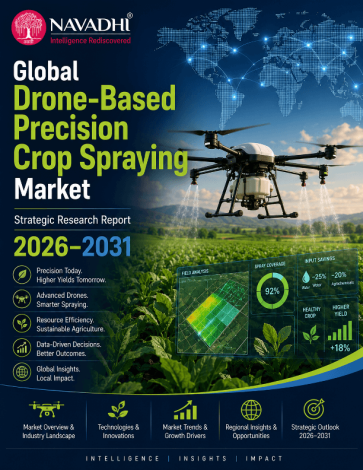

Drone-based precision crop spraying has transitioned from a niche agri-tech experiment to a commercially scalable input channel that institutional capital, government subsidy frameworks, and large agribusiness operators are actively integrating into their operational strategies. The technology enables GPS-guided, variable-rate aerial application of pesticides, herbicides, fungicides, and liquid fertilizers at 40-60x the ground-speed efficiency of manual backpack spraying, with input savings of 30-40% versus conventional equipment on comparable field areas.
Global drone-based precision crop spraying revenue reached an estimated USD 3.82 Bn in 2025, up from USD 1.84 Bn in 2022, representing a historical CAGR of 27.4% over 2022-2025 (Navadhi Market Research Estimate). This trajectory reflects accelerated adoption in Asia-Pacific driven by China's DJI-led market maturation, aggressive government subsidy programs in India under the Namo Drone Didi and SMAM schemes, and the entry of Latin American large-farm operators seeking spray-cost arbitrage on soybean and sugarcane estates exceeding 10,000 hectares.
The market is projected to reach USD 13.94 Bn by 2031, expanding at a forecast CAGR of 24.1% over 2025-2031. Unit volume is expected to scale from 0.73 Mn in 2025 to 2.97 Mn by 2031, as hardware price compression continues even as software, data services, and precision-application subscriptions elevate per-system revenue yields. The multi-rotor agricultural drone segment remains the dominant architecture, reaching USD 7.75 Bn by 2031.
DJI (SZ DJI Technology Co. Ltd.), XAG Co. Ltd. (Guangzhou Xaircraft Technology Co. Ltd.), Yamaha Motor Co. Ltd., AgEagle Aerial Systems Inc., Hylio Inc., EAVision (Hangzhou EAVision Intelligent Control Technology Co. Ltd.), Pyka Inc., Trimble Inc., PrecisionHawk Inc., ideaForge Technology Ltd.
*If Applicable.

NAVADHI is a market research company that helps global firms differentiate themselves, break market entry barriers, track their investments, develop business strategies and plan for future by providing actionable market research intelligence that helps them succeed.