

The global cosmetic peptides market is positioned for sustained double-digit growth through 2031. Anti-aging remains the dominant application, but emerging opportunities in skin brightening, hair growth, and bioidentical peptides are reshaping competitive dynamics. Asia-Pacific leadership, GLP-1 tailwinds, regulatory tailwinds, and supply-chain diversification toward Chinese manufacturers collectively support robust market expansion across both prestige and mass-premium segments worldwide.
The cosmetic peptides market is defined as the commercial supply of peptide active ingredients to cosmetics and personal care formulators. This includes signal peptides, neurotransmitter inhibitor peptides, carrier peptides, enzyme inhibitor peptides, bioidentical/mimetic peptides, and structural/tensor peptides - supplied as cosmetic actives in powder or liquid form to product manufacturers for inclusion in skincare, haircare, and colour cosmetic formulations.
This report covers the full spectrum of cosmetic peptides across all major global markets for the forecast period 2026–2031, with 2025 as the base year.
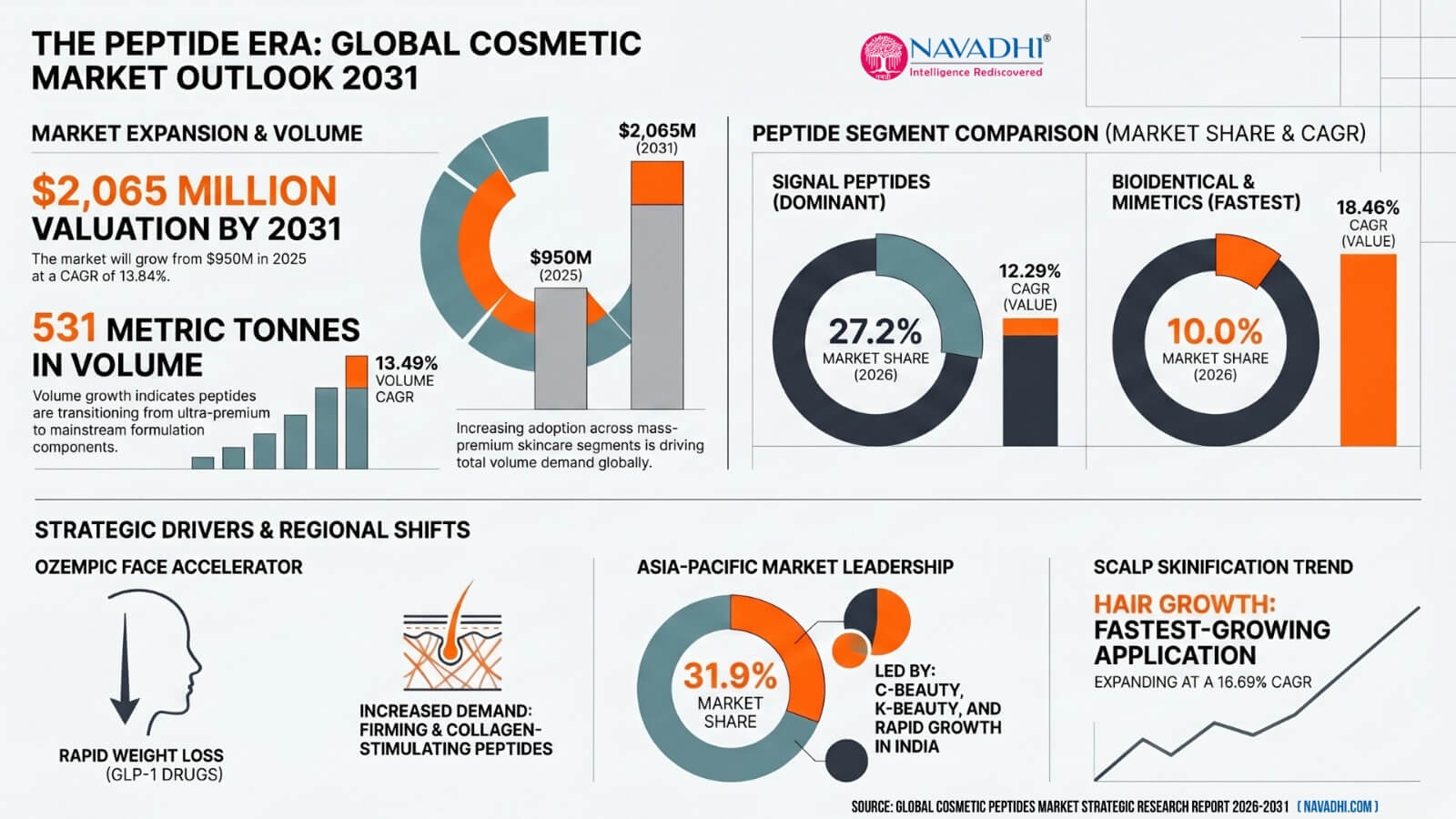
As per this report, the global cosmetic peptides market, which was worth USD 950 million in 2025, is expected to grow at a CAGR of 13.84% between 2026 and 2031 driven by accelerating adoption of peptide-based skincare ingredients across prestige and mass-premium segments worldwide. The global cosmetic peptides market is expected to be worth USD 2065 million by 2031.
The global cosmetic peptides market volume, which was 248 metric tonnes (MT) in 2025, is expected to grow at a CAGR of 13.49% between 2026 and 20231. The global cosmetic peptides market volume is expected to reach 531 metric tonnes (MT) by 2031. This volume growth indicates peptides are transitioning from niche, ultra-premium ingredients to mainstream formulation components.
GLP-1 anti-obesity pharmaceuticals (e.g., Ozempic, Mounjaro) have emerged as an unexpected market accelerator for global cosmetic peptides industry. These drugs drive skin laxity concerns, creating heightened demand for collagen-stimulating, firming, and lifting peptides in both professional skincare and consumer formulations.
Signal Peptides (Matrixyl, Palmitoyl) are the largest segment type in the global cosmetic peptides market at estimated 27.2% market share by value in 2026 and is expected to grow at a CAGR of 12.29% by value and 11.37% by volume during 2026-2031. This growth reflects their above-average selling price (ASP) driven by patent protection, clinical evidence, and brand equity.
Bioidentical Peptides & Mimetics which are estimated to have 10% market share by value in 2026 and is expected to grow fastest at a CAGR of 18.46% by value and 17.95% by volume during 2026-2031. This segment category includes: recombinant human collagen peptides produced via fermentation (not from animal sources); growth factor peptides produced via biotechnology; bioidentical elastin and fibronectin peptides; and microprotein/mini-protein active ingredients.
Enzyme Inhibitor Peptides (Leuphasyl, Syn-Ake) segment is expected to grow at a CAGR of 15.91% by value and 16.17% by volume during 2026-2031.
Anti-Aging & Wrinkle Reduction is the largest application segment in the global cosmetic peptides market at estimated 42.4% market share by value in 2026 and is expected to grow at a CAGR of 14.64% by value and 14.28% by volume during 2026-2031. This growth is driven by the "Botox alternative" positioning of Argireline and growing consumer demand for non-invasive preventative skincare.
Multiple converging demographic and cultural forces are expanding the anti-aging peptide market:
Hair Growth & Scalp Care is the fastest growing application segment in the global cosmetic peptides market which is expected to grow at a CAGR of 16.69% by value and 16.34% by volume during 2026-2031. This growth is driven by the 'scalp skinification' trend - the application of skincare-level ingredient science to scalp and hair care - is the structural driver.
Skin Brightening & Hyperpigmentation application segment is expected to grow at a CAGR of 15.76% by value and 15.40% by volume during 2026-2031. This growth is driven by acute demand from Asian markets, particularly China, South Korea, and Japan, where hyperpigmentation treatment is a significant beauty concern.
Asia-Pacific leads with estimated 31.9% market share in 2026, driven by Chinese beauty (C-beauty) brands (Proya, Botanee, Perfect Diary) adopting premium peptide actives, plus Japan's established cosmeceutical culture and South Korea's K-beauty innovation leadership. India emerges as the fastest-growing Asia Pacific sub-market (16.43% CAGR) as middle-class consumers seek premium skincare.
North America cosmetic peptides market remains dominated by prestige skincare, with Modernization of Cosmetics Regulation Act (MoCRA) 2022 regulations driving clinical substantiation of peptide efficacy claims.
Europe is expected to benefit from headquarters of major suppliers - Croda (UK), Lubrizol Lipotec (Spain), Clariant/Lucas Meyer (France) - fostering established distribution and innovation ecosystems.
Middle East & Africa cosmetic peptides market is expected to show disproportionately high growth potential (13.93% CAGR) fueled by UAE luxury beauty hubs and Vision 2030 initiatives and Saudi Arabia driving female workforce participation and personal care spend.
The global cosmetic peptides market is positioned for sustained double-digit growth through 2031. Anti-aging remains the dominant application, but emerging opportunities in skin brightening, hair growth, and bioidentical peptides are reshaping competitive dynamics. Asia-Pacific leadership, GLP-1 tailwinds, regulatory tailwinds, and supply-chain diversification toward Chinese manufacturers collectively support robust market expansion across both prestige and mass-premium segments worldwide.
This research report is ideal for people who wish to gain a thorough understanding of the Cosmetic Peptides market. Some of intended user for this report are:
*If Applicable.

NAVADHI is a market research company that helps global firms differentiate themselves, break market entry barriers, track their investments, develop business strategies and plan for future by providing actionable market research intelligence that helps them succeed.