
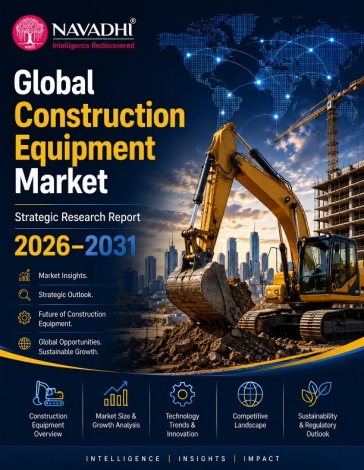

The global construction equipment market is successfully transitioning from a highly volatile, cyclical recovery phase into a structurally resilient, long-term infrastructure investment supercycle. During the 2022–2024 historical window, the industry faced severe operational friction, including post-pandemic supply chain bottlenecks, component shortages, and sudden logistics bottlenecks. Despite these headwinds, aggressive post-pandemic fiscal stimulus across North America and Asia-Pacific, combined with accelerating mechanization rates in rapidly developing emerging economies, elevated global revenues to USD 215.64 billion by the end of 2024, reflecting a stable compound annual growth rate (CAGR) of 2.7%.
Looking ahead, the forecast period spanning 2025–2031 projects a notable growth acceleration to a 5.0% CAGR. This inflection point indicates that the market is no longer merely rebounding from pandemic-era troughs, but is instead being propelled by multi-decade civil commitments.
With sustained cross-border capital allocations toward modernizing legacy grids, transport networks, and urban layouts, the global market value is fundamentally on track to breach the USD 300 billion threshold by 2031.
Product demand remains anchored by earthmoving equipment—encompassing hydraulic excavators, bulldozers, motor graders, scrapers, and articulated dump trucks—which represents the single largest absolute revenue pool in the industry. This segment generated USD 82.88 billion in 2024 and is projected to reach USD 117.05 billion by 2031, expanding at an above-market 5.2% CAGR due to its non-discretionary use across every foundational stage of civil, residential, and commercial development.
The underlying demand architecture driving these machinery sales relies on three interlocking pillars: public infrastructure investment, private real estate/commercial construction, and industrial or energy project development. In 2024, public infrastructure acted as the primary market anchor, commanding an estimated 42–45% of total equipment demand. This massive share reflects the direct, outsized influence of sweeping, government-funded initiatives. Chief among these are the United States’ Infrastructure Investment and Jobs Act (IIJA), India’s ambitious USD 1,400.00 billion National Infrastructure Pipeline targeting nationwide connectivity, Saudi Arabia's capital-intensive Vision 2030 giga-projects, and the European Union's REPowerEU framework aimed at rapid energy transition infrastructure.
In contrast, the private real estate market introduced localized friction. Residential construction generated USD 51.75 billion in equipment demand in 2024, accounting for approximately 24% of the global market value. This segment demonstrated acute sensitivity to central bank policies; the aggressive 2022–2023 interest rate tightening cycles executed by the U.S. Federal Reserve, the European Central Bank (ECB), and the Bank of England heavily suppressed global housing starts. The impact was most visible in the United States, where single-family housing starts plummeted by roughly 18% from their peak in 2022 to their cyclical trough in 2023, sidelining lighter equipment classes during that window.
On the supply side, the market landscape is structurally bifurcated, characterized by a pronounced oligopoly at the premium tier. Five global original equipment manufacturers (OEMs)—Caterpillar, Komatsu, CNH Industrial, Volvo CE, and Liebherr—dominated the upper echelon of the market, collectively capturing between 55–60% of total global OEM revenue in 2024. These industry titans maintain substantial pricing power, advanced telematics ecosystems, and deeply entrenched dealership networks across mature Western and Asia-Pacific markets, positioning them as the direct beneficiaries of massive public sector infrastructure outlays.
Conversely, the remaining 40–45% of the global market remains highly fragmented and localized, concentrated primarily within fast-growing emerging economies. This lower tier is led by prominent Chinese manufacturers such as XCMG, Sany, and Zoomlion, alongside Indian domestic players like Escorts Kubota. These regional OEMs specialize in high-volume, cost-competitive machinery tailored to accelerate mechanization across developing territories. This dual-market architecture—highly consolidated at the top yet intensely competitive and fragmented at the regional level—creates a compelling tactical dynamic. While it subjects regional players to fierce localized margin pressures, it simultaneously opens up lucrative cross-border M&A optionality for global tier-one OEMs. Top-tier players flush with capital are increasingly expected to pursue strategic acquisitions of these local brands to bypass high barriers to entry, secure localized supply chains, and capture incremental volume growth across emerging market frontiers
Earthmoving Equipment
Material Handling Equipment
Concrete & Road Equipment
Lifting Equipment
Tunneling & Underground Equipment
Others
Infrastructure Development
Residential Construction
Commercial Construction
Industrial Construction
Demolition & Renovation
Asia-Pacific
North America
Europe
Middle East & Africa
Latin America
This research report is ideal for those seeking a thorough understanding of the Construction Equipment market. Some of the intended users for this report are:
List of Exhibits
*If Applicable.

NAVADHI is a market research company that helps global firms differentiate themselves, break market entry barriers, track their investments, develop business strategies and plan for future by providing actionable market research intelligence that helps them succeed.