
NAVADHI Market Research
Published on NAVADHI Market Research (https://www.navadhi.com)

Home > Global Bento Boxes Market Strategic Research Report 2026-2031

Global Bento Boxes Market Strategic Research Report 2026-2031

Global Bento Boxes Market Strategic Research Report 2026-2031
Publication ID: 
NAV0926014
Publication Date: 
September 29, 2026
Pages: 
235
Countries: 
Global [1]
Please choose the suitable license type from above. More details are at given under tab "Report License Types" below.

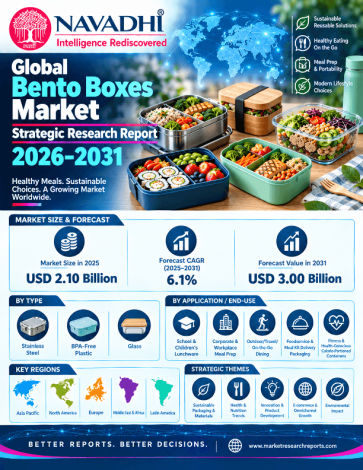
The global bento boxes market is valued at approximately USD 2.10 billion in 2025 and is projected to grow at a 6.1% CAGR to approximately USD 3.00 billion by 2031.

Real, Current Competitive Intelligence

Tupperware Brands Corporation initiated Chapter 11 proceedings in September 2024; its brand, intellectual property, and core-market operations were acquired by a lender-formed vehicle (Party Products LLC) in late November 2024, and the original corporation's liquidation trust plan became effective June 10, 2025. Sistema Plastics has been owned by Newell Brands since April 2017.

Scope of the Global Bento Boxes Market Strategic Research Report

This report provides market sizing (value) across material and end-use segments, and regional/country splits, through 2031, grounded in dated company disclosures and a transparently documented, independently-verified market-size methodology.

Segment by Type

  • Plastic (incl. BPA-Free)
  • Stainless Steel
  • Glass
  • Silicone & Other Materials
  • Wood & Bamboo Fiber

Segment by Application

  • School & Children's Lunchware
  • Workplace & Adult Meal Prep
  • Outdoor, Travel & On-the-Go
  • Foodservice & Meal-Kit Delivery
  • Fitness & Portion-Controlled Nutrition

Who Can Use This Report?

  • Housewares and lunchware brand teams benchmarking positioning against disclosed peer results
  • Retail and e-commerce category buyers sizing the reusable lunchware assortment
  • Investment analysts and M&A advisors assessing legacy-brand restructurings and consolidation in food-storage categories
  • Institutional procurement and public-program planners sizing compartmentalized meal-container demand
  1. Executive Summary
    1. 1.1 Market Synopsis
    2. 1.2 Key Findings
    3. 1.3 Market Size Methodology and Estimate Reconciliation
  2. Industry Overview & Forecast
    1. 2.1 Global Market Valuation and Methodology
    2. 2.2 Historical Market Trajectory
    3. 2.3 Forecast Period: 2026 to 2031
    4. 2.4 Regional Structure and Contribution
    5. 2.5 Segment Structure Within the Global Total
    6. 2.6 Structural Events Shaping the Forecast
    7. 2.7 Forecast Confidence and Limitations
  3. Market Segmentation by Type
    1. 3.1 Market by Type Overview
    2. 3.2 Plastic (incl. BPA-Free)
    3. 3.3 Stainless Steel
    4. 3.4 Glass
    5. 3.5 Silicone & Other Materials
    6. 3.6 Wood & Bamboo Fiber
    7. 3.7 Cross-Segment Synthesis
  4. Market Segmentation by Application
    1. 4.1 Overview of the Application Segmentation Framework
    2. 4.2 School & Children's Lunchware
    3. 4.3 Workplace & Adult Meal Prep
    4. 4.4 Outdoor, Travel & On-the-Go
    5. 4.5 Foodservice & Meal-Kit Delivery
    6. 4.6 Fitness & Portion-Controlled Nutrition
    7. 4.7 Application Segment Synthesis and Forecast
  5. Regional Market Forecast
    1. 5.1 North America
    2. 5.1.1 Regional Overview
    3. 5.1.2 Key Growth Drivers
    4. 5.1.3 Regulatory & Infrastructure Landscape
    5. 5.1.4 Country-Level Analysis
    6. 5.1.4.1 United States
    7. 5.1.4.2 Canada
    8. 5.1.4.3 Rest of North America
    9. 5.1.5 Market Forecast 2025–2031
    10. 5.2 Europe
    11. 5.2.1 Regional Overview
    12. 5.2.2 Key Growth Drivers
    13. 5.2.3 Regulatory & Infrastructure Landscape
    14. 5.2.4 Country-Level Analysis
    15. 5.2.4.1 Germany
    16. 5.2.4.2 United Kingdom
    17. 5.2.4.3 France
    18. 5.2.4.4 Spain
    19. 5.2.4.5 Italy
    20. 5.2.4.6 Rest of Europe
    21. 5.2.5 Market Forecast 2025–2031
    22. 5.3 Asia Pacific
    23. 5.3.1 Regional Overview
    24. 5.3.2 Key Growth Drivers
    25. 5.3.3 Regulatory & Infrastructure Landscape
    26. 5.3.4 Country-Level Analysis
    27. 5.3.5 Market Forecast 2025–2031
    28. 5.4 Latin America
    29. 5.4.1 Regional Overview
    30. 5.4.2 Key Growth Drivers
    31. 5.4.3 Regulatory & Infrastructure Landscape
    32. 5.4.4 Country-Level Analysis
    33. 5.4.4.1 Brazil
    34. 5.4.4.2 Mexico
    35. 5.4.4.3 Rest of Latin America
    36. 5.4.5 Market Forecast 2025–2031
    37. 5.5 Middle East & Africa
    38. 5.5.1 Regional Overview
    39. 5.5.2 Key Growth Drivers
    40. 5.5.3 Regulatory & Infrastructure Landscape
    41. 5.5.4 Country-Level Analysis
    42. 5.5.5 Market Forecast 2025–2031
  6. Country-Level Market Forecast
    1. 6.1 North America
    2. 6.1.1 United States
    3. 6.1.2 Canada
    4. 6.1.3 Rest of North America
    5. 6.2 Europe
    6. 6.2.1 Germany
    7. 6.2.2 United Kingdom
    8. 6.2.3 France
    9. 6.2.4 Spain
    10. 6.2.5 Italy
    11. 6.2.6 Rest of Europe
    12. 6.3 Asia Pacific
    13. 6.3.1 China
    14. 6.3.2 Japan
    15. 6.3.3 India
    16. 6.3.4 South Korea
    17. 6.3.5 Australia
    18. 6.3.6 Indonesia
    19. 6.3.7 Rest of Asia Pacific
    20. 6.4 Latin America
    21. 6.4.1 Brazil
    22. 6.4.2 Mexico
    23. 6.4.3 Rest of Latin America
    24. 6.5 Middle East & Africa
    25. 6.5.1 Saudi Arabia
    26. 6.5.2 United Arab Emirates
    27. 6.5.3 South Africa
    28. 6.5.4 Rest of Middle East & Africa
  7. Growth Drivers & Inhibitors
    1. 7.1 Reusable, Portion-Controlled Lunchware Adoption
    2. 7.1.1 Structural Demand Foundation
    3. 7.1.2 Consumer Health and Wellness as a Secular Tailwind
    4. 7.1.3 Environmental Regulation as a Demand Accelerant
    5. 7.2 Institutional and Government Meal Programs
    6. 7.2.1 Large-Scale Program Demand as a Structural Growth Signal
    7. 7.2.2 Budget Volatility as a Modulating Factor
    8. 7.2.3 Emerging Market School and Workplace Programs
    9. 7.3 Premiumisation Toward Stainless Steel, Glass, and Insulated Fo…
    10. 7.3.1 Material Mix Transition as a Revenue Multiplier
    11. 7.3.2 Financial Evidence from Listed Participants
    12. 7.3.3 Heated and Electrically Insulated Format Extension
    13. 7.3.4 Organised Distribution Enabling Premium Penetration
    14. 7.4 Market Restraints and Challenges
    15. 7.4.1 Price Sensitivity and Category Saturation
    16. 7.4.2 Tariff and Import-Cost Pass-Through Pressure
    17. 7.4.3 Legacy Brand Structural Fragility
    18. 7.4.4 Regional Demand Softness in Premium Insulated Categories
    19. 7.4.5 Data Quality and Scope Ambiguity
    20. 7.4.6 Limited Financial Disclosure from Pure-Play Participants
    21. 7.5 Opportunities and White-Space Analysis
    22. 7.5.1 Channel Repositioning of Distressed Legacy Brands
    23. 7.5.2 Material Substitution Pipeline
    24. 7.5.3 Emerging Market Institutional and Consumer Demand Convergence
    25. 7.5.4 Direct-to-Consumer Channel Penetration in Developed Markets
  8. Key Company Profiles
    1. 8.1 Tupperware (Party Products LLC)
    2. 8.1.1 Company Overview
    3. 8.1.2 Key Products & Segments
    4. 8.1.3 Financial Performance (2023–2025)
    5. 8.1.4 Business Strategy
    6. 8.1.5 SWOT Analysis
    7. 8.1.6 Strategic Implications (2025–2031)
    8. 8.2 Sistema Plastics
    9. 8.2.1 Company Overview
    10. 8.2.2 Key Products & Segments
    11. 8.2.3 Financial Performance (2023–2025)
    12. 8.2.4 Business Strategy
    13. 8.2.5 SWOT Analysis
    14. 8.2.6 Strategic Implications (2025–2031)
    15. 8.3 Zojirushi Corporation
    16. 8.3.1 Company Overview
    17. 8.3.2 Key Products & Segments
    18. 8.3.3 Financial Performance (2023–2025)
    19. 8.3.4 Business Strategy
    20. 8.3.5 SWOT Analysis
    21. 8.3.6 Strategic Implications (2025–2031)
    22. 8.4 Thermos LLC
    23. 8.4.1 Company Overview
    24. 8.4.2 Key Products & Segments
    25. 8.4.3 Financial Performance (2023–2025)
    26. 8.4.4 Business Strategy
    27. 8.4.5 SWOT Analysis
    28. 8.4.6 Strategic Implications (2025–2031)
    29. 8.5 Lock & Lock Co., Ltd.
    30. 8.5.1 Company Overview
    31. 8.5.2 Key Products & Segments
    32. 8.5.3 Financial Performance (2023–2025)
    33. 8.5.4 Business Strategy
    34. 8.5.5 SWOT Analysis
    35. 8.5.6 Strategic Implications (2025–2031)
    36. 8.6 Zhejiang Haers Vacuum Containers Co., Ltd.
    37. 8.6.1 Company Overview
    38. 8.6.2 Key Products & Segments
    39. 8.6.3 Financial Performance (2023–2025)
    40. 8.6.4 Business Strategy
    41. 8.6.5 SWOT Analysis
    42. 8.6.6 Strategic Implications (2025–2031)
    43. 8.7 Cello World Limited
    44. 8.7.1 Company Overview
    45. 8.7.2 Key Products & Segments
    46. 8.7.3 Financial Performance (2023–2025)
    47. 8.7.4 Business Strategy
    48. 8.7.5 SWOT Analysis
    49. 8.7.6 Strategic Implications (2025–2031)
    50. 8.8 Borosil Limited
    51. 8.8.1 Company Overview
    52. 8.8.2 Key Products & Segments
    53. 8.8.3 Financial Performance (2023–2025)
    54. 8.8.4 Business Strategy
    55. 8.8.5 SWOT Analysis
    56. 8.8.6 Strategic Implications (2025–2031)
    57. 8.9 Tiger Corporation
    58. 8.9.1 Company Overview
    59. 8.9.2 Key Products & Segments
    60. 8.9.3 Financial Performance (2023–2025)
    61. 8.9.4 Business Strategy
    62. 8.9.5 SWOT Analysis
    63. 8.9.6 Strategic Implications (2025–2031)
    64. 8.10 Bentgo
    65. 8.10.1 Company Overview
    66. 8.10.2 Key Products & Segments
    67. 8.10.3 Financial Performance (2023–2025)
    68. 8.10.4 Business Strategy
    69. 8.10.5 SWOT Analysis
    70. 8.10.6 Strategic Implications (2025–2031)
    71. 8.11 Monbento
    72. 8.11.1 Company Overview
    73. 8.11.2 Key Products & Segments
    74. 8.11.3 Financial Performance (2023–2025)
    75. 8.11.4 Business Strategy
    76. 8.11.5 SWOT Analysis
    77. 8.11.6 Strategic Implications (2025–2031)
    78. 8.12 ECOlunchbox
    79. 8.12.1 Company Overview
    80. 8.12.2 Key Products & Segments
    81. 8.12.3 Financial Performance (2023–2025)
    82. 8.12.4 Business Strategy
    83. 8.12.5 SWOT Analysis
    84. 8.12.6 Strategic Implications (2025–2031)
  9. Competitive Landscape
    1. 9.1 Competitive Landscape Overview
    2. 9.2 Competitive Intensity Assessment
    3. 9.2.1 Tier Structure and Revenue Ranges
    4. 9.2.2 Capacity vs. Demand Dynamics
    5. 9.2.3 Pricing Environment
    6. 9.2.4 Barriers to Entry and Exit
    7. 9.3 Key Player Strategies & Positioning
    8. 9.4 Competitive Dynamics & Strategic Outlook
    9. 9.4.1 Emerging Competitive Threats and New Entrant Pressure
    10. 9.4.2 Consolidation vs. Fragmentation Outlook
    11. 9.4.3 Competitive Response Matrix
    12. 9.4.4 Strategic Recommendations for 2025–2031
  10. Porter's Five Forces Analysis
    1. 10.1 Threat of New Entrants
    2. 10.2 Bargaining Power of Buyers
    3. 10.3 Bargaining Power of Suppliers
    4. 10.4 Threat of Substitutes
    5. 10.5 Competitive Rivalry
  11.  PESTLE Analysis
    1. 11.1 Political Factors
    2. 11.1.1 Government Nutrition and School Meal Policy
    3. 11.1.2 Trade Policy and Tariff Regimes
    4. 11.1.3 Government Procurement Preferences
    5. 11.1.4 Geopolitical Fragmentation
    6. 11.2 Economic Factors
    7. 11.2.1 Market Sizing and Growth Context
    8. 11.2.2 Disposable Income and Premiumisation
    9. 11.2.3 Inflationary Pressures on Input Costs
    10. 11.2.4 Currency and Exchange Rate Risk
    11. 11.2.5 Consumer Spending Resilience
    12. 11.2.6 Post-Tupperware Market Restructuring
    13. 11.3 Social and Demographic Factors
    14. 11.3.1 Urbanisation and the Working Lunchtime Economy
    15. 11.3.2 Bento Culture as a Global Lifestyle Export
    16. 11.3.3 Meal Preparation and Health Consciousness
    17. 11.3.4 Children and School Lunchbox Demand
    18. 11.3.5 Ageing Populations and Portion Management
    19. 11.3.6 Remote and Hybrid Work as a Demand Moderator
    20. 11.4 Technological Factors
    21. 11.4.1 Thermal Engineering and Temperature Control Innovation
    22. 11.4.2 Material Science and Sustainable Substrate Development
    23. 11.4.3 E-Commerce and Digital Commerce Enablement
    24. 11.4.4 Smart and Connected Packaging
    25. 11.4.5 Manufacturing Process Innovation
    26. 11.5 Legal and Regulatory Factors
    27. 11.5.1 Food-Contact Material Regulations
    28. 11.5.2 Single-Use Plastics Legislation
    29. 11.5.3 Product Safety and Certification Standards
    30. 11.5.4 Intellectual Property and Design Protection
    31. 11.5.5 Labelling and Claims Regulation
    32. 11.6 Environmental Factors
    33. 11.6.1 Sustainability as a Primary Consumer Purchase Driver
    34. 11.6.2 Material Substitution Dynamics
    35. 11.6.3 Plastic Waste and Microplastics Discourse
    36. 11.6.4 Circular Economy and Producer Responsibility
    37. 11.6.5 Climate-Related Supply Chain Risk
    38. 11.6.6 Carbon Footprint and Scope 3 Emissions Pressure
    39. 11.6.7 Synthesis: PESTLE Risk and Opportunity Weighting
  12. SWOT Analysis
    1. 12.1 Introduction
    2. 12.2 Market-Level Strengths
    3. 12.2.1 Deep Cultural Embeddedness and Category Longevity
    4. 12.2.2 Growing Health and Sustainability Tailwinds
    5. 12.2.3 Established and Diversified Competitive Ecosystem
    6. 12.2.4 Multi-Segment Revenue Base
    7. 12.2.5 Scalable Online and Direct-to-Consumer Reach
    8. 12.3 Market-Level Weaknesses
    9. 12.3.1 Market-Size Opacity and Scope Ambiguity
    10. 12.3.2 Low Disclosure from Private and Emerging-Market Players
    11. 12.3.3 Commodity Input Price Sensitivity
    12. 12.3.4 Consumer Habit Formation and Usage Consistency
    13. 12.3.5 Brand Heritage Risk from Tupperware's Restructuring
    14. 12.4 Strategic Opportunities
    15. 12.4.1 Premiumisation and Functional Innovation
    16. 12.4.2 Geographic Expansion into Underpenetrated Markets
    17. 12.4.3 Institutional and Government Procurement Channels
    18. 12.4.4 Sustainability Certification and Circular Economy Positioning
    19. 12.4.5 Direct-to-Consumer Model Expansion and Subscription Commerce
    20. 12.4.6 Corporate Gifting and Wellness Programme Integration
    21. 12.5 External Threats
    22. 12.5.1 Competitive Substitution from Food-Delivery and Meal-Kit Platf…
    23. 12.5.2 Intensifying Raw Material and Energy Cost Volatility
    24. 12.5.3 Regulatory Complexity and Material Safety Scrutiny
    25. 12.5.4 Currency Risk and Export Market Earnings Volatility
    26. 12.5.5 E-Commerce Platformisation and Margin Compression
    27. 12.5.6 Greenwashing Scrutiny and ESG Credibility Risk
    28. 12.6 Integrated SWOT Assessment
  13. Future Trends & Outlook
    1. 13.1 Heated, Insulated and Temperature-Controlled Bento Formats
    2. 13.2 Material Substitution
    3. 13.3 Direct-to-Consumer and Online Distribution
    4. 13.4 Long-Term Market Outlook (2032–2035)
    5. 13.5 Investment & M&A Activity Outlook

List of Exhibits:

  • 2.1 Exhibit 2.1: Forecast of Global (in USD Bn)
  • 2.2 Exhibit 2.2: Forecast of Global Market YoY Growth Rate & CAGR Summary (in %)
  • 2.3 Exhibit 2.3: Forecast of North America (in USD Bn)
  • 2.4 Exhibit 2.4: Forecast of Europe (in USD Bn)
  • 2.5 Exhibit 2.5: Forecast of Asia Pacific (in USD Bn)
  • 2.6 Exhibit 2.6: Forecast of Latin America (in USD Bn)
  • 2.7 Exhibit 2.7: Forecast of Middle East & Africa (in USD Bn)
  • 3.8 Exhibit 3.8: Forecast of Plastic (incl. BPA-Free) (in USD Bn)
  • 3.9 Exhibit 3.9: Forecast of Stainless Steel (in USD Bn)
  • 3.10 Exhibit 3.10: Forecast of Glass (in USD Bn)
  • 3.11 Exhibit 3.11: Forecast of Silicone & Other Materials (in USD Bn)
  • 3.12 Exhibit 3.12: Forecast of Wood & Bamboo Fiber (in USD Bn)
  • 4.13 Exhibit 4.13: Forecast of School & Children's Lunchware (in USD Bn)
  • 4.14 Exhibit 4.14: Forecast of Workplace & Adult Meal Prep (in USD Bn)
  • 4.15 Exhibit 4.15: Forecast of Outdoor, Travel & On-the-Go (in USD Bn)
  • 4.16 Exhibit 4.16: Forecast of Foodservice & Meal-Kit Delivery (in USD Bn)
  • 4.17 Exhibit 4.17: Forecast of Fitness & Portion-Controlled Nutrition (in USD Bn)
  • 6.18 Exhibit 6.18: Forecast of North America (in USD Bn)
  • 6.19 Exhibit 6.19: Forecast of United States (in USD Bn)
  • 6.20 Exhibit 6.20: Forecast of Canada (in USD Bn)
  • 6.21 Exhibit 6.21: Forecast of Europe (in USD Bn)
  • 6.22 Exhibit 6.22: Forecast of Germany (in USD Bn)
  • 6.23 Exhibit 6.23: Forecast of United Kingdom (in USD Bn)
  • 6.24 Exhibit 6.24: Forecast of France (in USD Bn)
  • 6.25 Exhibit 6.25: Forecast of Spain (in USD Bn)
  • 6.26 Exhibit 6.26: Forecast of Italy (in USD Bn)
  • 6.27 Exhibit 6.27: Forecast of Rest of Europe (in USD Bn)
  • 6.28 Exhibit 6.28: Forecast of Asia Pacific (in USD Bn)
  • 6.29 Exhibit 6.29: Forecast of China (in USD Bn)
  • 6.30 Exhibit 6.30: Forecast of Japan (in USD Bn)
  • 6.31 Exhibit 6.31: Forecast of India (in USD Bn)
  • 6.32 Exhibit 6.32: Forecast of South Korea (in USD Bn)
  • 6.33 Exhibit 6.33: Forecast of Australia (in USD Bn)
  • 6.34 Exhibit 6.34: Forecast of Rest of Asia Pacific (in USD Bn)
  • 6.35 Exhibit 6.35: Forecast of Latin America (in USD Bn)
  • 6.36 Exhibit 6.36: Forecast of Brazil (in USD Bn)
  • 6.37 Exhibit 6.37: Forecast of Mexico (in USD Bn)
  • 6.38 Exhibit 6.38: Forecast of Middle East & Africa (in USD Bn)
  • 6.39 Exhibit 6.39: Forecast of Rest of Middle East & Africa (in USD Bn)

Tupperware (Party Products LLC), Sistema Plastics, Zojirushi Corporation, Thermos LLC, Lock & Lock Co. Ltd., Zhejiang Haers Vacuum Containers Co. Ltd., Cello World Limited, Borosil Limited, Tiger Corporation, Bentgo, Monbento, ECOlunchbox

Single User License (PDF)

  • This license allows for use of a publication by one person.
  • This person may print out a single copy of the publication.
  • This person can include information given in the publication in presentations and internal reports by providing full copyright credit to the publisher.
  • This person cannot share the publication (or any information contained therein) with any other person or persons.
  • Unless a Enterprise License is purchased, a Single User License must be purchased for every person that wishes to use the publication within the same organization.
  • Customers who infringe these license terms are liable for a Enterprise license fee.


Site License (PDF)*

  • This license allows for use of a publication by all users within one corporate location, e.g. a regional office.
  • These users may print out a single copy of the publication.
  • These users can include information given in the publication in presentations and internal reports by providing full copyright credit to the publisher.
  • These users cannot share the publication (or any information contained therein) with any other person or persons outside the corporate location for which the publication is purchased.
  • Unless a Enterprise License is purchased, a Site User License must be purchased for every corporate location by an organization that wishes to use the publication within the same organization.
  • Customers who infringe these license terms are liable for a Enterprise license fee.


Enterprise License (PDF)*

  • This license allows for use of a publication by unlimited users within the purchasing organization e.g. all employees of a single company.
  • Each of these people may use the publication on any computer, and may print out the report, but may not share the publication (or any information contained therein) with any other person or persons outside of the organization.
  • These employees of purchasing organization can include information given in the publication in presentations and internal reports by providing full copyright credit to the publisher.

*If Applicable.

About Us

NAVADHI is a market research company that helps global firms differentiate themselves, break market entry barriers, track their investments, develop business strategies and plan for future by providing actionable market research intelligence that helps them succeed.

Infomation

  • About Us
  • Publications
  • FAQs
  • Privacy Policy
  • Terms & Conditions
  • Careers
  • Press Releases
  • Contact

Source URL:https://www.navadhi.com/publications/global-bento-boxes-market-strategic-research-report-2026-2031

Links
[1] https://www.navadhi.com/countries/global