
NAVADHI Market Research
Published on NAVADHI Market Research (https://www.navadhi.com)

Home > Global Agentic AI & AI Automation Enterprise Market Strategic Research Report 2026-2031

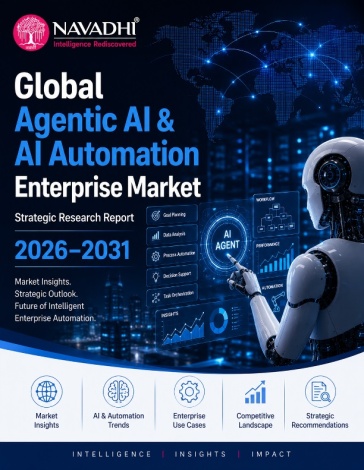
Global Agentic AI & AI Automation Enterprise Market Strategic Research Report 2026-2031

Global Agentic AI & AI Automation Enterprise Market Strategic Research Report 2026-2031
Publication ID: 
NAV0626004
Publication Date: 
June 30, 2026
Pages: 
342
Countries: 
Global [1]
Please choose the suitable license type from above. More details are at given under tab "Report License Types" below.

The newly published sector study by Navadhi Market Research details a massive, structural transformation within the B2B and B2G technology landscape, establishing Agentic AI and Enterprise AI Automation as the fastest-growing software sector globally. Grounded strictly in audited financials and strategic enterprise commitments, the report sets the 2025 base year valuation at USD 42.0 billion. Driven by an aggressive 32.6% compound annual growth rate, the study projects a 5.4-fold absolute market expansion to USD 227.8 billion by 2031, outpacing cloud migrations, cybersecurity, and standard SaaS categories. Absolute annual gains are forecast to accelerate sharply, peaking at an increase of USD 43.4 billion in 2030 before showing early signs of sub-segment maturation by 2031.

The publication identifies the primary catalyst for this expansion as a definitive migration away from rigid, rule-based Robotic Process Automation (RPA) toward adaptive, AI-native architectures. Although the report notes that AI-enhanced RPA will see absolute revenue growth, its relative market share is expected to compress as organizations pivot toward solutions that manage exceptions autonomously and interpret unstructured data. Capitalizing on this transition, the Agentic AI Platforms & Autonomous Agents segment is highlighted as the industry's growth leader, with a staggering 51% CAGR, projected to reach USD 54.7 billion by 2031. Major tech milestones, such as Salesforce's aggressive push to deploy one billion Agentforce agents by 2026, underscore this momentum, moving the technology from experimental pilots to scaled enterprise monetization.

According to the report's geographic and vertical breakdown, North America is poised to retain global market leadership—sustained by concentrated corporate R&D capital, a robust talent pool, and aggressive software spending—even as international markets gradually scale up. Across vertical applications, Healthcare & Life Sciences leads in pure acceleration with a 37.2% CAGR, while Customer Service & CX is projected to become the largest overall vertical by 2031 revenue. The analysis concludes that between 2026 and 2028, the defining competitive frontier will center on the evolution from simple co-pilots to fully autonomous digital workers, rewarding vendors that can successfully reduce deployment complexity for business users.

Scope of Global Agentic AI & AI Automation Enterprise Market Strategic Research Report

  • This report provides forecast data by value (in USD billion) till 2031 for the global Agentic AI & AI Automation Enterprise market.
  • This report provides segment by type (Agentic AI Platforms & Autonomous Agents, Enterprise Copilots & Generative AI Apps, AI-Enhanced Robotic Process Automation, AI-Powered Business Process Automation, AI Infrastructure & MLOps Platforms, Conversational AI & AI Contact Centre, AI Consulting & Implementation Services) forecast data by value (in USD billion) for the global Agentic AI & AI Automation Enterprise market till 2031.
  • This report provides application segments (IT Operations & DevOps Automation, Customer Service & Experience AI, Finance & Accounting Automation, HR & Talent Management Automation, Sales & Marketing AI Automation, Supply Chain & Operations AI, Healthcare & Life Sciences AI, Legal, Compliance & Risk Automation, Other Verticals) forecast data by value (in USD billion) for the global Agentic AI & AI Automation Enterprise market till 2031.
  • This report provides region-wise (Asia-Pacific, North America, Europe, Middle East & Africa, Latin America) forecast data by value (in USD billion) for the global Agentic AI & AI Automation Enterprise market till 2031.
  • This report also provides country-wise forecast data by value (in USD billion) for China, Japan, South Korea, India, Australia, Singapore, Rest APAC, USA, Canada, Mexico, Rest of North America, Germany, UK, France, Netherlands, Sweden, Italy, Rest Europe, UAE, Saudi Arabia, Israel, South Africa, Egypt, Rest MEA, Brazil, Colombia, Chile, Rest of LatAm.
  • This report identifies key growth drivers and inhibitors (pain points) affecting the global Agentic AI & AI Automation Enterprise market.
  • This report provides SWOT (Strengths, Weaknesses, Opportunities and Threats) analysis, company profile including revenue (in USD billion) and gross margin (%) for 2020-2025 along with competitive landscape for key companies in the global Agentic AI & AI Automation Enterprise market.
  • This report provides Porter’s Five Forces analysis for global Agentic AI & AI Automation Enterprise market.
  • This report provides PESTLE (political, economic, social, technological, legal and environmental) analysis for global Agentic AI & AI Automation Enterprise market.
  • This report provides SWOT (Strengths, Weaknesses, Opportunities and Threats) analysis for global Agentic AI & AI Automation Enterprise market.
  • This report identifies key future trends in the global Agentic AI & AI Automation Enterprise market.

Segment by Type in the Agentic AI & AI Automation Enterprise Market

  • Agentic AI Platforms & Autonomous Agents
  • Enterprise Copilots & Generative AI Apps
  • AI-Enhanced Robotic Process Automation
  • AI-Powered Business Process Automation
  • AI Infrastructure & MLOps Platforms
  • Conversational AI & AI Contact Centre
  • AI Consulting & Implementation Services

Segment by Application in the Global Agentic AI & AI Automation Enterprise Market

  • IT Operations & DevOps Automation
  • Customer Service & Experience AI
  • Finance & Accounting Automation
  • HR & Talent Management Automation
  • Sales & Marketing AI Automation
  • Supply Chain & Operations AI
  • Healthcare & Life Sciences AI
  • Legal, Compliance & Risk Automation
  • Other Verticals

Segment by Region and Country in the Global Agentic AI & AI Automation Enterprise Market

Asia-Pacific

  • China
  • Japan
  • South Korea
  • India
  • Australia
  • Singapore
  • Rest APAC

North America

  • USA
  • Canada
  • Mexico
  • Rest of North America

Europe

  • Germany
  • UK
  • France
  • Netherlands
  • Sweden
  • Italy
  • Rest Europe

Middle East & Africa

  • UAE
  • Saudi Arabia
  • Israel
  • South Africa
  • Egypt
  • Rest MEA

Latin America

  • Brazil
  • Colombia
  • Chile
  • Rest of LatAm

Who can use the Global Agentic AI & AI Automation Enterprise Market Research Report?

  • C-level executives (CEO, CTO, CIO, Chief AI Officers) driving digital transformation and automation strategies
  • Investment managers, Venture Capitalists, and Private Equity partners evaluating the enterprise AI and SaaS landscape
  • VP of Engineering, DevOps leads, and IT Operations directors managing enterprise software architectures
  • Business development, product, and marketing professionals at enterprise software providers, RPA vendors, and AI platforms
  • Global procurement, strategic sourcing, and operations directors looking to deploy autonomous agents and AI automation workflows
  • Industry consultants, system integrators, technology analysts, and advisory professionals guiding enterprise AI implementations
  • Corporate strategy and M&A managers monitoring consolidations and funding trends across the AI infrastructure and MLOps market
  1. Executive Summary
    • 1.1 Market Scale, Growth Trajectory & Strategic Significance
    • 1.1.1 Methodological Anchoring & Source Transparency
    • 1.1.2 Three Converging Structural Forces Driving Market Growth
    • 1.1.3 Fastest-Growing Technology Segment: Agentic AI Platforms & Autonomous Agents
    • 1.1.4 Technology Segment Structural Shift: From RPA-Dominance to Agentic-Led Architecture
    • 1.1.5 Fastest-Growing Application Domain: Healthcare & Life Sciences AI Automation
    • 1.1.6 Regional Analysis: North American Dominance and Asia-Pacific as Fastest-Growing Region
    • 1.1.7 Key Market Drivers and Growth Inhibitors
    • 1.1.8 Strategic Conclusions for Market Participants
  2. Industry Overview & Forecast
    • 2.1 Global Agentic AI & AI Automation Enterprise Market — 2025–2031
    • 2.1.1 Market Sizing Rationale & Base Year Anchor
    • 2.1.2 Overall Market Forecast 2025–2031
    • 2.1.3 Structural Growth Drivers
    • 2.1.4 Technology Segment Forecast
    • 2.1.5 Application Domain Forecast
  3. Market Segmentation by Type
    • 3.1 Overview of the Technology Classification Framework
    • 3.1.1 Agentic AI Platforms and Autonomous Agents — The Structural Disruptor
    • 3.1.2 Enterprise Copilots and Generative AI Applications — The Largest Absolute Value Segment
    • 3.1.3 AI-Enhanced Robotic Process Automation — Mature Platform in Strategic Transition
    • 3.1.4 AI-Powered Business Process Automation — Steady-State Growth in Enterprise Platforms
    • 3.1.5 AI Infrastructure and MLOps Platforms — Foundational Layer Under Margin Compression
    • 3.1.6 Conversational AI and AI Contact Centre Solutions — Category Maturing into Platform Consolidation
    • 3.1.7 AI Consulting and Implementation Services — Structural Decline in Share Despite Absolute Growth
    • 3.1.8 Segment Composition and Structural Shift: 2025 vs. 2031
    • 3.1.9 Analytical Summary: Investment Implications by Segment
  4. Market Segmentation by Application
    • 4.1 Section Overview
    • 4.1.1 Application Segment Landscape: Size, Share, and Trajectory
    • 4.1.2 IT Operations & DevOps Automation: The Incumbent Leader
    • 4.1.3 Customer Service & Experience AI: The Ascendant Market Leader
    • 4.1.4 Finance & Accounting Automation: Structural Core at Scale
    • 4.1.5 Sales & Marketing AI: The High-Velocity Revenue Accelerator
    • 4.1.6 Supply Chain & Operations AI: Industrial Resilience Automation
    • 4.1.7 HR & Talent Management AI: Workforce Intelligence at Enterprise Scale
    • 4.1.8 Healthcare & Life Sciences AI: The Fastest-Growing Application Segment
    • 4.1.9 Legal, Compliance & Risk AI: Regulatory Tailwinds Drive Adoption
    • 4.1.10 Other Verticals: Education, Energy, Public Sector, and Emerging Domains
    • 4.1.11 Application Segment Convergence: The Cross-Functional AI Platform Dynamic
  5. Regional Market Forecast
    • 5.1 North America
    • 5.1.1 Regional Overview
    • 5.1.2 Key Growth Drivers
    • 5.1.3 Regulatory & Infrastructure Landscape
    • 5.1.4 Country-Level Analysis
    • 5.1.5 Market Forecast 2025–2031
    • 5.2 Europe
    • 5.2.1 Regional Overview
    • 5.2.2 Key Growth Drivers
    • 5.2.3 Regulatory & Infrastructure Landscape
    • 5.2.4 Country-Level Analysis
    • 5.2.5 Market Forecast 2025–2031
    • 5.3 Asia-Pacific
    • 5.3.1 Regional Overview
    • 5.3.2 Key Growth Drivers
    • 5.3.3 Regulatory & Infrastructure Landscape
    • 5.3.4 Country-Level Analysis
    • 5.3.5 Market Forecast 2025–2031
    • 5.4 Middle East & Africa
    • 5.4.1 Regional Overview
    • 5.4.2 Key Growth Drivers
    • 5.4.3 Regulatory & Infrastructure Landscape
    • 5.4.4 Country-Level Analysis
    • 5.4.5 Market Forecast 2025–2031
    • 5.5 Latin America
    • 5.5.1 Regional Overview
    • 5.5.2 Key Growth Drivers
    • 5.5.3 Regulatory & Infrastructure Landscape
    • 5.5.4 Country-Level Analysis
    • 5.5.5 Market Forecast 2025–2031
  6. Country-Level Market Forecast
    • 6.1 North America
    • 6.1.1 USA
    • 6.1.2 Canada
    • 6.1.3 Mexico
    • 6.2 Europe
    • 6.2.1 Germany
    • 6.2.2 UK
    • 6.2.3 France
    • 6.2.4 Netherlands
    • 6.2.5 Sweden
    • 6.2.6 Italy
    • 6.2.7 Rest Europe
    • 6.3 Asia-Pacific
    • 6.3.1 China
    • 6.3.2 Japan
    • 6.3.3 South Korea
    • 6.3.4 India
    • 6.3.5 Australia
    • 6.3.6 Singapore
    • 6.3.7 Rest APAC
    • 6.4 Middle East & Africa
    • 6.4.1 UAE
    • 6.4.2 Saudi Arabia
    • 6.4.3 Israel
    • 6.4.4 South Africa
    • 6.4.5 Egypt
    • 6.4.6 Rest MEA
    • 6.5 Latin America
    • 6.5.1 Brazil
    • 6.5.2 Colombia
    • 6.5.3 Chile
    • 6.5.4 Rest of LatAm (incl. Mexico)
  7. Growth Drivers & Inhibitors
    • 7.1 Section 6: Growth Drivers & Inhibitors
    • 7.1.1 Section Overview
    • 7.1.2 Primary Growth Drivers
    • 7.1.2.1 Driver 1: Paradigm Transition from Rule-Based RPA to Autonomous Agentic AI — The Most Consequential Architecture Shift in Enterprise Automation Since 2015
    • 7.1.2.2 Driver 2: Enterprise Copilot Proliferation — The Largest Mass-Deployment Event in Enterprise Software History
    • 7.1.2.3 Driver 3: Labour Cost Arbitrage & Productivity Imperatives Under Macroeconomic Constraint
    • 7.1.2.4 Driver 4: Hyperscaler AI Infrastructure Investment — The Supply-Side Enabler of Demand at Scale
    • 7.1.2.5 Driver 5: Regulatory & Compliance Tailwinds — Governance Requirements Creating Mandatory AI Adoption Vectors
    • 7.1.2.6 Driver 6: Ecosystem Maturation & Reduced Technical Barriers — From Specialist Tooling to Business-User Deployment
    • 7.1.2.7 Driver 7: Demonstrated Measurable ROI from Early Enterprise Deployments — Evidence-Base Accelerating Subsequent Investment
    • 7.1.3 Secondary & Amplifying Drivers
    • 7.1.4 Primary Market Inhibitors
    • 7.1.4.1 Inhibitor 1: Data Quality, Governance & Availability — The Foundational Constraint on Enterprise AI Value Realisation
    • 7.1.4.2 Inhibitor 2: AI Governance, Ethics & Regulatory Compliance Risk — Particularly in High-Stakes Application Domains
    • 7.1.4.3 Inhibitor 3: Enterprise AI Talent Scarcity — Implementation Capability Bottleneck
    • 7.1.4.4 Inhibitor 4: Organisational Change Management & Workforce Resistance
    • 7.1.4.5 Inhibitor 5: Security, Privacy & Cyber Risk — Expanding Attack Surface and Data Exposure Risk
    • 7.1.4.6 Inhibitor 6: Total Cost of Ownership Uncertainty & Budget Competition
    • 7.1.4.7 Inhibitor 7: Integration Complexity with Legacy Enterprise Systems
    • 7.1.5 Driver–Inhibitor Net Assessment
    • 7.1.6 Regional Driver–Inhibitor Variance
    • 7.1.7 Analyst Commentary & Forward Outlook
  8. Key Company Profiles
    • 8.1 Microsoft Corporation
    • 8.1.1 Company Overview
    • 8.1.2 Key Products & Segments
    • 8.1.3 Financial Performance (2023–2025)
    • 8.1.4 Business Strategy
    • 8.1.5 SWOT Analysis
    • 8.1.6 Strategic Implications (2025–2031)
    • 8.2 Salesforce Inc.
    • 8.2.1 Company Overview
    • 8.2.2 Key Products & Segments
    • 8.2.3 Financial Performance (2023–2025)
    • 8.2.4 Business Strategy
    • 8.2.5 SWOT Analysis
    • 8.2.6 Strategic Implications (2025–2031)
    • 8.3 ServiceNow Inc.
    • 8.3.1 Company Overview
    • 8.3.2 Key Products & Segments
    • 8.3.3 Financial Performance (2023–2025)
    • 8.3.4 Business Strategy
    • 8.3.5 SWOT Analysis
    • 8.3.6 Strategic Implications (2025–2031)
    • 8.4 UiPath Inc.
    • 8.4.1 Company Overview
    • 8.4.2 Key Products & Segments
    • 8.4.3 Financial Performance (2023–2025)
    • 8.4.4 Business Strategy
    • 8.4.5 SWOT Analysis
    • 8.4.6 Strategic Implications (2025–2031)
    • 8.5 IBM Corporation
    • 8.5.1 Company Overview
    • 8.5.2 Key Products & Segments
    • 8.5.3 Financial Performance (2023–2025)
    • 8.5.4 Business Strategy
    • 8.5.5 SWOT Analysis
    • 8.5.6 Strategic Implications (2025–2031)
    • 8.6 Accenture PLC
    • 8.6.1 Company Overview
    • 8.6.2 Key Products & Segments
    • 8.6.3 Financial Performance (2023–2025)
    • 8.6.4 Business Strategy
    • 8.6.5 SWOT Analysis
    • 8.6.6 Strategic Implications (2025–2031)
    • 8.7 SAP SE
    • 8.7.1 Company Overview
    • 8.7.2 Key Products & Segments
    • 8.7.3 Financial Performance (2023–2025)
    • 8.7.4 Business Strategy
    • 8.7.5 SWOT Analysis
    • 8.7.6 Strategic Implications (2025–2031)
    • 8.8 Oracle Corporation
    • 8.8.1 Company Overview
    • 8.8.2 Key Products & Segments
    • 8.8.3 Financial Performance (2023–2025)
    • 8.8.4 Business Strategy
    • 8.8.5 SWOT Analysis
    • 8.8.6 Strategic Implications (2025–2031)
    • 8.9 Workday Inc.
    • 8.9.1 Company Overview
    • 8.9.2 Key Products & Segments
    • 8.9.3 Financial Performance (2023–2025)
    • 8.9.4 Business Strategy
    • 8.9.5 SWOT Analysis
    • 8.9.6 Strategic Implications (2025–2031)
    • 8.10 Palantir Technologies
    • 8.10.1 Company Overview
    • 8.10.2 Key Products & Segments
    • 8.10.3 Financial Performance (2023–2025)
    • 8.10.4 Business Strategy
    • 8.10.5 SWOT Analysis
    • 8.10.6 Strategic Implications (2025–2031)
  9. Competitive Landscape
    • 9.1 Competitive Landscape Overview
    • 9.2 Competitive Intensity Assessment
    • 9.2.1 Tier Structure and Revenue Stratification
    • 9.2.2 Tier 1: Hyperscale Platform Leaders
    • 9.2.3 Tier 2: Enterprise Application Specialists
    • 9.2.4 Tier 3: Pure-Play AI Specialists
    • 9.2.5 Capacity vs. Demand Dynamics
    • 9.2.6 Pricing Environment
    • 9.2.7 Barriers to Entry and Exit
    • 9.3 Key Player Strategies & Positioning
    • 9.3.1 Strategic Group Taxonomy
    • 9.3.2 Differentiation Strategies: Major Players Compared
    • 9.3.3 Geographic Strongholds and Regional Positioning
    • 9.3.4 M&A and Partnership Activity: 2022–Present
    • 9.3.5 R&D and Technology Investment Trends
    • 9.4 Competitive Dynamics & Strategic Outlook
    • 9.4.1 Emerging Competitive Threats & New Entrant Disruption
    • 9.4.2 Consolidation vs. Fragmentation Outlook
    • 9.4.3 Competitive Response Matrix
    • 9.4.4 Strategic Recommendations for 2025–2031
  10. Porter's Five Forces Analysis
    • 10.1 Threat of New Entrants
    • 10.2 Bargaining Power of Buyers
    • 10.3 Bargaining Power of Suppliers
    • 10.4 Threat of Substitutes
    • 10.5 Competitive Rivalry
  11. PESTLE Analysis
    • 11.1 Strategic Macro-Environmental Assessment 2026–2031
    • 11.1.1 Introduction
    • 11.1.2 Political Factors
    • 11.1.2.1 Government AI Policy and National Strategy Frameworks
    • 11.1.2.2 Geopolitical Fragmentation and Technology Sovereignty
    • 11.1.3 Economic Factors
    • 11.1.3.1 Macroeconomic Environment and Enterprise IT Spending
    • 11.1.4 Sociological Factors
    • 11.1.4.1 Workforce Transformation and the Human-AI Collaboration Paradigm
    • 11.1.5 Technological Factors
    • 11.1.5.1 The Large Language Model Capability Inflection and Its Enterprise Implications
    • 11.1.6 Legal Factors
    • 11.1.7 AI Regulation, Data Protection, and Intellectual Property
    • 11.1.8 Environmental Factors
    • 11.1.8.1 Sustainability, Energy Consumption, and ESG Imperatives
    • 11.1.9 PESTLE Summary: Integrated Strategic Assessment
  12. SWOT Analysis
    • 12.1 Section Overview
    • 12.2 Strengths
    • 12.2.1 S1 — Extraordinary Revenue Momentum Anchored to Disclosed Financials
    • 12.2.2 S2 — Dominant Market Position of Entrenched Platform Incumbents
    • 12.2.3 S3 — Multi-Vector Technology Convergence Creating Compound Value
    • 12.2.4 S4 — Broad Application Diversification Across Enterprise Value Chains
    • 12.2.5 S5 — Demonstrated ROI Driving Accelerating Enterprise Commitment
    • 12.3 Weaknesses
    • 12.3.1 W1 — Extreme Concentration in USA, UK, and Germany Supply Base
    • 12.3.2 W2 — Declining Share and Structural Displacement Risk in AI Consulting Services
    • 12.3.3 W3 — Disproportionate Dependency on a Single Vendor's Distribution Architecture
    • 12.3.4 W4 — Nascent Agentic AI Reliability and Trust Deficit
    • 12.3.5 W5 — Inference Cost Economics Constraining Enterprise Unit Economics at Scale
    • 12.4 Opportunities
    • 12.4.1 O1 — The 1 Billion Agent Vision as a Market Creation Framework
    • 12.4.2 O2 — Asia-Pacific Acceleration Driven by Structural Demand Advantages
    • 12.4.3 O3 — Healthcare & Life Sciences as a Premium Value Vertical
    • 12.4.4 O4 — The Copilot Penetration Gap Represents the Largest Near-Term Revenue Opportunity
    • 12.4.5 O5 — Regulatory Formalisation Creating Compliance-Driven Demand
    • 12.4.6 O6 — AI-Enhanced RPA Migration Wave Generating Platform Consolidation Revenue
    • 12.5 Threats
    • 12.5.1 T1 — Geopolitical Fragmentation and Technology Sovereignty Risk
    • 12.5.2 T2 — Rapid Commoditisation of Foundation Models Eroding Platform Differentiation
    • 12.5.3 T3 — Enterprise AI Governance Failure and Regulatory Backlash Risk
    • 12.5.4 T4 — Enterprise Change Management Failure Constraining Adoption Velocity
    • 12.5.5 T5 — Cybersecurity Attack Surface Expansion from Agentic AI Deployment
    • 12.5.6 T6 — Talent Scarcity Constraining Implementation Quality and Velocity
    • 12.6 SWOT Summary Matrix
  13. Future Trends & Outlook
    • 13.1 Section 7: Future Trends & Strategic Outlook 2026–2031
    • 13.1.1 Strategic Overview
    • 13.1.2 Trend 1 — The Agentic Transition: From Copilot Assistance to Autonomous Goal Execution
    • 13.1.3 Trend 2 — Multi-Agent Orchestration as the Dominant Enterprise Architecture
    • 13.1.4 Trend 3 — Commoditisation of Foundation Models and the Value Migration to Orchestration and Vertical Specialisation
    • 13.1.5 Trend 4 — Enterprise Copilot Saturation and the Shift to Outcome-Based Commercialisation
    • 13.1.6 Trend 5 — The Decline of Traditional RPA and the Rise of AI-Native Process Automation
    • 13.1.7 Trend 6 — Vertical AI Specialisation and the Emergence of Domain-Dominant Platforms
    • 13.1.8 Trend 7 — AI Governance, Regulatory Compliance, and Responsible AI as Commercial Value Drivers
    • 13.1.9 Trend 8 — Asia-Pacific Acceleration and the Emergence of Regional AI Ecosystems
    • 13.1.10 Trend 9 — Workforce Transformation, Organisational Change Management, and the Human-AI Collaboration Model
    • 13.1.11 Quantitative Scenario Analysis: Bear, Base, and Bull Cases
    • 13.1.12 Strategic Implications for Market Participants

List of Exhibits

  • Exhibit 2.1: Forecast of Global (in USD Bn)
  • Exhibit 2.2: Forecast of North America (in USD Bn)
  • Exhibit 2.3: Forecast of Europe (in USD Bn)
  • Exhibit 2.4: Forecast of Asia-Pacific (in USD Bn)
  • Exhibit 2.5: Forecast of Middle East & Africa (in USD Bn)
  • Exhibit 2.6: Forecast of Latin America (in USD Bn)
  • Exhibit 3.7: Forecast of Agentic AI Platforms & Autonomous Agents (in USD Bn)
  • Exhibit 3.8: Forecast of Enterprise Copilots & Generative AI Apps (in USD Bn)
  • Exhibit 3.9: Forecast of AI-Enhanced Robotic Process Automation (in USD Bn)
  • Exhibit 3.10: Forecast of AI-Powered Business Process Automation (in USD Bn)
  • Exhibit 3.11: Forecast of AI Infrastructure & MLOps Platforms (in USD Bn)
  • Exhibit 3.12: Forecast of Conversational AI & AI Contact Centre (in USD Bn)
  • Exhibit 3.13: Forecast of AI Consulting & Implementation Services (in USD Bn)
  • Exhibit 4.14: Forecast of IT Operations & DevOps Automation (in USD Bn)
  • Exhibit 4.15: Forecast of Customer Service & Experience AI (in USD Bn)
  • Exhibit 4.16: Forecast of Finance & Accounting Automation (in USD Bn)
  • Exhibit 4.17: Forecast of HR & Talent Management Automation (in USD Bn)
  • Exhibit 4.18: Forecast of Sales & Marketing AI Automation (in USD Bn)
  • Exhibit 4.19: Forecast of Supply Chain & Operations AI (in USD Bn)
  • Exhibit 4.20: Forecast of Healthcare & Life Sciences AI (in USD Bn)
  • Exhibit 4.21: Forecast of Legal, Compliance & Risk Automation (in USD Bn)
  • Exhibit 4.22: Forecast of Other Verticals (in USD Bn)
  • Exhibit 5.23: Forecast of North America (in USD Bn)
  • Exhibit 5.24: Forecast of USA (in USD Bn)
  • Exhibit 5.25: Forecast of Canada (in USD Bn)
  • Exhibit 5.26: Forecast of Mexico (in USD Bn)
  • Exhibit 5.27: Forecast of Rest of North America (in USD Bn)
  • Exhibit 5.28: Forecast of Europe (in USD Bn)
  • Exhibit 5.29: Forecast of Germany (in USD Bn)
  • Exhibit 5.30: Forecast of UK (in USD Bn)
  • Exhibit 5.31: Forecast of France (in USD Bn)
  • Exhibit 5.32: Forecast of Netherlands (in USD Bn)
  • Exhibit 5.33: Forecast of Sweden (in USD Bn)
  • Exhibit 5.34: Forecast of Italy (in USD Bn)
  • Exhibit 5.35: Forecast of Rest Europe (in USD Bn)
  • Exhibit 5.36: Forecast of Asia-Pacific (in USD Bn)
  • Exhibit 5.37: Forecast of China (in USD Bn)
  • Exhibit 5.38: Forecast of Japan (in USD Bn)
  • Exhibit 5.39: Forecast of South Korea (in USD Bn)
  • Exhibit 5.40: Forecast of India (in USD Bn)
  • Exhibit 5.41: Forecast of Australia (in USD Bn)
  • Exhibit 5.42: Forecast of Singapore (in USD Bn)
  • Exhibit 5.43: Forecast of Rest APAC (in USD Bn)
  • Exhibit 5.44: Forecast of Middle East & Africa (in USD Bn)
  • Exhibit 5.45: Forecast of UAE (in USD Bn)
  • Exhibit 5.46: Forecast of Saudi Arabia (in USD Bn)
  • Exhibit 5.47: Forecast of Israel (in USD Bn)
  • Exhibit 5.48: Forecast of South Africa (in USD Bn)
  • Exhibit 5.49: Forecast of Egypt (in USD Bn)
  • Exhibit 5.50: Forecast of Rest MEA (in USD Bn)
  • Exhibit 5.51: Forecast of Latin America (in USD Bn)
  • Exhibit 5.52: Forecast of Brazil (in USD Bn)
  • Exhibit 5.53: Forecast of Colombia (in USD Bn)
  • Exhibit 5.54: Forecast of Chile (in USD Bn)
  • Exhibit 5.55: Forecast of Rest of LatAm (incl. Mexico) (in USD Bn)
  1. Microsoft Corporation
  2. Salesforce Inc.
  3. ServiceNow Inc.
  4. UiPath Inc.
  5. IBM Corporation
  6. Accenture PLC
  7. SAP SE
  8. Oracle Corporation
  9. Workday Inc.
  10. Palantir Technologies

Single User License (PDF)

  • This license allows for use of a publication by one person.
  • This person may print out a single copy of the publication.
  • This person can include information given in the publication in presentations and internal reports by providing full copyright credit to the publisher.
  • This person cannot share the publication (or any information contained therein) with any other person or persons.
  • Unless a Enterprise License is purchased, a Single User License must be purchased for every person that wishes to use the publication within the same organization.
  • Customers who infringe these license terms are liable for a Enterprise license fee.


Site License (PDF)*

  • This license allows for use of a publication by all users within one corporate location, e.g. a regional office.
  • These users may print out a single copy of the publication.
  • These users can include information given in the publication in presentations and internal reports by providing full copyright credit to the publisher.
  • These users cannot share the publication (or any information contained therein) with any other person or persons outside the corporate location for which the publication is purchased.
  • Unless a Enterprise License is purchased, a Site User License must be purchased for every corporate location by an organization that wishes to use the publication within the same organization.
  • Customers who infringe these license terms are liable for a Enterprise license fee.


Enterprise License (PDF)*

  • This license allows for use of a publication by unlimited users within the purchasing organization e.g. all employees of a single company.
  • Each of these people may use the publication on any computer, and may print out the report, but may not share the publication (or any information contained therein) with any other person or persons outside of the organization.
  • These employees of purchasing organization can include information given in the publication in presentations and internal reports by providing full copyright credit to the publisher.

*If Applicable.

About Us

NAVADHI is a market research company that helps global firms differentiate themselves, break market entry barriers, track their investments, develop business strategies and plan for future by providing actionable market research intelligence that helps them succeed.

Infomation

  • About Us
  • Publications
  • FAQs
  • Privacy Policy
  • Terms & Conditions
  • Careers
  • Press Releases
  • Contact

Source URL:https://www.navadhi.com/publications/global-agentic-ai-ai-automation-enterprise-market-strategic-research-report-2026-2031

Links
[1] https://www.navadhi.com/countries/global