
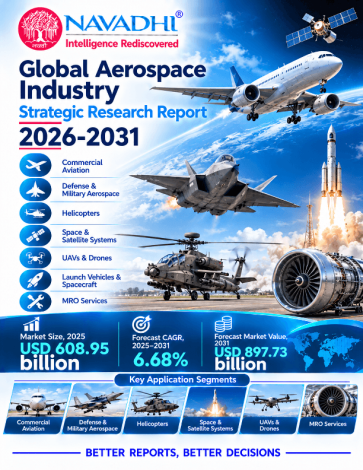

The global aerospace industry market is valued at US$608.9 billion in 2025 and is forecast to reach US$897.7 billion by 2031, a compound annual growth rate (CAGR) of 6.7% over 2025-2031. The report covers the value of commercial transport aircraft, defense aerospace systems, satellite manufacturing, orbital launch services, general aviation and advanced air mobility, and commercial aviation maintenance, repair and overhaul (MRO) sold worldwide. Airline and airport operations, satellite services and ground terminals, and non-aerospace defense segments are excluded. Values are Navadhi Market Research estimates at selling price in constant US dollars.
The report segments the market by six types and six applications across five regions and 31 country and country-group lines. Defense Aerospace is the largest type (48.0% of 2025 value) and Launch Services is the fastest growing (10.0% CAGR). Military Combat Surveillance and Airlift is the largest application (51.1%) and Cargo and Freight Aviation is the fastest growing (9.5% CAGR). North America is the largest region in 2025 (US$267.6 billion) and Asia Pacific is the fastest growing (8.0% CAGR). The report profiles 23 companies and does not state market shares or concentration, because no profiled company reports revenue that matches the market definition.
Scope of the Global Aerospace Industry Strategic Research Report
This report covers market value (US$ million) for 2022-2031, with 2025 as the base year and 2026-2031 as the forecast period. It analyses types, applications, regions and country-level markets, and includes company profiles, competitive landscape, Porter's Five Forces, PESTLE, SWOT and future trends.
Segment by Type
Segment by Application
Who Can Use This Report?
1. Executive Summary
1.1 Market Definition and Scale
1.2 Growth Drivers
1.3 Segment Summary Table
1.4 Regional and Country Highlights
1.5 Competitive Structure and Industry Dynamics
1.6 Principal Risks
1.7 Forward-Looking Outlook
2. Industry Overview & Forecast
2.1 Market Definition and Scope
2.2 Market Size and Historical Performance
2.3 Yearly Market Value
2.4 Forecast Logic and Growth Dynamics
2.5 Segment and Value-Chain Composition
2.6 Volume Context and Pricing Dynamics
3. Market Segmentation by Type
3.1 Overview of the Type Segmentation Framework
3.1.1 Commercial Aircraft
3.1.2 Defense Aerospace
3.1.3 Satellite Manufacturing
3.1.4 Launch Services
3.1.5 General Aviation and Advanced Air Mobility
3.1.6 Commercial Aviation MRO
3.2 Comparative Mix Shift Analysis
4. Market Segmentation by Application
4.1 Overview of the Application Framework
4.1.1 Military Combat Surveillance and Airlift
4.1.2 Passenger Air Transport
4.1.3 Cargo and Freight Aviation
4.1.4 Business and Private Aviation
4.1.5 Satellite Communications and Navigation
4.1.6 Earth Observation and Space Exploration
4.2 Comparative Analysis Across Application Segments
5. Regional Market Forecast
5.1 North America
5.1.1 Regional Overview
5.1.2 Key Growth Drivers
5.1.3 Regulatory & Infrastructure Landscape
5.1.4 Country-Level Analysis
5.1.5 Market Forecast 2025–2031
5.2 Europe
5.2.1 Regional Overview
5.2.2 Key Growth Drivers
5.2.3 Regulatory & Infrastructure Landscape
5.2.4 Country-Level Analysis
5.2.5 Market Forecast 2025–2031
5.3 Asia Pacific
5.3.1 Regional Overview
5.3.2 Key Growth Drivers
5.3.3 Regulatory & Infrastructure Landscape
5.3.4 Country-Level Analysis
5.3.5 Market Forecast 2025–2031
5.4 Latin America
5.4.1 Regional Overview
5.4.2 Key Growth Drivers
5.4.3 Regulatory & Infrastructure Landscape
5.4.4 Country-Level Analysis
5.4.5 Market Forecast 2025–2031
5.5 Middle East and Africa
5.5.1 Regional Overview
5.5.2 Key Growth Drivers
5.5.3 Regulatory & Infrastructure Landscape
5.5.4 Country-Level Analysis
5.5.5 Market Forecast 2025–2031
6. Country-Level Market Forecast
6.1 North America
6.1.1 United States
6.1.2 Canada
6.1.3 Mexico
6.2 Europe
6.2.1 United Kingdom
6.2.2 France
6.2.3 Germany
6.2.4 Italy
6.2.5 Spain
6.2.6 Russia
6.2.7 Sweden
6.2.8 Norway
6.2.9 Poland
6.2.10 Rest of Europe
6.3 Asia Pacific
6.3.1 China
6.3.2 India
6.3.3 Japan
6.3.4 South Korea
6.3.5 Australia
6.3.6 Southeast Asia
6.3.7 Rest of Asia Pacific
6.4 Latin America
6.4.1 Brazil
6.4.2 Argentina
6.4.3 Chile
6.4.4 Colombia
6.4.5 Rest of Latin America
6.5 Middle East and Africa
6.5.1 GCC Countries
6.5.2 Israel
6.5.3 Turkey
6.5.4 South Africa
6.5.5 Egypt
6.5.6 Rest of Middle East and Africa
7. Growth Drivers & Inhibitors
7.1 Overview
7.2 Growth Drivers
7.2.1 Record Commercial Order Backlogs and Rising Aircraft Deliveries
7.2.2 Structurally Higher Global Defense Budgets and Elevated Defense Backlogs
7.2.3 Accelerating Space Economy Expenditures Across Government and Commercial Segments
7.2.4 Fleet Expansion and Age-Related Maintenance Demand
7.2.5 Business Aviation Sector Momentum
7.2.6 Asia Pacific Regional Demand Leadership
7.3 Growth Restraints
7.3.1 Supply Chain Constraints on Engine and Structural Component Production
7.3.2 Budget Risk and Programme Execution Uncertainty in Defense and Space
7.3.3 Regulatory Certification, Safety Standards, and Export Controls
7.3.4 Cyclical Demand Sensitivity in Commercial Aviation
7.3.5 Competitive and Cost Pressure on Independent Service Providers
7.4 Impact Assessment Summary
7.5 Integrated Assessment
8. Key Company Profiles
8.1 Boeing
8.1.1 Company Overview
8.1.2 Key Products & Segments
8.1.3 Financial Performance (2023–2025)
8.1.4 Business Strategy
8.1.5 SWOT Analysis
8.1.6 Strategic Implications (2025–2031)
8.2 Airbus
8.2.1 Company Overview
8.2.2 Key Products & Segments
8.2.3 Financial Performance (2023–2025)
8.2.4 Business Strategy
8.2.5 SWOT Analysis
8.2.6 Strategic Implications (2025–2031)
8.3 Lockheed Martin
8.3.1 Company Overview
8.3.2 Key Products & Segments
8.3.3 Financial Performance (2023–2025)
8.3.4 Business Strategy
8.3.5 SWOT Analysis
8.3.6 Strategic Implications (2025–2031)
8.4 RTX
8.4.1 Company Overview
8.4.2 Key Products & Segments
8.4.3 Financial Performance (2023–2025)
8.4.4 Business Strategy
8.4.5 SWOT Analysis
8.4.6 Strategic Implications (2025–2031)
8.5 Northrop Grumman
8.5.1 Company Overview
8.5.2 Key Products & Segments
8.5.3 Financial Performance (2023–2025)
8.5.4 Business Strategy
8.5.5 SWOT Analysis
8.5.6 Strategic Implications (2025–2031)
8.6 GE Aerospace
8.6.1 Company Overview
8.6.2 Key Products & Segments
8.6.3 Financial Performance (2023–2025)
8.6.4 Business Strategy
8.6.5 SWOT Analysis
8.6.6 Strategic Implications (2025–2031)
8.7 Safran
8.7.1 Company Overview
8.7.2 Key Products & Segments
8.7.3 Financial Performance (2023–2025)
8.7.4 Business Strategy
8.7.5 SWOT Analysis
8.7.6 Strategic Implications (2025–2031)
8.8 BAE Systems
8.8.1 Company Overview
8.8.2 Key Products & Segments
8.8.3 Financial Performance (2023–2025)
8.8.4 Business Strategy
8.8.5 SWOT Analysis
8.8.6 Strategic Implications (2025–2031)
8.9 SpaceX
8.9.1 Company Overview
8.9.2 Key Products & Segments
8.9.3 Financial Performance (2023–2025)
8.9.4 Business Strategy
8.9.5 SWOT Analysis
8.9.6 Strategic Implications (2025–2031)
8.10 Rolls-Royce
8.10.1 Company Overview
8.10.2 Key Products & Segments
8.10.3 Financial Performance (2023–2025)
8.10.4 Business Strategy
8.10.5 SWOT Analysis
8.10.6 Strategic Implications (2025–2031)
8.11 General Dynamics
8.11.1 Company Overview
8.11.2 Key Products & Segments
8.11.3 Financial Performance (2023–2025)
8.11.4 Business Strategy
8.11.5 SWOT Analysis
8.11.6 Strategic Implications (2025–2031)
8.12 L3Harris Technologies
8.12.1 Company Overview
8.12.2 Key Products & Segments
8.12.3 Financial Performance (2023–2025)
8.12.4 Business Strategy
8.12.5 SWOT Analysis
8.12.6 Strategic Implications (2025–2031)
8.13 Textron
8.13.1 Company Overview
8.13.2 Key Products & Segments
8.13.3 Financial Performance (2023–2025)
8.13.4 Business Strategy
8.13.5 SWOT Analysis
8.13.6 Strategic Implications (2025–2031)
8.14 Embraer
8.14.1 Company Overview
8.14.2 Key Products & Segments
8.14.3 Financial Performance (2023–2025)
8.14.4 Business Strategy
8.14.5 SWOT Analysis
8.14.6 Strategic Implications (2025–2031)
8.15 Bombardier
8.15.1 Company Overview
8.15.2 Key Products & Segments
8.15.3 Financial Performance (2023–2025)
8.15.4 Business Strategy
8.15.5 SWOT Analysis
8.15.6 Strategic Implications (2025–2031)
8.16 Dassault Aviation
8.16.1 Company Overview
8.16.2 Key Products & Segments
8.16.3 Financial Performance (2023–2025)
8.16.4 Business Strategy
8.16.5 SWOT Analysis
8.16.6 Strategic Implications (2025–2031)
8.17 Leonardo
8.17.1 Company Overview
8.17.2 Key Products & Segments
8.17.3 Financial Performance (2023–2025)
8.17.4 Business Strategy
8.17.5 SWOT Analysis
8.17.6 Strategic Implications (2025–2031)
8.18 Thales
8.18.1 Company Overview
8.18.2 Key Products & Segments
8.18.3 Financial Performance (2023–2025)
8.18.4 Business Strategy
8.18.5 SWOT Analysis
8.18.6 Strategic Implications (2025–2031)
8.19 Israel Aerospace Industries
8.19.1 Company Overview
8.19.2 Key Products & Segments
8.19.3 Financial Performance (2023–2025)
8.19.4 Business Strategy
8.19.5 SWOT Analysis
8.19.6 Strategic Implications (2025–2031)
8.20 Hindustan Aeronautics
8.20.1 Company Overview
8.20.2 Key Products & Segments
8.20.3 Financial Performance (2023–2025)
8.20.4 Business Strategy
8.20.5 SWOT Analysis
8.20.6 Strategic Implications (2025–2031)
8.21 Lufthansa Technik
8.21.1 Company Overview
8.21.2 Key Products & Segments
8.21.3 Financial Performance (2023–2025)
8.21.4 Business Strategy
8.21.5 SWOT Analysis
8.21.6 Strategic Implications (2025–2031)
8.22 ST Engineering
8.22.1 Company Overview
8.22.2 Key Products & Segments
8.22.3 Financial Performance (2023–2025)
8.22.4 Business Strategy
8.22.5 SWOT Analysis
8.22.6 Strategic Implications (2025–2031)
8.23 AAR Corp
8.23.1 Company Overview
8.23.2 Key Products & Segments
8.23.3 Financial Performance (2023–2025)
8.23.4 Business Strategy
8.23.5 SWOT Analysis
8.23.6 Strategic Implications (2025–2031)
9. Competitive Landscape
9.1 Competitive Landscape Overview
9.1.1 Structure of the Global Aerospace Arena
9.1.2 Company Revenue Reference Table
9.1.3 Why Concentration Cannot Be Measured
9.1.4 Competitive Intensity and Backlog Dynamics
9.1.5 Overall Competitive Intensity Assessment
9.2 Competitive Intensity Assessment
9.2.1 Grouping of Competitors by Competitive Arena
9.2.2 Capacity Versus Demand Dynamics
9.2.3 Pricing Environment
9.2.4 Barriers to Entry and Exit
9.3 Key Player Strategies & Positioning
9.3.1 Strategic Group Mapping
9.3.2 Selected Company Revenue Comparison, FY2024–FY2025
9.3.3 Differentiation Strategies
9.3.4 Geographic Strongholds
9.3.5 Backlog and Demand Visibility as a Strategic Asset
9.4 Competitive Dynamics & Strategic Outlook
9.4.1 The Competitive Architecture in Transition
9.4.2 Emerging Competitive Threats
9.4.3 Consolidation vs. Fragmentation Outlook
9.4.4 Competitive Response Matrix
9.4.5 Strategic Recommendations for 2026–2031
10. Porter's Five Forces Analysis
10.1 Threat of New Entrants
10.2 Bargaining Power of Buyers
10.3 Bargaining Power of Suppliers
10.4 Threat of Substitutes
10.5 Competitive Rivalry
11. PESTLE Analysis
11.1 Strategic Environmental Assessment of the Global Aerospace Industry, 2025–2031
11.2 Political
11.3 Economic
11.4 Social
11.5 Technological
11.6 Legal
11.7 Environmental
11.8 PESTLE Summary Assessment
12. SWOT Analysis
12.1.1 Detailed Analysis
12.1.1.1 Strengths
12.1.1.2 Weaknesses
12.1.1.3 Opportunities
12.1.1.4 Threats
12.1.2 Strategic Implications and Priority Actions
13. Future Trends & Outlook
13.1 Overview
13.2 Accelerating Commercial Aircraft Production Recovery Reshaping the Civil Aerospace Ecosystem
13.3 Structural Defence Budget Expansion Entrenching Long-Cycle Demand
13.4 The Space Economy Bifurcation
13.5 Commercial Aviation MRO
13.6 Asia-Pacific Becoming the Industry's Primary Growth Engine
13.7 General Aviation Demand Plateau Contrasting With Advanced Air Mobility Optionality
13.8 Geopolitical Realignment Driving Regional Defence Supply-Chain Concentration
13.9 Scenario-Contingent Upside
13.10 Trend Summary Table
13.11 Forward Outlook
List of Exhibits
Exhibit 2.1: Forecast of Global Market YoY Growth Rate & CAGR Summary (in %)
Exhibit 2.2: Forecast of Global Market (in USD Bn)
Exhibit 2.3: Forecast of North America (in USD Bn)
Exhibit 2.4: Forecast of Europe (in USD Bn)
Exhibit 2.5: Forecast of Asia Pacific (in USD Bn)
Exhibit 2.6: Forecast of Latin America (in USD Bn)
Exhibit 2.7: Forecast of Middle East and Africa (in USD Bn)
Exhibit 3.8: Forecast of Commercial Aircraft (in USD Bn)
Exhibit 3.9: Forecast of Defense Aerospace (in USD Bn)
Exhibit 3.10: Forecast of Satellite Manufacturing (in USD Bn)
Exhibit 3.11: Forecast of Launch Services (in USD Bn)
Exhibit 3.12: Forecast of General Aviation and Advanced Air Mobility (in USD Bn)
Exhibit 3.13: Forecast of Commercial Aviation MRO (in USD Bn)
Exhibit 4.14: Forecast of Passenger Air Transport (in USD Bn)
Exhibit 4.15: Forecast of Cargo and Freight Aviation (in USD Bn)
Exhibit 4.16: Forecast of Business and Private Aviation (in USD Bn)
Exhibit 4.17: Forecast of Military Combat Surveillance and Airlift (in USD Bn)
Exhibit 4.18: Forecast of Satellite Communications and Navigation (in USD Bn)
Exhibit 4.19: Forecast of Earth Observation and Space Exploration (in USD Bn)
Exhibit 6.20: Forecast of North America (in USD Bn)
Exhibit 6.21: Forecast of United States (in USD Bn)
Exhibit 6.22: Forecast of Canada (in USD Bn)
Exhibit 6.23: Forecast of Mexico (in USD Bn)
Exhibit 6.24: Forecast of Europe (in USD Bn)
Exhibit 6.25: Forecast of United Kingdom (in USD Bn)
Exhibit 6.26: Forecast of France (in USD Bn)
Exhibit 6.27: Forecast of Germany (in USD Bn)
Exhibit 6.28: Forecast of Italy (in USD Bn)
Exhibit 6.29: Forecast of Spain (in USD Bn)
Exhibit 6.30: Forecast of Russia (in USD Bn)
Exhibit 6.31: Forecast of Sweden (in USD Bn)
Exhibit 6.32: Forecast of Norway (in USD Bn)
Exhibit 6.33: Forecast of Poland (in USD Bn)
Exhibit 6.34: Forecast of Rest of Europe (in USD Bn)
Exhibit 6.35: Forecast of Asia Pacific (in USD Bn)
Exhibit 6.36: Forecast of China (in USD Bn)
Exhibit 6.37: Forecast of India (in USD Bn)
Exhibit 6.38: Forecast of Japan (in USD Bn)
Exhibit 6.39: Forecast of South Korea (in USD Bn)
Exhibit 6.40: Forecast of Australia (in USD Bn)
Exhibit 6.41: Forecast of Southeast Asia (in USD Bn)
Exhibit 6.42: Forecast of Rest of Asia Pacific (in USD Bn)
Exhibit 6.43: Forecast of Latin America (in USD Bn)
Exhibit 6.44: Forecast of Brazil (in USD Bn)
Exhibit 6.45: Forecast of Argentina (in USD Bn)
Exhibit 6.46: Forecast of Chile (in USD Bn)
Exhibit 6.47: Forecast of Colombia (in USD Bn)
Exhibit 6.48: Forecast of Rest of Latin America (in USD Bn)
Exhibit 6.49: Forecast of Middle East and Africa (in USD Bn)
Exhibit 6.50: Forecast of GCC Countries (in USD Bn)
Exhibit 6.51: Forecast of Israel (in USD Bn)
Exhibit 6.52: Forecast of Turkey (in USD Bn)
Exhibit 6.53: Forecast of South Africa (in USD Bn)
Exhibit 6.54: Forecast of Egypt (in USD Bn)
Exhibit 6.55: Forecast of Rest of Middle East and Africa (in USD Bn)
*If Applicable.

NAVADHI is a market research company that helps global firms differentiate themselves, break market entry barriers, track their investments, develop business strategies and plan for future by providing actionable market research intelligence that helps them succeed.